Brazil pays 16% more for fertilizer and buys less, points out CNA
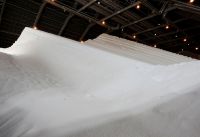
Brazil imported 4% less fertilizer between January and April this year, but paid 16% more. The volume fell from 7.7 million to 7.4 million tons of nitrogen and phosphates compared to the same period in 2025, while spending jumped from US$3.7 billion to US$4.3 billion. The data comes from a survey by the CNA (Confederation of Agriculture and Livestock of Brazil), published this Thursday (21).
The problem, according to CNA, is not just the price of the input. It's the producer's loss of purchasing power. The average price of urea rose 40% during the period of escalating conflict in the Middle East.
"The most worrying fact is not just the price of fertilizers, but the deterioration of the exchange ratio. To buy the same amount of fertilizer, the producer needs to deliver more bags of soybeans or corn than in previous years", says CNA.
MAP (monoammonium phosphate), the main phosphate used in Brazilian crops, became 20% more expensive in the same period. On the other hand, soybeans advanced just 0.9% and corn, 0.1%.
The exchange ratio - how many bags the producer needs to sell to buy a ton of fertilizer - is at its worst level since 2022, when the war between Russia and Ukraine caused the biggest fertilizer price shock in recent history, according to Campo Futuro CNA/Senar. That year, soybeans and corn were operating at historically high levels and offset some of the impact. Not now.
"The producer feels the impact even before planting. There are more bags to guarantee the same technological package", states the entity.
International prices continue to rise. Data from the World Bank shows that DAP, TSP, urea and potassium chloride did not return to pre-2022 levels and rose again at the beginning of 2026. "After the shock of 2022, the market was unable to return to normal", says the document.
With the increase in price, producers changed what they buy. Imports of SAM (ammonium sulfate) surpassed, in some months of 2026, those of urea. In the phosphate group, TSP and SSP gained space as MAP substitutes. These are inputs that are less affected by supply routes impacted by the conflict in the Middle East.
The supplier map has also changed. In 2024, Russia led with 26% of the volume imported by Brazil and China accounted for 20%.
In 2025, the position was reversed: China reached 26% and Russia fell to 25%. Canada (11%), Morocco (5%) and Egypt (4%) complete the ranking. Between February and April 2026, Turkmenistan, with 8%, became among the five largest suppliers - driven by the demand for potassium. The data is from Comex Stat.
External dependence remains a structural vulnerability: 93% of fertilizers consumed in Brazil in 2025 came from abroad.
"Brazil has high external dependence for the use of inputs. Around 93% of the fertilizers used in Brazil were imported. Any external shock, whether due to armed conflict, trade sanctions or logistical crisis, translates almost immediately into higher costs for the Brazilian countryside", points out the CNA.
The diagnosis is clear: the producer will pay even more for inputs until the end of the year. Purchases for the 2026/2027 harvest are concentrated in the second half of the year - precisely the moment when this environment of prices and uncertainties will define the producer's margin.
Source: CNN