Brazil launches first rocket powered by liquid propulsion; see images
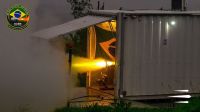
Brazil took an unprecedented step in its space program by launching, for the first time, a rocket powered exclusively by a liquid propulsion system since takeoff. The FTL-Perseu flight, developed entirely by the Brazilian company BIZU Space, took place on May 29, in Virgínia (MG).
The launch aimed to validate the ARION rocket engine, a technology considered strategic for future space missions.
Named "Missão Trem Baum", in homage to the culture of Minas Gerais, the operation marks the country's entry into a restricted group of nations that dominate this type of technology.
Unlike solid propulsion engines, widely used in training and sounding rockets, liquid engines allow greater control of thrust during flight and are used in launchers capable of placing satellites in orbit and performing maneuvers with greater precision.
The FTL-Perseus is approximately 4.5 meters long and weighs approximately 70 kilos when fueled. For the mission, BIZU Space used aviation kerosene (Jet-A) as fuel and concentrated hydrogen peroxide (HTP) as an oxidizer.
See video: Brazil tests rocket engine and launch gets closer
According to the company, the combination eliminates the use of cryogenic propellants, which require extremely low temperatures for storage, in addition to reducing environmental impacts by generating, mainly, water and oxygen during the decomposition of the oxidizer.
Although the project calls for the rocket to reach an altitude of up to ten thousand meters in its nominal configuration, the inaugural flight was carried out with a reduced propellant load.
The strategy is common in development campaigns, allowing to validate systems and reduce risks in the first operations.
After launch, the vehicle was successfully recovered using a parachute and tracking system. The rocket is at the headquarters of BIZU Space, in São José dos Campos (SP), where it will undergo technical analysis and may be reused in future test campaigns.
The launch also coincides with a historic milestone in space exploration. In 2026, one hundred years will have passed since the flight of Nell, considered the first rocket powered by liquid propellants in history, launched by the American physicist Robert H. Goddard.
Rocket launched by Goddard - BIZU Space
Brazilian studies on liquid propulsion began in the 1990s, with research conducted by the IAE (Institute of Aeronautics and Space). In 2014,
Operation Raposa carried out the first flight of a liquid engine as a payload on a solid rocket.
The FTL-Perseu project began in 2025 and brought together institutions such as CENIC, UNIVAP, ITA (Instituto Tecnológico de Aeronáutica) and OBA (Brazilian Astronomy Olympics).
In the company's assessment, the success of the mission represents an advance in the country's technological capacity and paves the way for the development of more complex launch vehicles, expanding Brazilian autonomy in access to space.
See images of the launch
https://admin.cnnbrasil.com.br/wp-content/uploads/sites/12/2026/07/WhatsApp-Video-2026-07-04-at-17.02.30.mp4
https://admin.cnnbrasil.com.br/wp-content/uploads/sites/12/2026/07/WhatsApp-Video-2026-07-04-at-17.02.49.mp4
https://admin.cnnbrasil.com.br/wp-content/uploads/sites/12/2026/07/WhatsApp-Video-2026-07-04-at-17.02.40.mp4
*Under AR supervision.
Source: CNN