Blue economy transforms conservation into opportunities for small businesses in ES
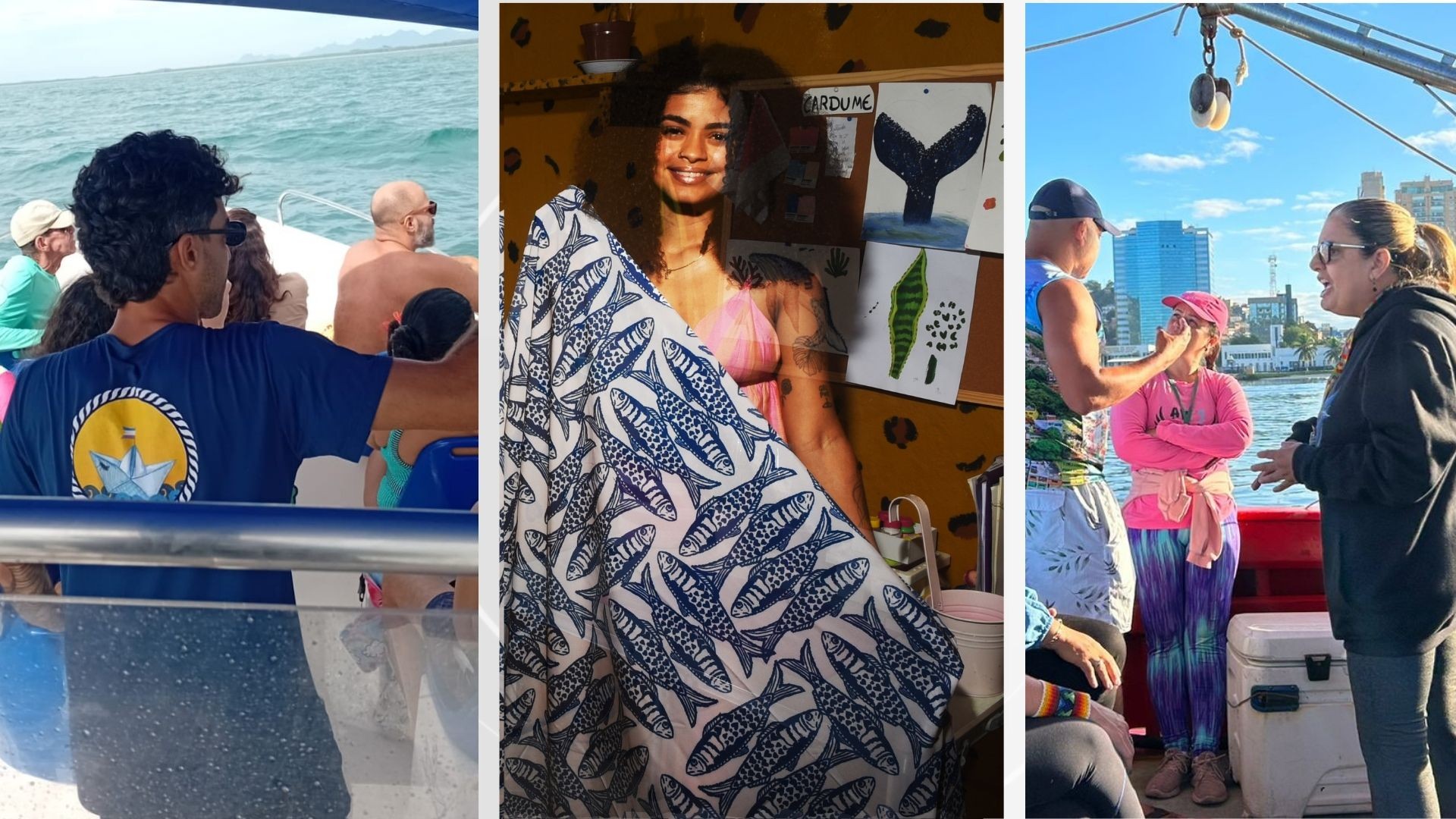
'I live from the sea', sailor and entrepreneur Ruan Nolasco Cardoso, owner of a nautical tourism company in Espírito Santo.
Personal archive
"I live from the sea". The phrase summarizes the story of sailor and entrepreneur Ruan Nolasco Cardoso, owner of a nautical tourism company in Greater Vitória. His grandfather was a fisherman, worked in the Port of Vitória and in the capital's old waterway system. His father spent 35 years on ships and oil platforms. Now, it is his mission to transform the ocean into a job opportunity for a new generation.
It was looking at his own family history that Ruan decided to create, in 2017, Capitão Grilo, a business focused on sea trips along the coast of Espírito Santo.
Click here to follow the g1 ES channel on WhatsApp
"My grandfather did this work decades ago. I thought: is there still room for this today? It was a rescue of my family's history. We started small and grew along with nautical tourism in Espírito Santo." Entrepreneurship came accompanied by the need to study. "I started taking courses as a tour guide, natural areas monitor, local driver and I continue to seek training. Tourism requires knowledge. We try to awaken in people a sense of belonging to our sea, our mangroves and our biodiversity." Find out how to go on whale watching tours with the start of the season
'CPF CAPIXABA': almost 100 humpback whales were born on the coast of ES in 2025
RESEARCH: Monitoring seeks to save the most threatened marine mammal in the South Atlantic
DISCOVER THE CYCLE: Where do humpback whales swim when they are not in Brazil?
Ruan's trajectory translates, in practice, a concept that is gaining strength: the blue economy. A development model that combines environmental conservation, innovation and income generation through the sustainable use of marine resources.
And few examples better represent this transformation than the humpback whale season.
Every year, between June and October, thousands of them leave Antarctica to reproduce on the Brazilian coast.
In Espírito Santo, in addition to enchanting tourists, they drive a production chain that involves artisans, sailors, tour guides, hotels, restaurants, reception agencies and researchers.
Artisan Erani de Oliveira Castro is inspired by the marine fauna of Espírito Santo
Carlos Alberto Silva/Rede Gazeta
From crafts to hotels: when the whale generates income
When humpback whales arrive on the coast of Espírito Santo, those who also celebrate are small entrepreneurs spread across the entire coast.
While tourists embark in search of an encounter with the giants of the sea, hotels receive guests, restaurants expand the movement, artisans sell souvenirs inspired by whales and tourist guides work at an intense pace.
The spectacle of nature helps to move an economic chain that grows year after year and shows, in practice, how environmental conservation can generate income.
In 2025, the Whale Festival in Vitória, a cultural event dedicated to the species, generated around R$ 250 thousand in revenue for local artisans and traders.
Artisan Erani de Oliveira Castro is inspired by the marine fauna of Espírito Santo
Personal archive
In Vila Velha, designer and artisan Erani de Oliveira Castro, creator of Estúdio Ira, feels the effects of the season every year. Inspired by the marine fauna of Espírito Santo, it produces sarongs, scarves and other products that depict species found on the state's coast.
During the whale watching period, sales increase by around 90%. "The majority of sales are products inspired by whales.
People want to take a souvenir of this experience and learn more about these animals", said the artisan.
For Erani, the interest of visitors goes beyond the boarded tours. "People want to buy seasonal products, they want to know more. I've even thought about working somewhere close to the whale watching boats, but even from afar I already have a lot of work and orders", said Erani, who is already working on a new collection for 2026.
The movement shows how the presence of humpbacks goes beyond observation tourism and reaches other sectors of the creative economy, generating income for small entrepreneurs who find the sea a source of inspiration and sustenance.
When preserving generates business
"Whales are perhaps the most symbolic example of transformation that the blue economy can cause in our society." The statement comes from environmentalist Thiago Ferrari, coordinator of the Amigos da Jubarte Project.
According to him, few activities represent so well the paradigm shift that has occurred in recent decades.
Thiago Ferrari is an environmentalist and is part of the Amigos da Jubarte Project in Espírito Santo
Personal archive
"Before, they were hunted for the exploitation of oil and meat. Today, they generate employment and income through observation tourism, in a sustainable way and without removing any animal from nature."
For Ferrari, this economic development was only possible thanks to the scientific knowledge produced in Espírito Santo.
Since 2020, the Scientific Hub Jubarte.Lab, developed in partnership with the Federal University of Espírito Santo (UFES), uses drones, hydrophones and innovative methodologies to monitor whales and dolphins on the coast of Espírito Santo.
The initiative has placed the state among the main Brazilian references in cetacean research and helped to consolidate Espírito Santo as an international destination for whale watching.
"This study is carried out collaboratively. In addition to the development of highly technological methodologies, this partnership guarantees cutting-edge scientific production in Espírito Santo, strengthens researchers linked to local institutions and places Espírito Santo in a prominent international position in the conservation of whales and dolphins." Today, we are able to offer tours with practically a 100% chance of sighting between July and October."
Sesc de Praia Formosa in Aracruz, Espírito Santo
Rodrigo Gaviorno
The numbers of the blue economy with whales
According to data from the Amigos da Jubarte Project, in 2025, actions linked to whale watching tourism resulted in 17 tourist embarkations, 265 visitors embarked, 132 whale and 26 dolphin sightings.
The training promoted for the sector reached 514 people, of which 327 received certification.
During the Whale Festival, artisans and traders generated around R$250,000 in revenue.
265 tourists embarked
132 whale sightings
26 dolphin sightings
354 cetaceans registered
514 people enrolled in tourism training
✅ 327 certified professionals
R$250,000 in revenue for artisans
150 thousand people reached by publicity actions
Researchers from Espírito Santo exchange and explain the cycle of whales at sea.
Reproduction
Knowledge became a development tool
Long before the activity gained commercial strength, the Projeto Amigos da Jubarte and the Instituto Baleia Jubarte invested in preparing the production chain.
They promote technical training for tourism agencies, operators, guides, boat masters and owners, tourism representatives reception and professionals from the hotel chain.
The training is carried out in partnership with the Brazilian Micro and Small Business Support Service (Sebrae).
During the training, participants receive guidance on marine biodiversity, biology and ecology of cetaceans, environmental legislation, correct techniques for approaching whales and concepts of receptive and regenerative tourism.
The learning is complemented with an on-board whale and dolphin watching trip, allowing participants to experience in practice the content presented in the classroom.
Agents undergo training with the support of Sebrae in Espírito Santo and Rio de Janeiro
Disclosure/Friends of Jubarte
Whoever chooses the whales moves the entire economy
For the coordinator of the Sebrae/ES Tourism Center, Leandro Tononi, whale watching has established itself as a tourist product capable of moving different economic segments.
"When a visitor decides to come to Espírito Santo Saint for whale watching, it provides accommodation, food, transport, commerce, tours and tourist services.
According to Tononi, the activity has undergone a process of professionalization in recent years. "Today we have specific vessels, trained teams and structured companies to offer a safe and quality experience."
The impact is also felt by accommodation facilities. The owner of Artsy Vitória Hostel, tourismologist Felipe Silva Santos has been following the project since its early years and believes that the whales helped put Vitória on the Brazilian ecotourism map. coast of ES in 2025
According to him, researchers and tourists staying at the hostel end up getting to know the project and including the observation of humpbacks in the travel itinerary.
"They already represent much more than a tour. They are becoming part of the state's cultural identity just like moqueca and congo", he said.
Felipe said that the hostel is always busy and is proud of what it does for everything and for 10 families depending on the company him.
For Mônica Velasques, director of Hospitality, Tourism and Leisure at Sesc Espírito Santo, the economic strength of whales lies precisely in their ability to attract visitors outside of the high season.
"The whale watching season takes place between June and November and helps reduce the seasonality of tourism.
This generates additional flow of visitors and moves hotels, inns, restaurants, agencies, transport companies and various services linked to the tourism production chain."
According to her, the activity creates a concrete reason for the trip and strengthens the state's positioning as a destination for nature and experiences.
"The great value of the whale season is not only in the occupancy of hotels during the tours, but in the ability to transform a natural resource into a sustainable tourist product, capable of generating revenue, employment and visibility for the destination during several months of the year", she explained Mônica.
Far beyond the tour
Tour guide Tatiana Sarmento Noronha, a graduate in Law and postgraduate student in Environmental Law, accompanies tourists from reception to disembarkation during expeditions.
Tour guide Tati Sarmento with a group of tourists in Espírito Santo
Personal file
She has participated in the operation since the beginning of Agência Aves' activity "I do the entire operational part, from reception to disembarkation of tourists. I usually say that I earn money to do what I like."
According to her, few experiences provoke so much emotion. "When the first whale appears, many remain silent. Then come the applause, the crying and the joy. It's a very strong connection with nature."
The guide says that visitors' reactions tend to be repeated each time they go out. "They are impacted by the size of the whales. When they jump, flap their fins or appear with their babies, the emotion is very intense. Many people cry. It's a feeling that's difficult to measure."
Tatiana also highlights that each tour at the agency where she works also functions as an environmental education experience.
In addition to explanations about biology and conservation, all expeditions have researchers on board, responsible for guiding passengers and monitoring compliance with the standards established by environmental agencies and the Port Authority, ensuring the safety of the activity and respect for animals.
Rules
To carry out tours, tourism agencies must be registered with Cadastur. Boats must respect some rules when watching whales, such as keeping a distance of 100 meters from the whale or dolphin, and 200 meters if the animal is with a calf.
Observation must be carried out for a maximum of 30 minutes for each animal. Furthermore, the boat cannot chase the whale and if the animal comes too close to the vessel, it must keep the engine running and out of gear.
Tourists are enchanted by watching whales in Espírito. Santo
Beatriz Marins
Whales as drivers of tourism
Oceanographer Paulo Pinheiro Rodrigues, from the Instituto Baleia Jubarte, states that whale watching is one of the most successful initiatives for transforming environmental conservation into economic development.
"The Baleia Jubarte Project promotes research, conservation, environmental education and encourages ecotourism as a sustainable alternative. We generate work and income around the image of whales and the marine environment."
According to him, the activity helps to reduce the seasonality of tourism in the state. "Whales are inductors of destiny. Many people choose to travel to Greater Vitória specifically to participate in the tours."
Paulo highlights that the activity has been attracting public and private investment, from vessels adapted to transport passengers to new environmental education spaces.
The Instituto Baleia Jubarte expects that around 2,000 tourists will embark on a journey to see the whales in the 2026 season.
Paulo Pinheiro Rodrigues is an oceanographer and is part of the Instituto Baleia Jubarte in Espírito Santo
Archive personal
Strategy for the future
For the state secretary of Tourism, Luciano Machado, whale watching has already established itself as one of the most promising tourism products in Espírito Santo.
"We have an extraordinary natural heritage.
Whale watching strengthens our image as a nature destination and expands economic movement in different regions of the state."
In Aracruz, where tours are also starting to gain space, the municipal secretary for the Environment, Aladim Cerqueira, sees humpbacks as one of the city's main natural assets.
"The growth of whale watching has been encouraged within a blue economy and sustainable development strategy. Today they represent a natural heritage that needs to be valued."
According to him, the municipality has been investing in initiatives linked to the conservation and valorization of natural resources, including partnerships to expand the publicity of whales as a tourist attraction.
Artisan Erani de Oliveira Castro was inspired by the marine fauna of Espírito Santo
Personal archive
The ocean as an opportunity
For Ruan Nolasco, who grew up listening to stories about his fisherman grandfather and his father on ships, the whales represent more than a tourist attraction. "They show that it is possible to live from the sea without destroying the sea."
In Espírito Santo, the blue economy has been showing this path. Where there was previously exploitation of natural resources, opportunities linked to conservation arise. latest news from g1 Espírito Santo
Source: G1