Between barbs and diplomacy: Lula's balance in the G7 with Trump, EU and Ukraine
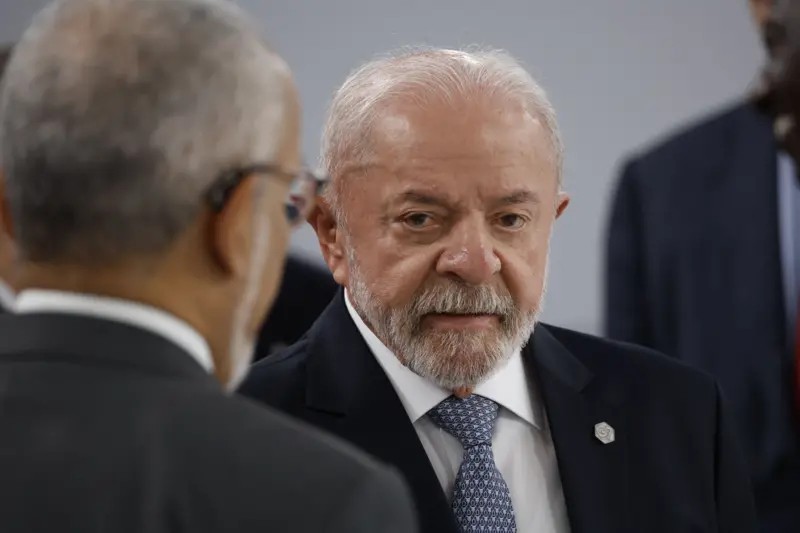
President Lula at a G7 meeting in France.
EPA/Shutterstock
President Luiz Inácio Lula da Silva (PT) ended this Wednesday (17/06) his tenth participation in a G7 summit, the forum that brings together seven of the largest industrialized economies on the planet and in which Brazil participates as a guest alongside other developing countries.
This year's event was held on French territory, in Évian-les-Bains. During his visit to the small city located on the shores of Lake Geneva, Lula met privately with the leaders of Japan, Egypt, Ukraine, France and the European Union (EU).
The Brazilian president also had private meetings with the president of the Swiss Confederation, Guy Parmelin, and with the secretary general of Interpol, the Brazilian Valdecy Urquiza.
In the corridors and expanded meetings of the event, Lula also met with all the participating leaders, including Donald Trump.
The expectation for the interaction with the American president was great with the tension in relations due to the possibility of the application of new tariffs and the classification of Brazilian criminal factions as terrorists.
Both said they had spoken, but after the end of the forum, during separate press conferences, they exchanged barbs, with Trump saying that Brazil has become "dangerous from a political point of view" and Lula endorsing his view that his counterpart acts like an "emperor".
Lula responded by saying that it is Trump's right to like Bolsonaro, but he cannot interfere in the elections in Brazil.
In France, Brazil ended its participation in the forum by endorsing only three of the eight statements published by the G7 member countries (Canada, United States, United Kingdom, France, Italy, Germany and Japan).
According to a source within the Brazilian government itself, this diplomatic balance highlights the distance between Brasília and the group of the world's seven main economies.
From 'good work' to the defense of sovereignty
President Lula at a G7 meeting, in France.
Getty Images
In one of their first interactions recorded during the three-day summit meeting, Trump and Lula crossed paths in the corridors of the hotel hosting the summit.
In a video obtained by the ICL Notícias portal, the American, upon seeing the Brazilian, points in his direction and walks to greet him. Trump then pats Lula on the back and says, in English: 'How are you? Good job'.
The PT member, who had just given a speech about the imbalances in the world economy, responds by looking towards Trump.
The day before, in the official photo session, Lula and Trump appeared close, but there was no greeting, public conversation or interaction recorded between the two presidents.
At the end of the summit, however, the political differences between the two leaders became evident, with an exchange of accusations during simultaneous press conferences.
In Évian-les-Bains, Trump was asked about his relationship with the Brazilian and responded by saying that Brazil has become "dangerous from a political point of view" and clumsily citing the conviction of former federal deputy Eduardo Bolsonaro on Tuesday (16/06), saying it was the arrest of a candidate for the elections.
Eduardo Bolsonaro was convicted by the STF for coercion during the process, a crime that occurs when someone tries to intimidate, pressure or interfere in investigations or legal actions.
He was accused of articulate in the United States retaliations by the Trump government against Brazil and Brazilian authorities to try to prevent the trial of his father, former president Jair Bolsonaro (PL-SP).
Lula had the chance to respond while answering questions from journalists at a press conference held in Geneva, which is about 45 kilometers from the French city where the summit was taking place.
"I just hope that he doesn't violate the code of ethics among nations that want to be respected in their sovereignty.
I just hope that," said the PT member.
"For me, he can continue to like Bolsonaro, his father, his son, his grandson, there's no problem - it's his problem after all, taste can't be discussed. Now, don't get involved in Brazil's elections, because Brazil's elections are Brazil's problem."
The Palácio do Planalto stated, however, that it continues to negotiate with Washington after the American government announced the possibility of applying an extra 25% tax on part of Brazilian imports.
According to Lula, his team did not even ask for a bilateral meeting with Donald Trump, as the issues that need to be addressed are already being discussed by diplomats and technicians behind the scenes.
"When the time ends, negotiation, if nothing comes of it, I have no problem picking up the phone and calling Trump again and scheduling another conversation", said the Brazilian president.
Help for Ukraine?
Lula and Zelensky met behind closed doors to talk about the war in Ukraine
Getty Images
Also on the last day of the summit, before traveling to Geneva for his return to Brazil, Lula met behind closed doors with the president of Ukraine, Volodymyr Zelensky.
According to Lula, this was the best meeting he had ever had with the Ukrainian and, for the first time, he felt he was "willing to find a solution" to the current conflict with Ukraine.
"For the first time, I felt Zelensky was willing to find a solution. I will help in whatever way I can", he highlighted.
The Brazilian president also stated that he reinforced to the Ukrainian the importance of the permanent members of the UN Security Council acting more effectively to end the war. "They are the ones who have the veto power. They are the ones who can make the decision for war or for peace," he said.
Lula also said that he committed to calling all five members (China, Russia, USA, France and the United Kingdom) to reinforce the need for them to take control of the problem.
On his social networks, Zelensky said that he had "a good meeting" with Lula and that both agreed to make "new contacts" on the issue.
G7 leaders declare unwavering support for the Ukraine
An appeal to the EU
Another highlight of Brazil's participation in the forum was the bilateral meeting between Lula and Ursula von der Leyen, president of the European Commission, and António Costa, president of the European Council.
Just over a week before the start of the G7, the EU made official its decision to ban the import of meat, tripe, fish and honey produced in Brazilian territory, with a veto that should come into force from the 3rd of September.
According to the European Commission, Brazil was unable to prove that its producers meet some of the European health requirements.
The topic was the main focus of the closed meeting between the leaders.
The veto was not suspended after the talks, but it was established that closer monitoring of the negotiations on phytosanitary standards would be implemented from now on.
The understanding is that a relationship based solely on dialogue between technical officials from the EU and the Brazilian government could be hindering the progress of the negotiations and, therefore, a more "political" vision would be necessary to speed up the process.
This same monitoring will also be implemented in negotiations on the export of steel products.
In April this year, the bloc reached a political agreement to increase tariffs on steel imports above quotas from 25% to 50% and significantly reduce exempt volumes, in an attempt to protect the sector in the face of Chinese dominance.
On her social networks, Von der Leyen also said that Europe and Brazil "look at the world with the same eyes" and that the agreement between the European Union and Mercosur, which came into force provisionally in May, "is just the beginning" of the partnership.
A stranger in the nest?
Leaders meeting at the G7, in France.
Getty Images
In total, the G7 leaders adopted nine declarations during the forum.
Of these, eight could be endorsed by the invited partner countries, which is the case of Brazil.
The country, however, only agreed to three.
The texts signed by the country dealt with the fight against cancer, the guarantee of a safe digital space for children and adolescents and the fight against drug trafficking.
The other statements discussed solutions for global macroeconomic imbalances, the fight against Ebola, critical minerals, international partnerships for development and the fight against smuggling of migrants.
According to a source linked to Brazilian diplomacy, this scenario is a reflection of the dissonance between Brazil and the G7 powers on many topics.
The text that deals with mining, for example, was classified by a government interlocutor as having an "extractivist" and "anti-China" vision.
In the specific case of the 2026 edition of the forum, the Brazilian government admitted that much of what was discussed or signed was shaped so that Donald Trump's United States could participate in the event without much discomfort.
In the last edition, hosted by Canada, the American president left the summit early, causing discomfort among the other participants.
"It's almost like a one-note samba. When the guests arrive at the meeting, the G7 has already approved its documents", said Lula in a press interview in Geneva.
The Brazilian also mentioned the criticism of the United States and the European Union towards China and said that Brazil does not intend to enter into the fight between the two with the Chinese.
He also defended the partnership of the countries of the Global South with the Asian giant, saying that Beijing has invested much more in development, and at fairer rates, than Western countries.
"They cannot complain that China is taking up space if the space was empty," he said.
Negotiations with Japan
On the sidelines of the G7 summit, Lula also met with the Japanese Prime Minister, Sanae Takaichi. After the meeting, Mercosur and Japan announced the formal launch of negotiations for an economic partnership agreement.
According to the official note, the inauguration of negotiations will take place at the 68th Summit of Heads of State of Mercosur and Associated States, scheduled for the end of June in Asunción, Paraguay.
The two sides "exchanged information regarding areas of mutual interest and sensitivities", according to the document, and expressed "satisfaction with the progress achieved".
The initiative reflects Japan's commercial diversification strategy. In May, Tokyo signaled its intention to open negotiations with Mercosur this summer, given the trade barriers adopted by Donald Trump and the restrictions imposed by China on rare earth exports.
In this context, Mercosur emerges as a relevant partner: it is one of the few large global markets with which Japan does not yet have a free trade agreement.
Source: G1