Banned in Brazil, Polymarket and Kalshi go viral on the right as an alternative to electoral polls
Betting sites are not a good barometer of the electoral dispute, experts warn
Reproduction via BBC
In April, the Brazilian government blocked at least 27 sites from the so-called prediction market, such as Kalshi and Polymarket - platforms where contracts are bought and sold betting on whether or not an event will happen, from elections to sports games. In financial market jargon, they are called derivatives.
Even though they are prohibited, these platforms continue to be treated on Brazilian social networks as a political thermometer and a kind of "alternative" to traditional electoral polls - although experts emphasize that they are not a good way of estimating voting intentions nor of outlining a scenario of the dispute or predicting its result, despite the name given to this market.
🗒️Do you have any suggestions for a report? Send it to g1
The speech is driven, in large part, by a network of right-wing politicians and influencers who present the betting numbers as a counterpoint to research institutes, suggesting that senator Flávio Bolsonaro (PL) would lead the presidential race, according to an analysis of publications made by BBC News Brasil on the social network X.
The analysis identified an increase in the number of mentions of Polymarket and Kalshi in Portuguese in 2026, with some of the most popular posts made after the ban.
Now on g1
The report carried out searches in which the names of the platforms appeared linked to candidates for the Presidency of the Republic and the 2026 election. At the top of the list of engagement measures on the networks, such as likes, comments and shares, accounts linked to Bolsonarism and the right predominate.
The most engaged publication in the section is by former federal deputy Eduardo Bolsonaro (PL) and is a post from May 6, 2026.
In reference to the Brazilian government's decision to block the platforms, the deputy wrote: "Lula banned Polymarket in Brazil, but he doesn't just want to stop you from seeing that Flávio Bolsonaro is leading the presidential race", alongside a video. The post received 16.7 thousand likes and 5.6 thousand shares.
In the same vein, businessman Paulo Figueiredo, supporter of the Bolsonaro family, published on his X account three days later, on May 9, the following message: "Why did Dario Durigan (current Minister of Finance) and Lula ban the Polymarket predictive technology platform? Flávio has already opened up almost 5 points of advantage. The text had 11.6 thousand likes and 3 thousand shares.
The scenario described by them, however, changed at the end of May, when posts on X that highlighted Lula's "turn" on the Polymarket platform began to have more engagement on the social network.
These new publications associate Flávio's fall in the site's bets with the revelation of audios between Flávio Bolsonaro and banker Daniel Vorcaro with requests for financing for the film Dark Horse, about former president Jair Bolsonaro (PL), the senator's father.
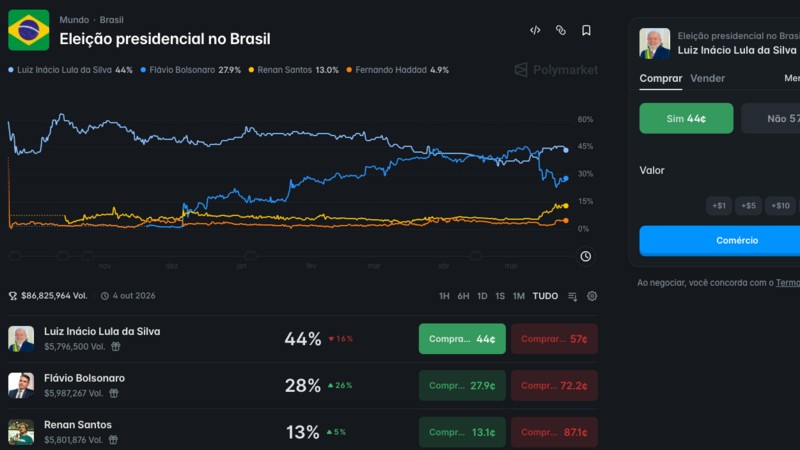
Contracts linked to the 2026 Brazilian presidential election on Polymarket totaled around US$86.8 million (around R$435 million) in volume traded last week May - with Lula (US$ 5.79 million), Flávio Bolsonaro (US$ 5.98 million) and Renan Santos (US$ 5.80 million) ahead in financial transactions.
Lula appeared on the platform with around a 44% chance of winning. In turn, Flávio Bolsonaro had close to 28%. Renan Santos, in third, had 13%.
As access to the site is blocked in Brazil, one way to enter the platforms is through a VPN, a virtual private network service that masks the user's IP address and encrypts their connection, allowing access to content in a given location.
What are the 'betting on everything' sites that have irritated bets in Brazil
Polymarket is one of the largest platforms for the so-called prediction market
AFP via Getty Images/BBC
'Research and betting market answer different questions'
For experts interviewed by the report, the betting market and electoral polls do not measure the same thing.
Raphael Nishimura, a statistician at the University of Michigan, in the United States, explains the distinction.
"Electoral research is trying to estimate what each candidate's voting intention will be. These betting platforms are literally answering what is the probability of a candidate winning the election. They are different questions that will give different results."
In other words, a candidate appearing with 40% or 50% on Polymarket does not mean that he will have that proportion of voting intention. It means that the market is calculating the probability of victory based on how much users of this type of platform are willing to pay to bet on that outcome.
The statistician observes that the prediction market, in practice, feeds on electoral polls.
"As soon as a survey comes out, especially depending on the result, there is a change in the probabilities. Bettors are absorbing the information from the survey and updating what they believe to be who will be the winner", he explains.
Josilmar Cordenonssi, professor of Economic Sciences at Universidade Presbiteriana Mackenzie, observes that surveys and betting sites operate at different paces: surveys require field collection of a representative sample and take days between calculation and publication, while contracts move in real time, reacting to new facts.
"Whoever uses these markets is betting, putting their own money there. It is not simply a disinterested opinion", says Cordenonssi.
"They are betting on what is most likely, because the objective is to make money, not to win politically, to manipulate the electorate."
Who bets - and who wins
The market's quick reaction to new facts that have not yet been captured by research is, for Nishimura, what is different about these platforms. But he warns that this same characteristic opens a window for risks.
According to an analysis by Bloomberg News, between the beginning of 2025 and the end of April this year, the number of Polymarket accounts that lost money after betting more than US$1,000 (around R$5,600) was almost double the total number of accounts that made a profit.
Another survey, published by the American newspaper The Wall Street Journal, showed that 67% of Polymarket's gains are concentrated in just 0.1% of accounts. According to the newspaper, almost US$500 million (around R$2.8 billion) ended up in the hands of less than 2 thousand users.
The analysis also indicated that those who tend to do best on these platforms are companies with specialized teams, capable of paying for resources that help support their bets, such as having access to real-time data and using servers and artificial intelligence robots to analyze a large volume of information.
The data suggests that what is sold as a "collective thermometer" may, in practice, reflect more the behavior of a few sophisticated operators than a collective public intuition.
There is also the risk of using privileged information - a situation in which bettors with early access to a fact that has not yet been made public make major moves that alter the calculation of probabilities reported by a platform.
In January of this year, the United States Department of Justice denounced Gannon Ken Van Dyke, a member of the American special forces, for alleged use of privileged information.
Van Dyke would have earned more than US$409,000 (around R$2 million) betting on Polymarket on the capture of the then president of Venezuela, Nicolás Maduro, before the operation became public. He pleaded not guilty.
How the US military involved in Maduro's capture tried to hide R$2 million that he profited from a bet
Why the White House instructed employees not to place bets on prediction markets such as Kalshi and Polymarket
Sergeant is arrested in the US after profiting R$2 million from a plan against Maduro
For Nishimura, the case illustrates the problem.
"That person who knew [of Maduro's capture] was a user of this platform, ended up placing very large bets, which ended up increasing the probability of that event occurring, because there was internal information there."
Another risk pointed out by the statistician is direct manipulation. "Because probability calculations are made based on betting volumes, there is in fact a window in which, if a person or group of people with a lot of money want, in some way, to manipulate those numbers."
This does not happen in electoral polls, highlights the statistician. "The institutes have their methods to investigate the population's voting issues to estimate what is as close as possible. There will not be a group of people who will be able to manipulate the results of the polls. Institutes have no interest in selling a distorted result, because this hurts their own reputation."
Nishimura also makes a counterpoint about what is expected from a poll. "Research does not serve as a prognosis. Its role is to portray a moment in the electorate, which may continue or not. There may be changes."
As an example, he cites the 2018 state elections, when surveys released the day before showed Romeu Zema (Novo) in third place in the dispute for the government of Minas Gerais, and Wilson Witzel (then in the PSC, now DC), in Rio de Janeiro, out of the leadership. Both ended up ahead in the first round after a surge associated with the Bolsonarista wave in the final stretch.
The statistician points out an alternative for those looking for the probability of victory of each candidate - without having to resort to betting platforms.
"There are aggregators that calculate probabilities based on electoral surveys only. Not only does it aggregate and take the average of voting intention surveys, but it also has a model behind it to calculate the probability of Lula winning the election, or Flávio winning, or having a second round."
(For the 2026 election, the BBC News Brasil Research Aggregator, made in partnership with the consultancy PollingData, compiles results from electoral surveys and calculates the estimate of voting intention for pre-candidates for the Presidency.)
Why the platforms were banned in Brazil
The blockade made by the federal government came from a resolution approved by the National Monetary Council (CMN), the body that regulates the Brazilian financial system.
At the time, minister Dario Durigan stated that the sector "suffered a space of anarchy" between 2018 and 2022 and that this type of bet cannot be treated as a regular derivative in Brazil.
"We are not going to have a forecast of rain here, or the death of a certain celebrity, as a possibility of being seen as a regular derivative in Brazil", said Durigan.
Today, the betting market on real sporting events, known as bets, and online games with defined rules are permitted in the country.
The pressure for the blockade also came from the regulated market itself, according to the Brazilian press.
Folha de S. Paulo stated that Brazilian bets - which paid grants of R$30 million each to operate legally in the country - requested the government, in meetings with the Ministry of Finance, that platforms like Kalshi be blocked.
The bets' argument is that these companies could not operate in Brazil because they do not have headquarters in the country nor have they paid for concessions. In an interview with the newspaper Valor Econômico, the founder of Kalshi said that the company is expanding and is studying the possibility of opening an office in Brazil.
For Cordenonssi, from Mackenzie, the central problem is regulatory. "They circumvent all financial market regulations", says the professor about prediction market platforms.
"They thought it would be better to prohibit this type of betting, leaving it to the financial market to organize this type of activity here in Brazil."
Source: G1