Asado or barbecue? World Cup reignites dispute between Argentines and Texans over who makes the best meat
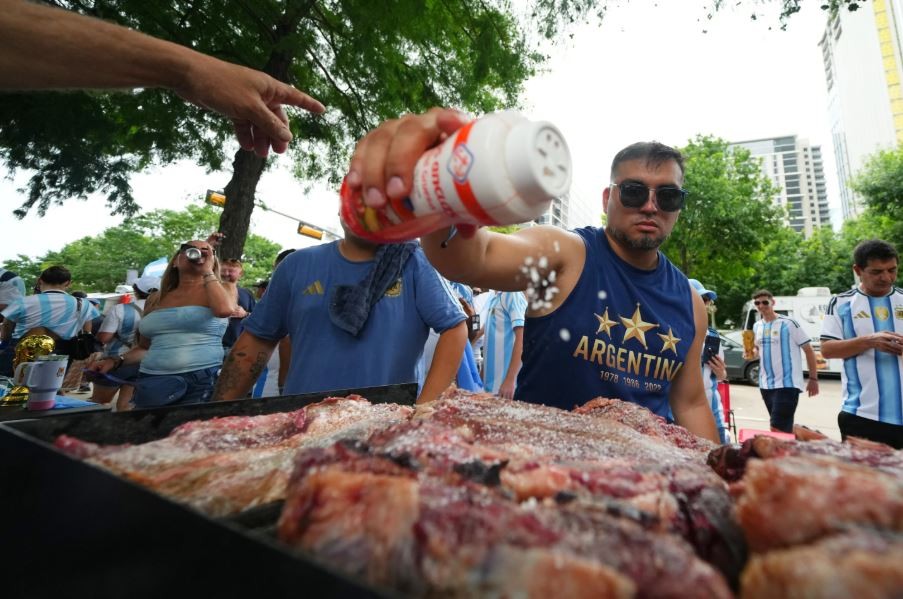
Lucas Martinez, an Argentina fan, seasons meat with salt while preparing a barbecue during a gathering before the World Cup Group J match against Austria, on Sunday, June 21, 2026, in Dallas.
AP Photo/Julio Cortez
Thousands of Argentine fans arrived in Texas for the World Cup, and an old dispute resurfaced. It's not about who has the best team or whether Lionel Messi is the best player in the championship. The discussion is different: who produces the best meat and what is the right way to prepare it.
That's right: there is a dispute over beef between two of the largest cattle-producing regions in the world, where steak is part of the culture and diet.
Texas leads beef production in the United States. The country occupies second place in the world ranking, behind only Brazil, according to the US Department of Agriculture. Argentina appears in sixth place.
But, after all, who makes the best meat?
The argument in favor of Argentine meat
Argentina fans barbecue during a gathering before the World Cup Group J match against Austria, on Sunday, June 21, 2026, in Dallas
AP Photo/Julio Cortez
"Argentine meat is simply unbeatable. The texture, the type of cut... there is no way to compete", says Carlos Eduardo Barahona, a 64-year-old Argentine chef who has lived in Texas since 1998.
From the cheapest cuts to the finest, Argentina is superior, guarantees Barahona, who has worked in restaurants in Argentina, Uruguay and Texas.
"You can make an Argentine asado with the cheapest cut in the country and you will still enjoy the meat. Here, you can use the best cut, such as filet mignon, and, depending on the origin, it can be hard, inedible or soft. Our meat, however, has a completely different flavor profile," he said.
Most Argentine beef comes from cattle raised on pasture, in open fields. This causes the animals to take longer to reach the ideal slaughter point. The result is leaner meat, with an intense and earthy flavor.
The cost of beef falls in Foz do Iguaçu and stimulates preparations for the World Cup
The argument in favor of Texas beef
In Texas and the USA, most cattle are fed grains. This causes the meat to have more marbling - the layers of fat interspersed in the muscle fibers, which help maintain juiciness and tenderness during preparation - and a sweeter flavor.
"There is no better meat than American meat, especially Texas meat," said Texas Agriculture Commissioner Sid Miller.
But, according to Miller, Argentine meat is also very good. Thanks to Texas.
According to him, the organization opened, more than a decade ago, a representative office to connect Texas cattle ranchers with cattle breeders in South America, especially Argentina.
"I don't want to belittle our friends in Argentina, but we helped improve their production," he said.
The verdict of those who eat meat
Argentinean Gonzalo Herrera took advantage of a trip to Walmart in Arlington, Texas, to see the meats available later of watching Lionel Messi's two goals in the victory over Austria. For him, the discussion about which meat is better doesn't make much sense.
"To be honest, I don't see that big of a difference," said Herrera as he placed four T-bone steaks in the shopping cart.
"The secret is knowing exactly which cuts to buy and finding the equivalent to what we eat in Argentina," he said, shaking his head when he saw the price of US$45.
"The prices here are higher," said Herrera.
The discussion also involves recipes and preferences in relation to to the style and thickness of the cuts.
In the end, it's literally a matter of taste when it comes to seasoning, searing the meat, smoking, butter, pepper, sauces and other ingredients.
At Argentine steakhouse Corrientes 348 in Dallas, the steaks are prepared only with salt and mesquite wood charcoal, according to assistant manager Emmanuel Tobon.
"There's a big difference. Texans use a lot of pepper, butter and a little barbecue sauce," Tobon said. "Argentines prefer to enhance the full flavor of the meat using only salt."
Argentina still has at least one more match in Dallas, on Saturday. Albiceleste fans have been flocking to the restaurant looking for a taste of home during the World Cup.
"They have been enjoying the Texan culture," said Tobon. "(But) it has been a great pleasure to welcome them all and make them feel at home."
According to him, Argentines are very proud of the barbecue culture, the recipes passed down from generation to generation and the "sacred" work of the barbecue chef at big family lunches.
For Fernando Garcia Morillo, an Argentine from Buenos Aires who now lives near Miami, the meat from both countries is excellent. Still, he misses his country's traditions whenever he orders a steak in the US.
"I order just salt, no pepper, very simple," Morillo said. "Sometimes they use a lot of sauce."
He rejected any idea of rivalry between the US and Argentina over meat.
"Maybe there is the usual rivalry with Brazil, our neighbor," he said. "I love US beef."
Source: G1