Are you bringing food from abroad? See what can enter Brazil and what requires authorization
Are you bringing food from abroad? See when and how to ask for authorization after rule changes
Everyone likes to bring souvenirs when they return from a trip, but did you know that not all food can enter Brazil?
Since February 4th, new rules from the Ministry of Agriculture have defined which foods can enter the country in travelers' luggage and which require authorization. Eggs, for example, were not on the list of prohibitions for 2025, but are now on it this year.
The rule applies even when the product is in the original, labeled and sealed packaging.
The Ministry explains that prohibited items can bring pests and diseases into the country, posing a risk to crops, animals and even human health.
Pork, for example, only enters Brazil with authorization because it can bring African swine fever. The disease is caused by a virus, is fatal to pigs and has no vaccine or treatment.
Today, this disease does not exist in Brazil, but it is present in more than 50 countries in Africa, Europe, Asia and the Americas. Spain, for example, has confirmed cases. The country is the third largest producer of pork in the world.
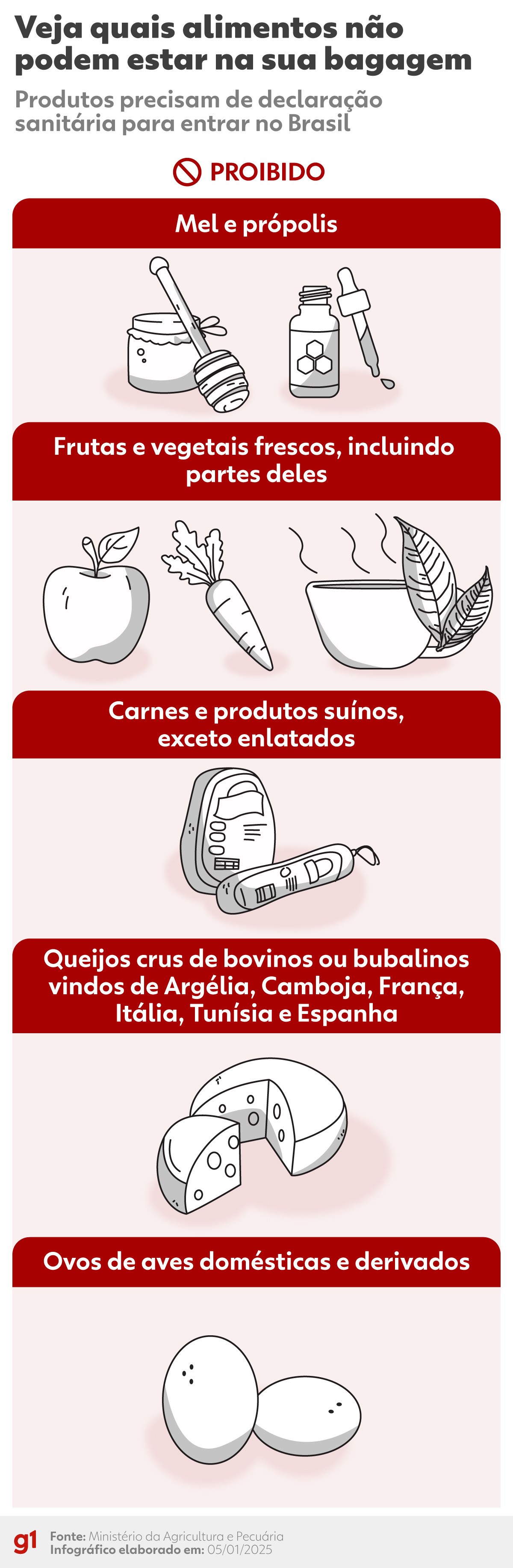
See which foods cannot be in your luggage
Arte g1
In addition to these products, the Ministry warns that there may be blockages related to products from specific countries, with an incidence of diseases. For example, in cases of bird flu, African swine fever and contagious nodular dermatosis.
The institution also points out that not only fresh vegetables, but some of them that may contain diseases can be confiscated. This is the case of dried leaves for tea, where the drying process is not known.
Inspection carried out by the Ministry of Agriculture
Disclosure
How to obtain authorization?
To enter the country with these foods, it is necessary to register with the Electronic Declaration and Traveler's Goods (e-DBV).
Then, it is necessary to go to the Vigiagro unit, at customs control, to complete the process.
In addition, when the Ministry of Agriculture considers that more rigorous control is necessary, a Prior Import Authorization may be additionally requested.
In this category, it is necessary to inform:
the description of the agricultural goods that will be imported, including the quantity, the form of packaging and the country of origin and origin;
the mode of transport, which may be air, sea, river, lake (by lake), road and rail;
the authorized transport route, specified as accompanied baggage;
the place of entry into the national territory;
the identification of the traveler who will transport the agricultural goods, including full name, CPF and passport number;
the validity period of the import authorization.
In this case, the authorization must be sent electronically by the issuing Technical Service to the Vigiagro Units at the entry points.
If an irregular product is seized, it must be destroyed.
According to the Ministry, two procedures are carried out for destruction: autoclaving (the product is subjected to a temperature of 133° C and pressure of 3 bar for 20 minutes) and incineration. The procedures are the responsibility of the airport administrator.
The standard that regulates the topic provides for other measures, but does not detail which ones.
g1 questioned the Ministry of Agriculture, but did not receive a response until the last update of this report.
Read also: After pressure from agriculture, the government temporarily suspends the list that considered tilapia an invasive species
Authorized products
Even when there is no documentation requirement, the product must be in the original packaging, with a label, seal and no signs of violation.
Some examples are:
extracts or concentrates of meat and fish, of all species, except pork.
meat (except pork) and smoked, dried, salted or dehydrated fish;
canned pork derivatives;
gelatin;
pasteurized or sterilized milk, including cream;
dulce de leche;
powdered milk or whey;
butter, clarified butter (ghee) and spreadable paste of products from milk;
yogurts, kefir, curds and other fermented milk drinks;
hydrolyzed milk protein and lactose;
cheese and cottage cheese, excluding dairy products made with milk from cattle and buffaloes from countries with notification of contagious nodular dermatosis (in the case of Algeria, Cambodia, France, Italy, Tunisia, Spain);
cakes, biscuits, biscuits, petit fours, sweet and savory pies, waffles, pastry pastries, sweets and delicacies; sulfited, freeze-dried, cooked, charred, parboiled, ground, polished, toasted or oven-dried.
Iberian ham: pork meat only enters Brazil with authorization, unless it is canned
Photo by Hawksbill.24
See also:
Uruguayan cows on the verge of death on a ship disembark in Libya, and NGO calls for investigation into the health of the animals animals
Trump tariff: see the new list of Brazilian products that are excluded from the 40% tariffs
Spain calls on the army to prevent pigs from becoming infected with African swine fever
Brazil without tilapia? What does the inclusion of fish on the list of invasive species mean?
Source: G1