Analysis: Trump's reliance on interim officials tests Constitution
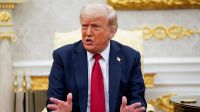
It seems strange that President Donald Trump would nominate a housing expert to oversee the United States intelligence community.
But Trump stands by his decision to temporarily nominate Bill Pulte, the housing official the president wants to start next week to "turn things around" and clean up the institution during his temporary assignment at the head of the intelligence community.
Democrats, protesting this hire, may allow a key foreign surveillance law to expire, while Republicans in Congress are acting urgently, according to the latest CNN report.
It seems like a similar problem to qualified leaders at the Centers for Disease Control and Prevention and the Food and Drug Administration, who have been removed and have not yet been replaced.
The position of director general of Public Health has not yet been filled permanently during Trump's second term.
Trump's power to advance his proposed nominees for key Senate posts is waning as his party prepares for the November elections, where his low approval ratings could be a drag on other Republicans.
As he did in his first term, Trump is likely to increasingly rely on acting directors at certain agencies, at least as long as the law allows.
Meanwhile, he will continue to test the law itself, the Federal Vacancy Reform Act of 1998, by giving a few close aides enormous responsibility over multiple agencies.
This is not a new concept in the Trump administration, in which Secretary of State Marco Rubio also served as acting archivist, or where the director of the Social Security Administration serves a dual role in the invented role of CEO of the IRS, as that position can no longer legally be held on a temporary basis.
The common thread for Pulte, the soon-to-be acting director of National Intelligence and director of the Federal Housing Finance Agency, whose nomination was confirmed by the Senate, is neither housing nor intelligence but rather, as CNN reported, his record of using his federal position to attack Trump's political enemies.
On June 4, in the Oval Office, the president made it clear that Pulte would not remain in office for long: "It's an interim position, it's not permanent," Trump declared.
And rather than pleading the need to coordinate intelligence in times of war, the president hopes that with Pulte in office, "he can figure out some things about the fraudulent elections."
"It's an accumulation of management problems," commented Max Stier, CEO of the Partnership for Public Service, a nonpartisan group that advocates efficient government.
The public administration, which has already been intimidated by attempts to cut jobs and eliminate what Trump believes is a "deep state" plotting against him, also has to deal with leaders who have no experience in the agencies they run.
"It's a recipe for waste, corruption, incompetence and a bad outcome for the American people," Stier said.
Trump's choice of Pulte raises questions
Pulte's rise, in particular, raises two distinct questions about how Trump has run the United States government:
- The first problem is Trump's use of interim officials to temporarily bypass the Senate confirmation process, which can be controversial and political even in the best of circumstances. Every president has done this, but Trump does it much more frequently and more openly. In his first term, he spoke of the "flexibility" that the absence of the confirmation process gave him.
Without caring about the fact that this is provided for in the Constitution.
- The second problem is the accumulation of unrelated responsibilities among Trump's group of trusted advisors, which has created multiple combinations of unusual functions.
Ultimately, both subjects end up being the subject of laws.
The law that created the position of director of National Intelligence (DNI), for example, requires that anyone appointed "have extensive experience in national security."
When the announcement was made, Pulte did not even have security clearance, although he was not appointed to the permanent position either.
However, another part of the law states that if a vacancy occurs, the principal deputy director of National Intelligence will "act in lieu of" the DNI during that period. The current principal deputy director of National Intelligence is an experienced former CIA officer named Aaron Lukas.
But here comes another law.
The Federal Vacancies Act of 1998 was passed with bipartisan support to limit President Bill Clinton's ability to bypass lawmakers' approval of key political appointments that require Senate confirmation. In Washington, these positions are called PAS.
The Vacancy Law establishes a somewhat complex system for filling these vacancies.
First, it determines that presidential appointment positions with Senate confirmation can only be held by their deputy directors, other senior agency officials or another Senate-confirmed official. Pulte is a Senate-confirmed official.
But there are also time limits. An interim employee can only hold the position for 210 days after the vacancy opens.
If the president nominates a permanent replacement, this 210-day period is interrupted during the nomination process. The president has an additional 210 days for an interim period if the first nomination fails or is withdrawn. But there is no third period.
According to the US Government Accountability Office, presidents of both parties have systematically violated this law.
Trump left positions vacant instead of nominating permanent candidates
US Trade Representative Jamieson Greer was already busy with Trump's trade war when he was also given the job of heading the Office of Government Ethics.
This entity should, in theory, prevent conflicts of interest in the administration, as does the Office of Special Counsel, which plays an important role in supporting government whistleblowers.
Trump does not appear to see much use for either position in his second term. None of them currently have a permanent leader.
The commissions are without key figures
The Federal Election Commission, which is supposed to be bipartisan, currently does not have enough commissioners to initiate investigations.
The U.S. Merit Systems Protection Board, responsible for handling complaints from federal employees, somewhat has a quorum, but only because its chairman, Senate-approved Henry Kerner, also serves as acting vice president.
Hundreds of vacant political positions
According to Stier's nonprofit Partnership for Public Service, there are about 1,300 positions that require Senate approval.
This organization monitors more than 800 important positions, and more than 270 of them do not have a Trump administration appointee.
Around 100 positions have a candidate nominated, but not yet confirmed by the Senate. In fact, this confirmation rate for "Trump 2.0" is slightly higher than that of the Biden administration or the first Trump administration.
But Trump's reliance on interim officials puts to the test the laws defining how these vacancies should be filled and the spirit of the Constitution, which attempted to force a compromise between lawmakers and the president by requiring the Senate's "advice and consent" for senior government officials.
"That seems to be the main lesson he learned in his first term: choosing people who will do what he wants no matter what, rather than choosing people who defend the Constitution, the rule of law and who are capable of leading these very important and complex organizations that have had a huge impact on the American public," Stier said.
Source: CNN