Analysis: Iran's leaders bet on risks avoided by their predecessors
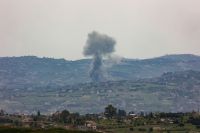
Iran's strikes against Israel this week were some of its boldest moves yet to redefine the boundaries of a confrontation that for decades has been fought primarily through allied groups, covert operations and carefully calculated retaliations.
By targeting Israel in response to attacks in Lebanon, Tehran appeared to signal that its red lines are no longer limited to its own borders - and that its leaders are willing to take bigger risks.
Since the ceasefire between the United States and Iran signed on April 8, Tehran has repeatedly accused Israel and the United States of undermining the truce through military action.
The United States carried out strikes against Iranian targets even as indirect negotiations continued. Israel, in turn, launched almost 3,500 attacks in Lebanon, according to the country's prime minister, including attacks in the capital, Beirut, despite restrictions imposed by the ceasefire agreement.
Iran responded with a series of carefully calculated retaliatory strikes against US and Gulf targets, while warning that if diplomacy failed, it would be prepared to resume the war and expand it beyond the Persian Gulf, potentially threatening sea lanes stretching from the Indian Ocean to the Red Sea and the Mediterranean.
Between the night of Tuesday (9) and the early hours of Wednesday (10), new clashes occurred between the United States and Iran following the downing of an American Army helicopter at the beginning of the week, highlighting the persistent instability in the region.
Iranian attacks on Israel signal broader shift
This week's attacks on Israel, however, appeared to represent a step further.
Tehran has signaled that Israeli military actions against its regional allies could also provoke a direct response from Iran.
The objective would be to break the diplomatic impasse in negotiations to reach a provisional peace agreement and support the Hezbollah group.
"We reversed the logic of the ceasefire that existed on paper, but which had been repeatedly violated in practice, on the ground," said Mohammad Bagher Ghalibaf, the main Iranian negotiator in the talks, on Monday (8). "Until there is a genuine willingness to build trust, Iran's response will remain the same."
Iran has insisted that it will not allow Israel and the United States to continue carrying out attacks while claiming to remain committed to a ceasefire that, according to Tehran, has been repeatedly violated. "Under no circumstances" would the country accept such a situation, declared on Monday the spokesperson for the Ministry of Foreign Affairs, Esmaeil Baghaei.
The move suggests a broader shift in Tehran, where a new generation of leaders is increasingly abandoning the cautious, reactive stance that has long defined the Islamic Republic's strategy in the face of its adversaries.
Rather than relying primarily on deterrence and strategic patience, these leaders appear more willing to take risks and use Iran's military, economic power and regional influence to shape developments in the Middle East.
It is also this same Iranian leadership that US President Donald Trump has described as "more rational" and "quite reasonable".
"The Iranians have put both the Israelis and the United States against the wall now," Aaron David Miller told CNN's Jessica Dean. "They are willing to take risks. They believe they are winning. They don't think the ceasefire is serving their interests."
In 2020, Donald Trump's first administration broke a long-standing taboo by ordering the assassination of Qasem Soleimani, the highest-ranking Iranian official killed by the United States to date.
Tehran's response, under the leadership of then-Supreme Leader Ali Khamenei, reflected its preference for calculated retaliation rather than uncontrolled escalation: Iran launched a missile attack on an American air base in Iraq after transmitting advance warnings that gave U.S. forces time to seek shelter.
In June 2025, when the United States joined Israel in attacks against Iran, Tehran again opted for a proportionate response, signaling that, despite aggressive rhetoric, it still considered it necessary to carefully manage the risk of an escalation of the conflict.
This week's attacks on Israel suggest that calculation may be changing. "This is the first time in decades that a regional power has the means, capacity and willingness to employ direct military power against Israeli military maneuvers or acts of aggression against a third party actor," said Trita Parsi of the Quincy Institute.
After the attack, Iran warned that it was prepared to "raise the level of tension" in order to challenge what it described as Israeli and American assumptions about the limits of its response.
"If the Israelis and Americans imagine that, through 'controlled tension', they can make Iran and the so-called Axis of Resistance (a network of allies and groups supported by Tehran) predictable in the face of their crimes, or limit the type of Iranian response, they are making a foolish mistake," said an unidentified military source, cited by the news agency Tasnim News Agency, considered close to the IRGC (Iranian Revolutionary Guard).
Tehran seeks to create a "new equation" with the aim of preventing Israel from acting not only against Iran itself, but also against its network of allies and partner groups in the region, Danny Citrinowicz told journalist Becky Anderson.
"The events of the last 24 hours have demonstrated once again that the current Iranian leadership increasingly believes that what cannot be achieved through diplomacy can ultimately be achieved through the use of force," he wrote on social media site X.
Exploring fissures in the relationship between the US and Israel
Iran also appears to be testing the alliance between the United States and Israel and exploiting the growing disagreements between the two countries over the outcome of the conflict.
In recent weeks, US President Donald Trump has publicly distanced himself on several occasions from Israeli Prime Minister Benjamin Netanyahu, insisting that a diplomatic agreement with Tehran is within reach and saying that Israel will have "no choice" but to accept it.
This strategy may be producing results.
After Iran attacked Israel on Monday, US President Donald Trump acted quickly to prevent further escalation, speaking twice with Israeli Prime Minister Benjamin Netanyahu within hours in an attempt to convince him not to retaliate.
Esmaeil Baghaei, spokesman for Iranian diplomacy, stated that Washington "bears responsibility" for Israel's actions and warned that they would "inevitably" affect the diplomatic process.
Meanwhile, an Israeli military official stressed that US forces did not participate in the attacks against Iran, although they did help intercept Iranian missiles launched towards Israel.
Iran may have succeeded in forcing Washington to choose between supporting Israel's freedom of military action or preserving its diplomatic path with Tehran.
The pressure exerted by Trump on Netanyahu "added another chip to the table" for Iran, said Aaron David Miller, referring to the new bargaining power gained by Tehran. "This will lead to the creation of a new norm."
Understand how tension in Hormuz affects ceasefire between the US and Iran
Source: CNN