Analysis: Delcy Rodríguez repeats Chavismo tactics to maintain power
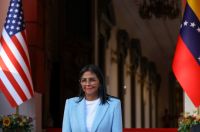
Chavismo often uses the expression "new political moment" to refer to the impact of the capture of its leader, Nicolás Maduro, on January 3, and the decisions adopted since then, which include a profound reformulation of the cabinet and the approval of laws with a more favorable environment for international investment.
The authorization to carry out military exercises by the Southern Command at the headquarters of the United States embassy in Caracas, last week, is the most recent example of this new reality - an unimaginable situation at the end of 2025, but which also reveals the priorities of the regime that came to power 27 years ago.
With the exception of the disappearance of anti-imperialist discourse from the top of power, everything remains more or less the same in Venezuela.
As of May 25, there were still 409 political prisoners, according to data gathered by the NGO Foro Penal, despite the releases that have occurred since January and the timid political opening, which allowed the return of several opposition leaders and the emergence of others from hiding.
There is still no concrete date for the holding of presidential elections, nor has the repressive structure that gave rise to the harsh condemnations of the UN Independent International Fact-Finding Mission and an investigation into possible crimes against humanity before the International Criminal Court, which the government considers an instrumentalization of the mechanisms of international justice for political purposes, been dismantled.
Now, Delcy Rodríguez leads a phase that, despite criticism within Chavismo, continues the tradition of her predecessors of making tactical concessions with the ultimate goal of remaining in power. And in the President of the United States, Donald Trump, he has an unexpected ally.
Preservation of political power
A few weeks ago, CNN revealed that, before the capture of Nicolás Maduro and Cilia Flores, Venezuela and the US participated in conversations mediated by Qatar about what the country could be like if Maduro left power.
In these conversations, according to the article, the name of opposition leader María Corina Machado to lead the South American country was never considered, despite the 2025 Nobel Peace Prize winner's open support for the formation of an international military coalition to dislodge Hugo Chávez's successor.
The surprise of the Venezuelan opposition hours after the spectacular capture of Maduro and his wife Cilia Flores, when Trump supported Rodríguez's continuation, is already history. Machado then described the capture as "the hour of freedom".
Part of the justification for this latest setback by Chavismo in its postulates was recorded in a recording published on YouTube.
Seven days after Maduro's capture, Venezuela's Minister of Communication and Information, Freddy Ñáñez, held a meeting with communicators aligned with the Bolivarian government.
In a straight-faced environment, Ñáñez outlined the general propaganda strategy and the key messages that should be replicated by those present, who were also trying to explain - and explain themselves - what had happened on January 3.
At the end of the meeting, Ñáñez interrupted one of the speakers with an announcement: Delcy Rodríguez was waiting to speak on the phone with the participants.
Within a few minutes, the interim president explained how she would act from now on (as long as Washington remained "breathing down her neck"). "We have to act with patience and prudence, with three very clear objectives, sisters and brothers. The first is to preserve the peace of the Republic, the second is to rescue our hostages and the third is to preserve political power," he said.
Four and a half months after that meeting, Rodríguez consolidates this political power with the support of Washington, which needs Venezuelan oil supplies now that it is involved in a military campaign in the Middle East, while waiting for what might happen to Trump in the midterm elections in November.
A recent compilation of essays published by the Center for Inter-American Politics and Research at Tulane University points out that the transition to democracy in Venezuela is not the priority of the current American administration, which, despite the three-phase plan announced by Secretary of State Marco Rubio, appears to feel comfortable with the tutelage it exercises over Maduro's successors. "Delcy Rodríguez is doing a fantastic job," Trump said on several occasions.
"This revolution is eternal"
For years, Chavismo mixed its grandiose proclamations with advances and retreats to remain in power. "This revolution is eternal", said Hugo Chávez repeatedly in his long speeches.
The commander-president made this statement in 2002, during the brief coup d'état he faced in April of that year. Upon returning to power, 48 hours after being overthrown, Chávez defended the country's unity with a crucifix in his hand, called for dialogue and, in the following weeks, recovered part of the enormous popularity he had, according to polls at the time.
Meanwhile, his opponents were looking for a way to end his mandate through initiatives that were, first, clearly insurrectionary - such as the strike of PDVSA, the state-owned oil company, between December 2002 and February 2003 - and, second, electoral.
The solution agreed upon by the government and the opposition at the time, with the mediation of the OAS (Organization of American States) and its then secretary general, César Gaviria, in addition to the Carter Center, was the call for a recall referendum - a mechanism provided for in the 1999 Constitution - before the end of the presidential term, on January 10, 2007.
With the agreement signed at the end of May 2003, the National Assembly appointed the new authorities responsible for organizing the consultation.
Of the five members of the National Electoral Council, Chavismo secured three seats, thus ensuring a majority that allowed it to determine that the plebiscite would be held in August 2004.
This was the deadline established by the Constitution to call the referendum and guarantee, in the event of the government's defeat, the holding of new elections.
Despite allegations of fraud by the Democratic Coordinator, never proven, the opposition coalition at the time, Chávez remained in power thanks, moreover, to the establishment of a program of clear Cuban inspiration: the "social missions", which created a direct structure for transferring resources and medical care to the Chavista electoral base.
And he remained in office again when, despite having narrowly lost the popular consultation on his 2007 constitutional reform proposal, he again presented part of this project, specifically the one relating to the continuous re-election of popularly elected positions, in February 2009, as an amendment to the social contract that governs Venezuelans.
Not only did he win that consultation, but this decision allowed him to stand as a candidate in the elections held in October 2012.
Two and a half years after Chávez's death, Maduro suffered a defeat in the legislative elections of December 6, 2015. His opponents, however, were unable to exercise the qualified majority obtained at the polls, which would have allowed them to count on the votes necessary to initiate reforms with a major impact on the country.
The Electoral Chamber of the Supreme Court of Justice (TSJ) suspended the proclamation of three deputies from the state of Amazonas while the challenge to the results was resolved. As a result, the opposition only obtained a simple majority.
The new Parliament board went ahead with plans to swear in the new deputies, ensuring that the TSJ responded to the Government's interests, which, in turn, gave room for the United Socialist Party of Venezuela to sue the new Parliament board for contempt of the court decision.
The opposition's fears were not just based on a certain perception rooted in public opinion. After reviewing more than 45,000 sentences from Venezuela's highest court issued between 2004 and 2013, a study led by lawyer Antonio Canova, recorded in the book "The TSJ at the service of the revolution", concluded that the TSJ never issued a sentence against the Chavista regime in those years.
The conflict of powers was won by Maduro. In 2017, the then president decided to convene a National Constituent Assembly in response to the protests that began in March of that year.
The new body acted as a parallel Parliament and relegated the opposition National Assembly to an irrelevant political forum. Facing repression and exile, his rivals were greatly weakened.
If until that year everything could be seen as an unrelenting struggle between two conflicting poles, the National Electoral Council's decision to declare Maduro's victory on July 28, 2024, without publishing the results of the vote, inaugurated a new stage in Venezuela marked by the condemnation of the majority of Western governments, repression, imprisonment or clandestinity of the opposition political leadership, which culminated unexpectedly on January 3.
"Get over it, forgive us and come back"
While the ruling Chavismo now consolidates its unexpected bond with Washington, Delcy Rodríguez seems to be on track to continue aspiring to lead it in this new stage, marked by calls to leave behind the difficult years of her predecessor.
"Get over it, forgive us and come back", asked his brother, Jorge Rodríguez, president of the National Assembly, to the Venezuelan diaspora at the end of April, in an intervention that was memorable.
A public document supports these plans. In the middle of that month, lawyer Jihad M. Smaili registered with the Department of Justice as the acting president's legal representative in the United States. According to the document presented, Smaili could advise her on several aspects, including her future campaign for the presidential elections in Venezuela.
This latest turn of events places Chavismo in the same line as other major caudillista movements in Latin America, such as Peronism in Argentina. Basically, both share the same maxim: the government's ideological orientation can change over time. The key is to preserve power.
Source: CNN