Analysis: Crisis in Venezuela could strengthen Delcy's stay in power
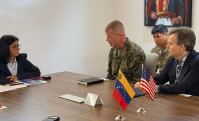
The devastating earthquakes that hit Venezuela two weeks ago would have tested any government. But they hit a country still grappling with the fallout from the capture of authoritarian leader Nicolás Maduro six months ago, turning a natural disaster into a political test for interim President Delcy Rodríguez and exposing dissatisfaction with the state's response.
The two catastrophic earthquakes that hit Venezuela in quick succession on June 24 left more than 3,000 people dead, a number that experts say is far below reality.
Both inside and outside the country, many citizens believe that authorities were too slow to react and failed to adequately deal with the tragedy, a criticism that Rodríguez firmly rejects.
Analysts interviewed by CNN say the earthquakes have become a litmus test for the interim government, exposing its political vulnerability and the limits of the state's ability to respond to the disaster. They assess that the outcome remains highly uncertain and that the actions of the United States will be decisive, considering the supervisory role that Washington currently plays in Venezuela.
"Delcy Rodríguez now faces the biggest test of her leadership," said Imdat Oner, a researcher at Florida International University. "At the same time, popular dissatisfaction is growing due to mismanagement and delayed response. But in authoritarian regimes, crises like this often strengthen those in power."
Oner suggested that Rodríguez could use "emergency measures to centralize his authority, expand security control and postpone political reforms in the name of stability and reconstruction."
"The disaster has exposed the fragility of the state," said Oner, "but in the short term it gives the government more room to stay in power rather than being forced out of it."
But beyond any political opportunity the disaster may present for Rodríguez, the government remains extremely fragile, and the task of recovering from the earthquakes is an enormous challenge.
"The immediate challenge is gigantic, but so is the task of economic recovery and reconstruction of the devastated region," said Phil Gunson, a Caracas-based analyst with the International Crisis Group. "This will require a large amount of money that the government simply does not have."
The tragedy exposed weaknesses
The June 24 earthquakes are among the deadliest natural disasters in Venezuelan history. In addition to the 3,685 deaths recorded, more than 16,000 people were injured and more than 17,000 were displaced, according to country authorities.
Hundreds of buildings were damaged, and the economic impact is estimated at approximately 6% of Venezuela's Gross Domestic Product, according to the United Nations Development Program (UNDP).
A disaster of this magnitude would challenge any government, but analysts say Venezuela's situation is particularly serious because it occurred in a country with institutions weakened by 25 years of rule by followers of the late president Hugo Chávez.
"The state simply does not have the capacity to respond," Gunson said. "It has no budget, personnel, planning, leadership, equipment or heavy machinery."
At the scene, several witness reports indicate that the government's response has been insufficient, with many people still trapped under the rubble or missing.
When asked about this criticism during a press conference last Thursday, Rodríguez denied that authorities had acted slowly. Instead, it stated that 4,000 professionals were mobilized in the first 24 hours, a number that quickly increased to 19,000, with the support of international rescue teams.
"Anyone who wants a reality check is welcome," she said. "This is the guidance given to the national government: mobilize efforts and work tirelessly, save lives and care for survivors, as we are doing and will continue to do. Despite the challenges, we received support both nationally and internationally."
Opposition kept at a distance
In this scenario, opposition groups intensified their criticism of the Venezuelan government. Before the earthquakes, some opposition figures were optimistic, especially after senior government officials met with Dinorah Figuera, former president of the National Assembly elected in 2015 - the last Venezuelan legislature recognized by the international community.
According to opposition groups, the meeting could have represented a first step towards negotiating a political transition with support from the United States. However, Venezuelan academic Carlos Torrealba told CNN that the earthquakes disrupted any process that might have been underway.
"Uncertainty has only increased," Torrealba said, adding that any political change would likely be delayed further. The process was already unclear, according to him, and now it seems even more distant.
The opposition's dilemma is exemplified by one of its most prominent leaders, Nobel Peace Prize winner María Corina Machado, who has tried unsuccessfully to enter Venezuela since the earthquakes. In a video published on X on June 29, Machado stated that she was in Panama and accused the Venezuelan government of preventing her from entering the country to participate in humanitarian aid efforts.
"This isn't about me," Machado said. "There are thousands - millions - of us who want to be together, a grieving nation that needs to mourn together. At this moment, I am willing to do whatever is necessary, speak to whoever is necessary, to coordinate actions and serve our people."
The United States, however, does not appear to support Machado's intended return to Venezuela.
When asked about the matter, a State Department spokesperson told CNN in an email sent on Thursday: "The Trump administration remains fully focused on advancing our response to the devastating earthquakes in Venezuela. Our response has been quick and effective. Introducing sensitive political issues at this time would be counterproductive to our efforts to address this tragedy."
According to Gunson, of the International Crisis Group, statements like this suggest that Washington does not consider Machado's movement a viable alternative to governing Venezuela.
"The United States does not believe in María Corina Machado's strategy," he said. "They do not believe that she and her allies are capable of managing the current situation. This was true before the earthquake and is even more so now."
Oner, a professor at Florida International University, added that many Venezuelans believed Rodríguez's weak response to the earthquakes would lead Washington to reconsider its support for her, but that did not happen.
In his view, this indicates that the United States will likely continue to support the interim president - at least for now - while prioritizing Venezuela's stability and the protection of its economic and oil interests.
"Delcy knows how to make his government useful to Washington by responding to every request coming from the United States," Oner said. "This makes it likely that the White House will continue to support her as she pushes for limited reforms and cooperation, without seriously demanding elections or a full democratic transition in the near future. For now, a political transition remains off the horizon."
Understand how the strength of earthquakes is measured
Source: CNN