After defeat at the Supreme Court, Trump asks Congress to create new citizenship legislation
American justice maintains rule of automatic citizenship by birth in United States territory
The President of the United States, Donald Trump, said he should support Congressional initiatives to reverse the right to American citizenship for children of immigrants born in the country.
In a post on social media, he stated that the judgment of the American Supreme Court this Tuesday (30), which overturned the Republican's decision that denied nationality in the country to descendants of foreigners, is "regrettable" for the USA, and that birthright is "expensive and unfair" for the nation.
"Congress must start TODAY working to end citizenship by birth, which is expensive and unfair for our country. They will have my full support and unrestricted!"
✅ Follow the g1 international news channel on WhatsApp
➡In the same session, the Supreme Court ruled that states can prohibit the participation of transgender girls and women in women's school and university sports. The court also overturned limits on political campaign financing, rejecting federal restrictions on coordinated spending between parties and candidates.
According to him, parliamentarians can reverse the decision through new legislation that would have their unrestricted support.
President of the United States, Donald Trump, criticizes the Supreme Court's decision on citizenship by birth on June 30, 2026.
Reproduction/Donald Trump at Truth Social
Children of immigrants have the right to American citizenship
The US Supreme Court maintained the broad interpretation of citizenship by birth. The court rejected the executive order signed by Trump, which declared that children of illegal immigrants or tourists were not American citizens.
By 6 votes to 3, the judges confirmed a consolidated understanding of the 14th Amendment to the Constitution and concluded that anyone born in the country, with very limited exceptions, is a citizen of the United States.
The restrictions imposed by Trump had already been blocked by several lower courts and never came into force anywhere in the United States. country.
Hours before the verdict, the politician republished on his official Truth Social account a report that stated that "his efforts to limit birthright citizenship may succeed with or without the Supreme Court."
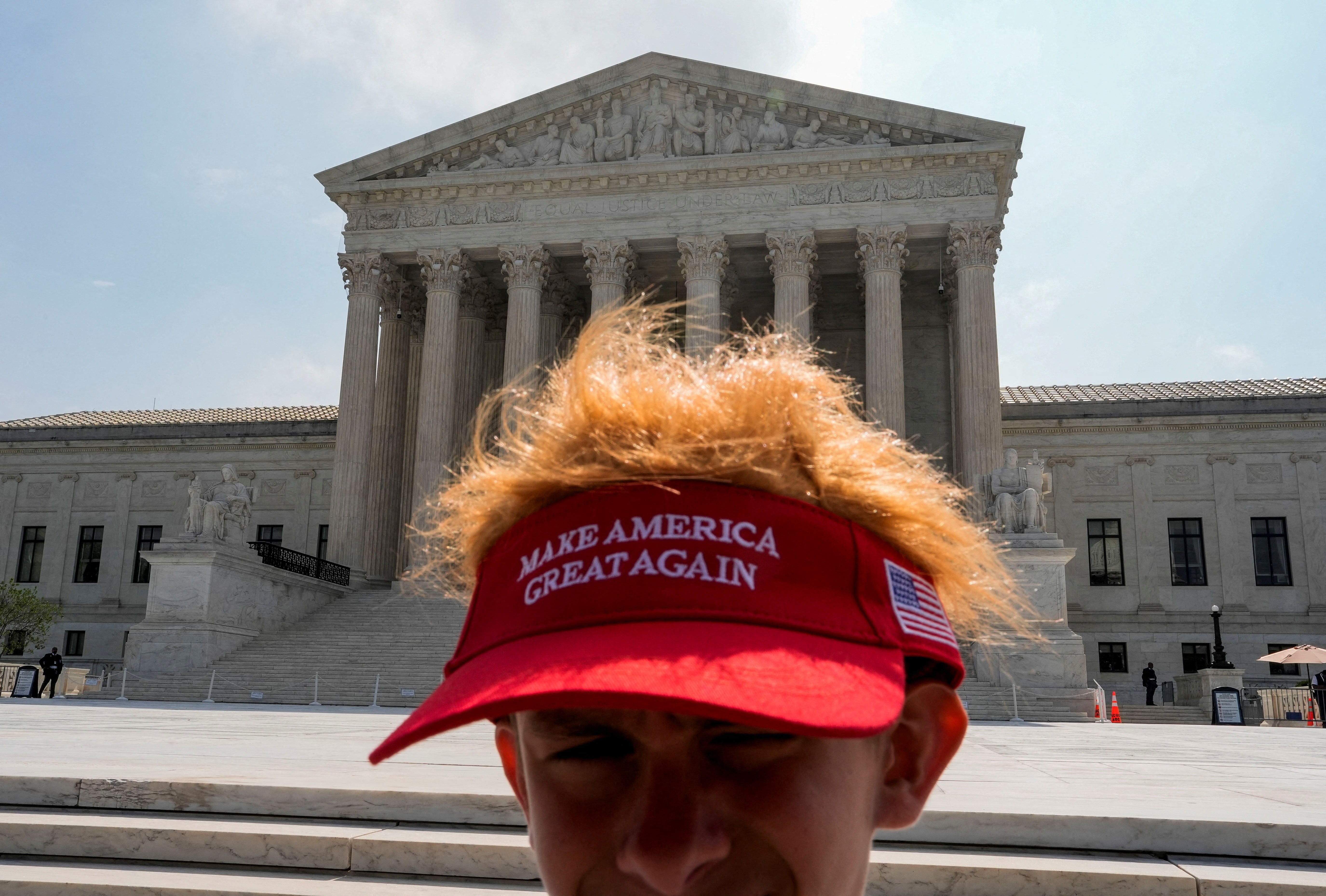
Trump supporter in front of the US Supreme Court in Washington, DC
Cheney Orr/Reuters
Principle of right to soil
Historically, the United States grants citizenship on the principle of "jus soli", or right to soil: all Those born in the United States are American citizens, including children of tourists or immigrants. Exceptions are few and specific, such as for children of diplomats from other countries serving in the US.
The so-called birthright citizenship is provided for in the 14th Amendment to the US Constitution, which states that "all persons born" in the United States "are citizens of the United States".
On the first day of his second term as president, however, Donald Trump signed an executive order limiting this right, although without clear details about granting citizenship. The measure is part of a broader package to combat immigration, which could bar the granting of citizenship to children born in the US to immigrants or tourists.
The case reached the Supreme Court through a process initiated in New Hampshire called "Trump versus Barbara".
The Republican presidential candidate, former president Donald Trump, speaks after voting at the Morton and Barbara Mandel Recreation Center in Palm Beach, Florida
Evan Vucci/AP
It began when an immigrant A Honduran woman named Barbara, a resident of the state of New Hampshire, sued the Trump administration for considering a measure restricting American citizenship unconstitutional.
Barbara and her husband are undocumented immigrants and she has three children, all born in Honduras.
She decided to sue the government after discovering that she was pregnant with her fourth child, who would be born in the USA, but would not be entitled to American citizenship.
Barbara's last name was not publicly released for fear that she would be the target of reprisals from the president's supporters.
In early April, Trump personally attended a Supreme Court hearing that would hear arguments from the parties on the case. It was the first time in the history of the United States that a president of the country went to the Supreme Court to monitor a trial.
The appearance was seen by the country's press as a way for Trump to put pressure on the court to judge the case in his favor.
This Tuesday's decision by the Supreme Court maintains the understanding of the 14th Amendment consolidated since 1898, when it decided in favor of granting citizenship to Wong Kim Ark, son of Chinese parents born in the USA.
The Trump administration claimed that automatic citizenship encourages citizenship. irregular immigration and so-called "birth tourism," when foreigners travel to the country to have children and secure American citizenship for them.
The justices' arguments
Conservative Justice John Roberts, chief justice of the Supreme Court and rapporteur of Tuesday's decision, cited 1898 precedent and said there was "little evidence" to support the Trump administration's "drastically revisionist view" on how to interpret the 14th Amendment's language to limit birthright citizenship.
"It is not surprising, then, that in 128 years since then, we have repeatedly understood the rule established in Wong Kim Ark to guarantee citizenship to all children born in the United States and subject to its jurisdiction," Roberts wrote. "We see no reason to depart from that interpretation today."
Source: G1