25% US tariff could hit steel, juice and machinery; see products outside the exemption list
Míriam Leitão: 25% tariff is more dangerous than the 2025 tariff
Despite the list of exceptions released by the United States, several Brazilian products may still be affected by the 25% tariff proposed by the country after the conclusion of a trade investigation conducted by the Office of the US Trade Representative (USTR).
The measure was announced on Monday (1st) and is based on Section 301 of the 1974 Trade Act. (understand how it works here)
Do you have any suggestions for a report? Send to g1
According to the American government, the tariff is a response to practices and policies adopted by Brazil that, in the US assessment, would be "unreasonable" and would harm North American trade.
Despite the surcharge, a list of exceptions published by the USTR preserves some of the main products exported by Brazil to the American market, such as crude oil, aircraft, coffee and cellulose.
Other relevant items on the Brazilian export agenda, however, were left out of the exemptions and may face additional charges.
Steel leads the list of most exposed products
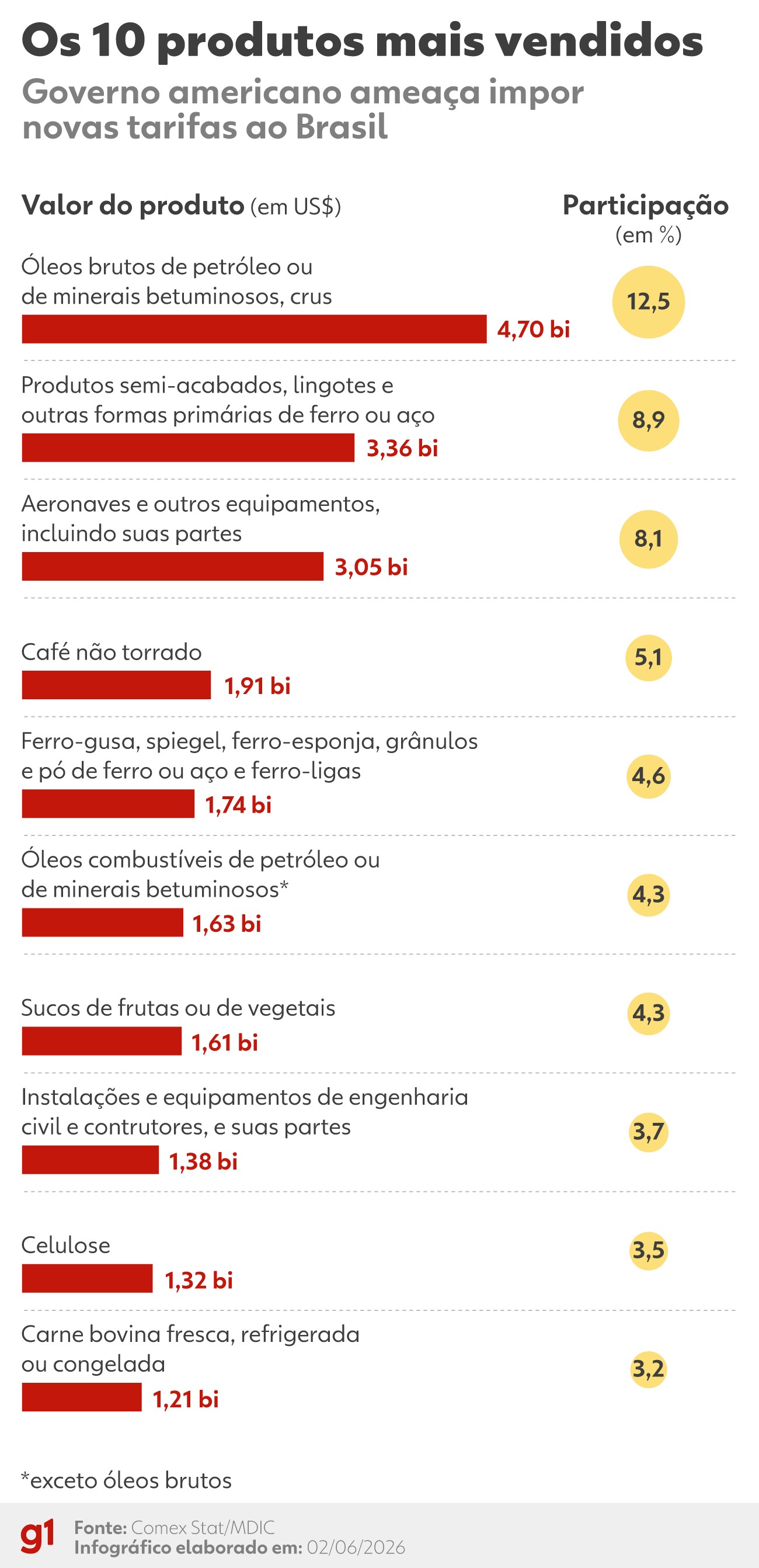
Data from the Ministry of Development, Industry, Commerce and Services (MDIC) show that semi-finished iron and steel products were the second most exported item from Brazil to the USA in 2025, with sales of US$3.36 billion, equivalent to 8.92% of the total shipped.
Although the US Supreme Court overturned part of the tariffs imposed by Trump, the taxes applied to steel and aluminum remained in force, including for Brazil.
This is because they were adopted based on Section 232, which was not affected by the court decision.
The Minister of Industry and Commerce, Márcio Elias Rosa, said this Tuesday (2) that the new proposal from Donald Trump's government could impact 21% of Brazil's exports to the United States. According to him, around 25% of Brazilian goods are already subject to surcharges provided for in Section 232, which includes items such as steel, aluminum and auto parts. Another 54% of exports are not affected by tariffs.
Although the list of exceptions includes some specific categories linked to the steel sector, such as ferroalloys, direct reduction products and certain steel tubes used in aviation, semi-finished products, ingots and primary forms of steel do not appear among the exempt items.
Another relevant segment is pig iron, spiegel and sponge iron, which generated a turnover of US$ 1.74 billion in exports last year, representing 4.63% of Brazil's exports to the USA.
Part of this category may benefit from the exceptions granted to ferroalloys, but other products in the group were not mentioned in the list of exemptions.
Fruit juice and construction equipment
Among agro-industrial products, fruit and vegetable juices appear among the most vulnerable to the new tariff. The sector's exports totaled US$1.61 billion in 2025, corresponding to 4.28% of Brazilian sales to the United States.
The list of exceptions includes fresh, dried, frozen fruits and even pulps, but does not include processed juices.
Equipment and facilities used in civil engineering works and projects may also be impacted. The segment exported US$1.38 billion to the USA in 2025, equivalent to 3.67% of the total.
Although some machinery and industrial equipment were included in the exemptions, the benefit is restricted to products intended for the aeronautical sector, leaving out a large part of the machinery used in civil construction and infrastructure projects.
Other sectors at risk
In addition to the main products on the export list, other items with a relevant share also do not appear among the exceptions announced by the USA.
Among them are:
Lime, cement and construction materials: US$ 794 million (2.11%). They do not appear on the list of exemptions.
⚡ Electric power machines: US$ 660 million (1.75%). Exemptions focus on the aerospace sector, without including general purpose machinery.
Rubber tires: US$536 million (1.42%).
Exemption restricted to aircraft tires only.
Alumina (aluminum oxide): US$463 million (1.23%). The ore (bauxite) is exempt, but the processed product is not.
Animal oils and fats: US$ 450 million (1.19%). Not on the list of exemptions.
✈ Piston engines and parts: US$ 435 million (1.15%). Exemption valid only when destined for aircraft.
Wood (veneers, plywood and particleboards): around US$360 million (0.95%). No exemption provision.
In the case of tires, the exemption provided by the USA only applies to models intended for aviation. As for wood, the exceptions only cover some specific species, such as teak, mahogany, ferrule and balsa.
The 10 best-selling products
Art/g1
Main exports preserved
On the other hand, some of the most important products on the Brazilian agenda were protected by the list of exemptions published by the USTR.
Crude oil, the main item exported by Brazil to the USA in 2025, with sales of US$ 4.7 billion and share of 12.48%, is among the preserved products. (see the complete list here)
See the list of Brazilian products that were excluded from the 25% tariff
Crude oil and derivatives (crude and refined petroleum oils, fuels and natural gas)
✈ Aircraft, engines, aeronautical parts and components
☕ Coffee (roasted, unroasted and decaffeinated)
Beef (fresh, chilled, frozen, canned and processed)
Cellulose and paper products
Industrial chemicals
Fertilizers (urea, potassium chloride, sodium nitrate and others)
Medicines, vaccines and pharmaceutical products
⛏ Iron ore and other minerals (manganese, copper, nickel, aluminum, zinc, tin, titanium, among others)
Fruits and agricultural products (orange, mango, banana, pineapple, coconut, avocado, lemon and others)
Nuts (Brazil nuts, cashew nuts and macadamia nuts)
Cocoa and derivatives
Spices (pepper, cinnamon, ginger, turmeric, vanilla and others)
Teas and yerba mate
Semiconductors, processors and machines for making chips
Gold, silver and platinum
Understand the investigation
According to a document released by the USTR, the investigation opened by the American government concluded that the Brazilian government adopts practices that "encumber or restrict" trade with the Americans. Among them are PIX, illegal deforestation, piracy and failures in the application of anti-corruption laws.
When the investigation was opened in July 2025, the US trade representative, Jamieson Greer, had already stated that he had documented "unfair trade practices by Brazil that have restricted the access of American exporters to its market for decades", but did not present evidence to support the accusation.
Based on these conclusions, the US proposed the application of an additional tariff on 25% on part of Brazilian imports, although they included a list of exceptions for several products.
The process is not yet definitive: there will be public consultations and a hearing scheduled for July 6, 2026, and the final decision must be made by July 15, 2026.
Tariff changes
In February, the US Supreme Court ruled that the International Emergency Economic Powers Act (IEEPA) does not allow the president to impose tariffs unilaterally.
With this, all tariffs based on this instrument were annulled, including the 10% "reciprocal" tariffs and a previously announced 40% surcharge on Brazilian products.
After the decision, Trump began to use another legal mechanism to apply a global tariff of 10% to products imported from all origins, with the exception of those already subject to Section 232 tariffs.
Several products are now affected by the additional 10% rate, including machinery and equipment, footwear, furniture, clothing, chemical products, wood and derivatives, ornamental rocks, instant coffee, fish and honey.
Under Section 232, higher tariffs of 25% remain in force, applied mainly to steel and aluminum, regardless of the country of origin.
Port of Santos
Santos Port Authority
Source: G1