2026 World Cup: how the new 'stubborn' works for offside calls
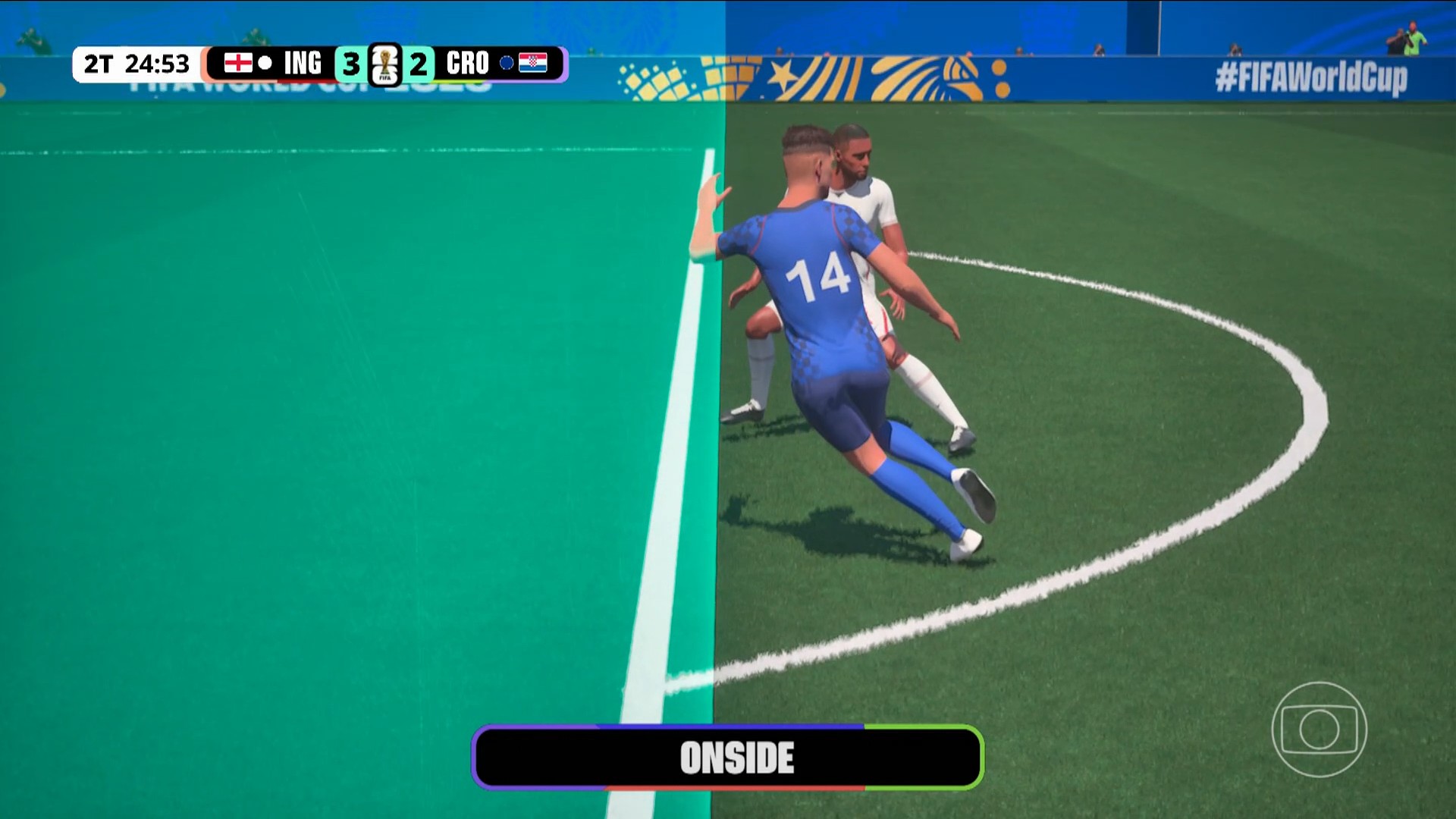
FIFA's spot-up reproduces possible offside plays
Disclosure/FIFA
The 2026 World Cup games gained a "team-up" system that allows for more faithful reproduction of possible offside situations.
Until then, animated replays showed players with the same size, which did not correspond exactly to the real play and could raise doubts in more complex moves.
Do you have any suggestions for a report? Send it to g1
In this World Cup, each athlete started to be represented with their real dimensions, which facilitates analysis in the VAR booth and provides more clarity for those watching the match.
Before the start of the tournament, the players from the 48 teams were photographed in a booth with 36 cameras with 4K resolution. The images helped to create a unique 3D avatar for each of them.
Now on g1
Each player stays in the booth for around 30 seconds, from the preparation time to capturing the photo itself, which takes less than a second, according to Lenovo, FIFA's partner in creating the system.
Then, artificial intelligence algorithms create animated versions that consider details such as the height and size of the athlete's feet, which is ignored in older models.
"It is possible to interpret texture, posture, movement and replication in the avatar. It's more than a 3D photo, it's effectively the replication of the player in a digital environment", said Valério Mateus, general manager of Services and Solutions at Lenovo for Latin America.
Players from the 48 teams were photographed in the booth before the start of the World Cup
Disclosure/Lenovo
The 3D avatar system does not determine whether or not a player is in an offside situation - this function remains with the referee. VAR -, but it helps those in the booth to make decisions more quickly.
"VAR has the possibility of looking to understand if there was a foot or a shoulder in front and rotating the image to see from another angle if there was a touch in a free kick, for example", said Valério.
The new "team strip" is also useful because it makes it clearer to fans why VAR took a certain decision, said FIFA's Director of Innovation, Johannes Holzmüller, at an event held by the entity at the beginning of June.
"We will improve 3D replays, where the players are really similar and it is obvious which ones are in an offside position", he stated.
Tira-teima was used in the match between England and Croatia
Reproduction/TV Globo
This system had already been tested in December 2025, in the match between Flamengo and Pyramids, from Egypt, valid for the third phase of the FIFA Intercontinental Cup.
In addition to avatars, the 2026 World Cup brings an evolution in the cameras used by referees. The recordings are now stabilized in real time using artificial intelligence.
As the referee moves abruptly, previous versions suffered from blurring and shaking, which was uncomfortable for those watching. With less balance, broadcasts can take better advantage of the angle of those on the field.
Teira-teima was used in the match between France and Senegal
Reproduction/TV Globo
In-booth photos allow scanning various angles of players to create animated versions
Reproduction
Source: G1