


Leia a noticia completa
Peru closes voting in the second round of the presidential election.
With 93% of the ballots counted, Roberto Sánchez took the lead in the presidential race and is ahead of Keiko Fujimori in the number of votes in the second round of the presidential elections in Peru.
✅ Follow the g1 international news channel on WhatsApp
According to the official count from the country's electoral body, after several hours with the count pointing to the conservative candidate winning the Presidency, the left-wing deputy turned the result around.
Sánchez has 50.008% of the votes, while Fujimori has 49.992%.
The conservative candidate was seen as the favorite in exit polls, but the deputy was expected to grow in the end, as he is strong in rural electoral areas, the last to be counted.
Due to the small difference, the result of the election remains undefined.
Keiko, daughter of the convicted former president Alberto Fujimori, came first in the first round, with 17.2% of valid votes. Sánchez won 12% of the valid votes in the first vote.
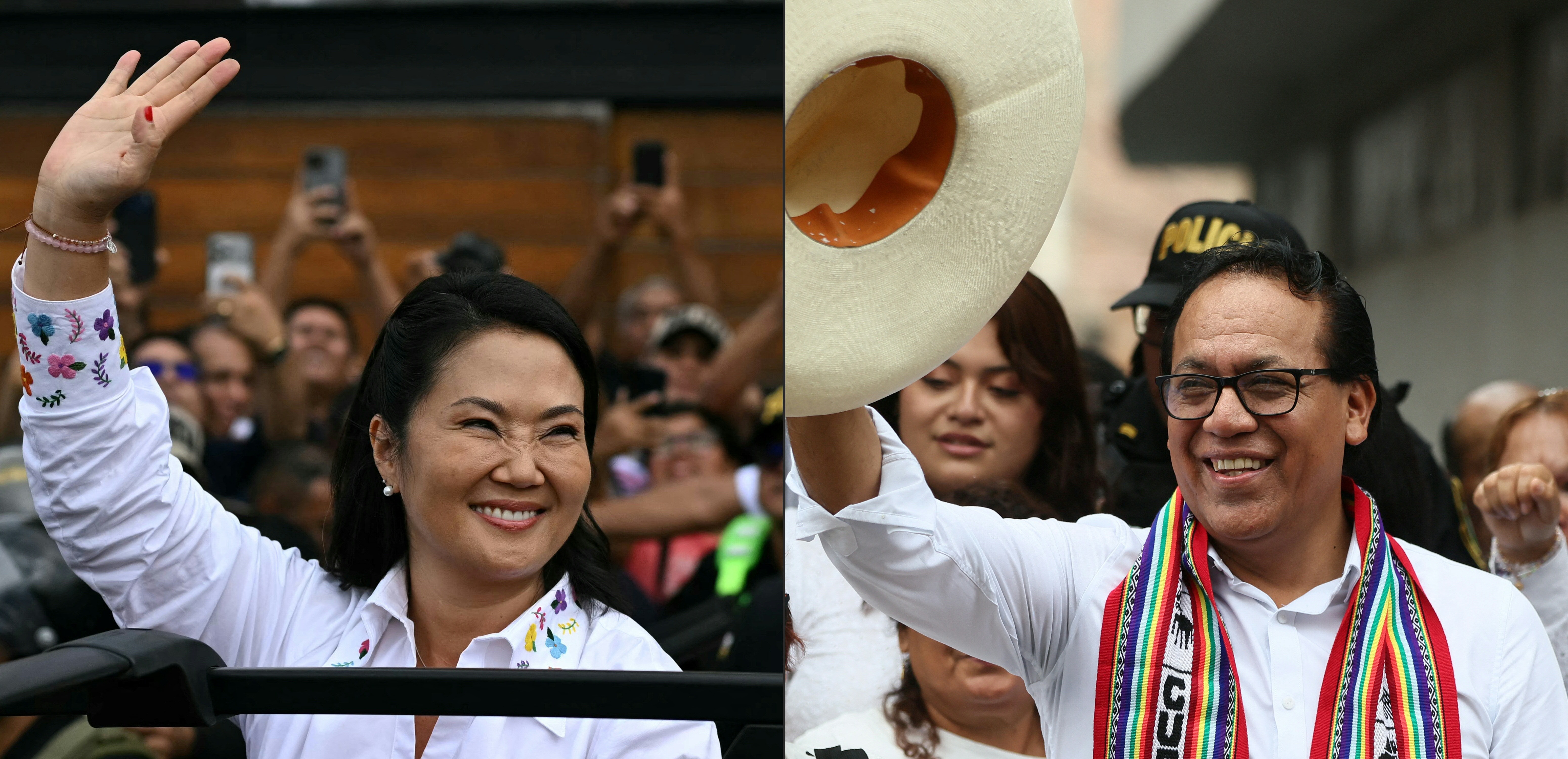
Montage shows candidates for the presidency of Peru Keiko Fujimori (right) and Roberto Sánchez on June 7, 2026, the day of voting in the second round
ERNESTO BENAVIDES / AFP
The polling stations were closed at 5 pm local time (7 pm Brasília time), after a journey without major incidents, unlike the chaotic first round, marked by technical failures and allegations of fraud.
Fragmented first round
The country went to the polls amid a fragmented political scenario, with a record number of presidential candidates in the country, 35 in total.
Lucas Berti, political scientist, researcher on Peru at the South American Political Observatory and executive coordinator of the International Relations and Global South Group, states that, in fact, what happened in these elections in the country did not come from a "vacuum".
"It is a symptom of a process of institutional delegitimization that has been happening in recent years in the country. And this, to the extent that elected presidents are unable to govern", he stated.
9 presidents in 10 years
Peru has had 9 presidents in 10 years. To give you an idea, presidential terms in Peru are 5 years. In other words, in democratic stability, the country would only have two presidents in the same period. However, the reality was different and some leaders did not last even 5 days in office.
"In these years, the leadership that lasted the longest was that of Dina Boluarte, who remained in power for almost three years. But, after displeasing the opposition led by Keiko's Fujimorist coalition in Congress, he also fell", says Berti
In addition, it is worth highlighting article 113 of the Peruvian Constitution, which states that a president can be overthrown due to "permanent moral or physical incapacity" - and those who evaluate this diagnosis are the parliamentarians.
So, by For example, if Congress simply doesn't like a law that the president is trying to pass, they can activate that article, vote and, in less than 24 hours, overthrow a president who was elected by the majority of the population.
For political scientist Berti, this ease of the process demonstrates the institutional fragility at play in Peru. According to him, in recent years, the Fujimorist coalition, with an absolute majority in Congress, has been articulating powers, whether in the Legislature, in the courts or in the judicial system.
Since 2008, Alberto Fujimori's daughter has led this Fujimorist current by founding the Fuerza Popular party and trying to reach the Executive Power in Peru. But that doesn't happen, explains Berti.
"Keiko lost the last three elections (2011, 2016 and 2021) in the second round, by very tight margins. And now in this election, in 2026, he goes to the second round with a larger margin of votes. Some institutes give an advantage to Keiko, others to Sánchez.
Which indicates one thing: the election will be difficult and the result is still open", says Berti.
Democracy in crisis: 'chronic distrust'
The consequence of this struggle between the Executive and Legislative branches in the country resulted not only in a deep political crisis, but also in the way the population sees democracy.
"The credibility of institutions is very low if we look at the last 10 years. And distrust in Congress exceeds 90%, especially during the process that would result in the fall of former president Dina Boluarte, in 2025", explains Berti.
The most recent data from the Latinobarómetro survey, which measures the level of democracy in Latin American countries, shows that Peru faces one of the lowest levels of trust in institutions compared to other countries in Latin America. There is what can be classified as "chronic distrust".
According to the data, 90% of Peruvians have little or no confidence in the government and Congress; and only 10% say they are satisfied with democracy. Furthermore, the survey also noted another dangerous feeling: indifference to politics or the type of government regime.
"There is a great ease in creating parties in Peru and they are parties called 'little institutionalized'. These are parties that do not have effective roots in a society, which is not a party that enters the dispute for 20, 40 years. But rather parties that appear and disappear, just as there is no loyalty between the candidates and the parties, who also change coalitions easily", explains Berti.
This whole scenario reinforces in voters the logic that candidates often arrive at an election without a solid base or without a known party. This ends up generating a reading of distrust and, often, disbelief and fear of the ease with which these elected people can fall.
*With information from Thais Fascina, from GloboNews
Source: G1
Elections in Peru: Roberto Sánchez turns on Keiko Fujimori with 94.4% of the votes counted
Peru closes voting in the second round of the presidential election.With 94.42% of the votes counted, Roberto Sánchez...
Demi Moore is the target of family dispute and accused of threatening ex-son-in-law
Actress Demi Moore, 63, was named in the legal dispute between her daughter, Rumer Willis, 37, and her ex-partner, mus...
Bitcoin rises and recovers part of the losses with the recovery of ETFs
Bitcoin rose on Monday afternoon, recovering part of the losses recorded the previous week. The market evaluates inves...
Toque agora.





Historias das musicas em destaque
 Historia da musica
On My Mind II: learn to play Anand Bhatt's song with a pop and engaging atmosphere
08/06/2026
On My Mind II, by Anand Bhatt, is a song with a pop, romantic and danceable atmosphere, bringing an immersive sound that can work very...
 Historia da musica
In Awe Of You: play an intense worship of Jesus Culture on the guitar
08/06/2026
In Awe Of You, by Jesus Culture, is a worship song with a deep atmosphere, worship lyrics and a musical construction aimed at moments o...
 Historia da musica
A Chance: learn to play a romantic song full of feeling
08/06/2026
A Chance, by Gutemberg Silveira, is a romantic song that talks about mistakes, forgiveness, regret and the possibility of starting love...
 Historia da musica
In Capernaum: learn to play a song of faith, miracle and overcoming on the guitar
08/06/2026
In Capernaum, by Alisson Santos, is a song marked by spiritual strength, biblical narrative and growing emotion. The song takes the lis...
 Historia da musica
At Canga: learn to play Jammil E Uma's hit Noites with a summer atmosphere
08/06/2026
"Na Canga", by Jammil E Uma Noites, is a song full of energy, sun, beach and high spirits. The song carries that contagious atmosphere...
 Historia da musica
Adorar: learn to play the Fluir song with emotion and presence
08/06/2026
"Adorar", by Fluir, is a praise song that translates in a few words a very strong feeling: the desire to prostrate oneself before God a...
 Historia da musica
It Is In Your Presence: learn to play this praise of surrender and adoration
08/06/2026
"Esta Em Tua Presença", by Cristiano Cruz, is a song of praise marked by a direct, deep and spiritual message. The song talks about the...
 Historia da musica
Nobody Explains God in Black and White and Gabriela Rocha: an inspiring figure for moments of worship
08/06/2026
Nobody Explains God is one of the most popular gospel songs of recent years. Performed by Preto no Branco with the participation of Gab...
 Historia da musica
Make a Miracle in Me by Régis Danese: a gospel song that marked generations
08/06/2026
Make a Miracle in Me is one of the best-known songs of Régis Danese's career. The song has become a true anthem of faith, hope and pers...
 Historia da musica
Lugar Secreto by Gabriela Rocha: a powerful worship chord for the guitar
08/06/2026
Lugar Secreto is one of the most impactful songs in Gabriela Rocha's repertoire. The song won over churches and worship ministries for...
Mais noticias para voce
 Noticia
08/06/2026
Disney hid Taylor Swift's participation in "Toy Story 5"; understand
The participation of singer Taylor Swift, 36, in "Toy Story 5" was kept confidential even by part of the team involved in the production of the animation. Accor...
 Noticia
08/06/2026
After shooting at police, vehicle invades condominium in Indaiatuba
A fleeing vehicle caused, in the early hours of this Monday (8), a shootout against the police and invaded a condominium of houses, in Indaiatuba, in the interi...
 Noticia
08/06/2026
Patrocinadora do time feminino do Corinthians faz campanha para lançamento de produto
By Meu Timão on 08 of June of 2026 at 17:32 Na tarde desta segunda-feira, a Vizzela, empresa de cosméticos que patrocina o time feminino do Corinthians desde 20...
 Noticia
08/06/2026
Governor of RJ says he hopes to recover R$1.4 billion from RioPrevidência investments in Master
The acting governor of Rio de Janeiro, Ricardo Couto, stated this Monday (8) that there is an expectation of recovering around R$ 1.4 billion of the resources t...
Noticia
08/06/2026
Elections in Peru: Roberto Sánchez turns on Keiko Fujimori with 94.3% of the votes counted
Peru closes voting in the second round of the presidential election.With 94.34% of the votes counted, Roberto Sánchez took the lead in the presidential race and...
 Noticia
08/06/2026
Coffee closes in fall in NY as the harvest advances in Brazil
Arabica coffee prices fell again on the New York Stock Exchange this Monday (8), pressured by the advance of the Brazilian harvest and the prospects of an incre...
Participe da conversa
Seu comentario ajuda a manter a discussao viva e ainda convida outros leitores a continuar navegando pelo portal.
Seja o primeiro a comentar esta noticia.