




Leia a noticia completa
This Saturday (6th) marks 82 years since D-Day, the first day of the landing in Normandy, which laid the foundation for the defeat of Nazi Germany by the Allies in the Second World War.
The invasion, codenamed Operation Overlord, involved tens of thousands of soldiers from countries such as the United States, United Kingdom and Canada, who landed on five stretches of the coast of Normandy, France, codenamed Utah, Omaha, Gold, Juno and Sword beaches.
Planning for D-Day began more than a year in advance, and the Allies carried out a massive military deception operation to confuse the Germans about when and where the invasion would take place.
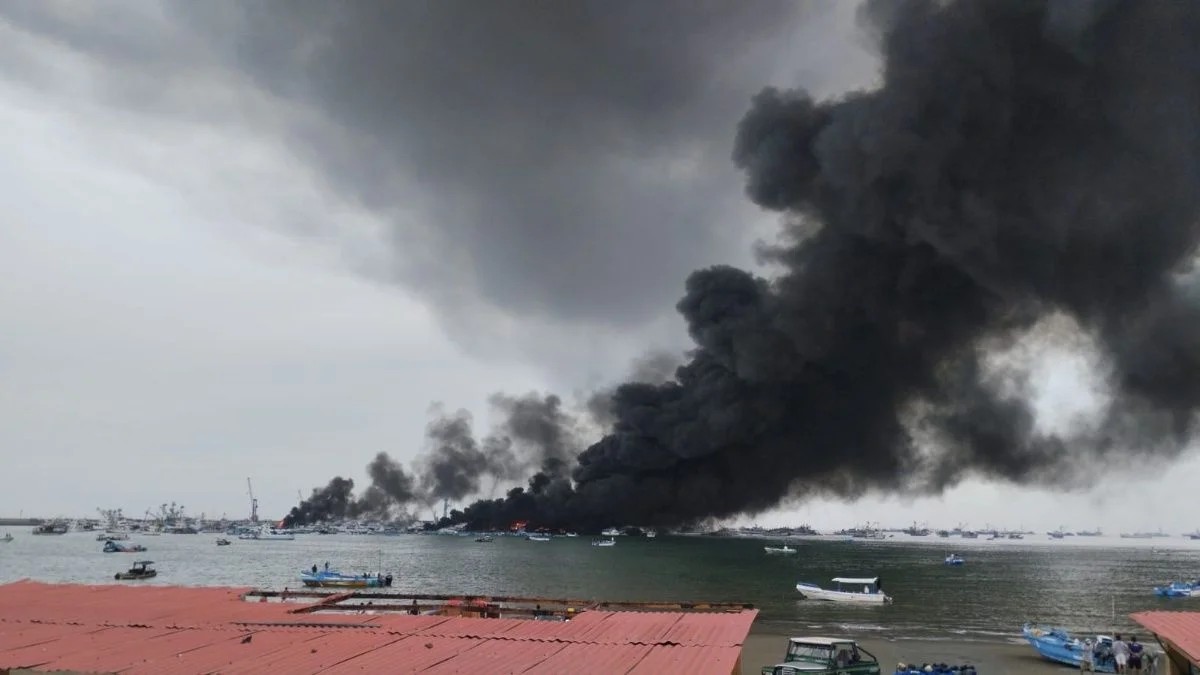
Fire in the port of Manta, Ecuador, affects at least 14 fishing boats
Fire in the port of Manta, Ecuador, hits several fishing boatsA fire hit fishing boats in the port of Manta, Ecuador,...
Brazil at the 2026 World Cup: see dates and times of the team's games
Carlo Ancelotti during the call-up of the Brazilian teamRafael Ribeiro/CBFBrazil and Egypt face each other this Saturd...
Shots injure police officers in operation to reopen highway in Bolivia
Bolivian police and armed forces cleared part of a major highway in San Julián, in the eastern region of Santa Cruz, o...
Understand what D-Day is.
When was D-Day?
The operation was originally scheduled to begin on June 5, 1944, when a full moon and low tides were expected to coincide with good weather conditions, but storms forced a 24-hour postponement. Allied divisions began landing on the five beaches at 6:30 on the morning of June 6.
What does "D-Day" mean?
The term "D-Day" was military code for the start of a major operation, with the first "D" being an abbreviation for "Day". This means that "D-Day" literally means "Day-Day".

Toque agora.



According to the Royal British Legion, the expression "D-Day" was already used with some frequency before the Allied invasion in June 1944. After that, however, the term became associated specifically with this event, and today "D-Day" is commonly understood as the beginning of Operation Overlord.
Which Allied countries took part?
D-Day featured unprecedented cooperation between international armed forces, with more than 2 million soldiers in the United Kingdom preparing for the invasion, according to the Imperial War Museums (IWM).
The majority of these soldiers were from the United States, United Kingdom and Canada, according to the IWM, but troops from Australia, Belgium, Czechoslovakia (now Czechia), France, Greece, the Netherlands, New Zealand, Norway, Rhodesia (now Zimbabwe) and Poland also participated in Operation Overlord.
What preparations were made?
The invasion by Allied troops was coordinated by air, land and sea, in an operation that can be described as an amphibious landing.
These actions were preceded by an extensive bombing campaign to damage German defenses, as well as the use of deception tactics.
Operation Bodyguard was an umbrella term for the strategy of deception that preceded the Allied invasion of Europe in June 1944. Operation Fortitude was a tactic within that strategy, specifically linked to the invasion of Normandy, and was intended to make Nazi Germany believe that the initial attacks on Normandy were just a distraction and that the real invasion would take place elsewhere.
According to the Imperial War Museums (IWM), Fortitude North was intended to deceive the Germans into believing that the Allies would attack Norway. Fortitude South was planned to convince the Germans that the Allies would invade Pas de Calais, a French region northeast of Normandy and closer to the United Kingdom.
What happened on D-Day?
United States troops were assigned to Utah Beach at the base of the Cotentin Peninsula and Omaha Beach at the northern end of the Normandy coast.
Then the British landed on Gold Beach, followed by the Canadians at Juno and finally the British again at Sword, the easternmost point of the invasion.
By midnight, troops had secured their beachheads and advanced further inland from Utah, Gold, Juno and Sword.
No entanto, nem todos os desembarques foram bem-sucedidos; US forces suffered significant losses at Omaha Beach, where strong currents diverted many vessels from their intended points, delaying and disrupting the invasion strategy.
Intense fire from German positions on the steep cliffs, which had not been effectively destroyed by Allied bombing before the invasion, also caused casualties.
How did the Germans try to defend themselves?
According to the IWM, Germany's reaction to Operation Overlord was "slow and confused".
Weather conditions on June 6 were still poor, many high-ranking commanders were not at their posts, and Operation Fortitude convinced Adolf Hitler that the invasion of Normandy was a diversionary maneuver before a larger attack on the Pas de Calais.
A força aérea alemã estava atuando em outros locais, combatendo operações de bombardeio dos Estados Unidos sobre a Alemanha. Seus navios de guerra estavam atracados em portos ou já haviam sido destruídos pelos Aliados. Isso deixou apenas o exército alemão para defender contra a Operação Overlord, segundo o Imperial War Museums (IWM).
In addition, the success of Operation Fortitude meant that many army units were kept away from the Normandy battlefield until July, as an attack on the Pas de Calais was still expected.
German troops defending coastal positions "did as much as could be expected of them", according to the IWM, before eventually being "silenced", allowing Allied forces to advance inland.
How many people died on D-Day?
On D-Day alone, around 4,440 Allied soldiers were confirmed dead, according to the Commonwealth War Graves Commission (CWGC), with more than 5,800 injured or missing.
Because Omaha Beach was the bloodiest landing site, the United States Army lost the most men in the amphibious landings. About 2,500 American soldiers died in beach raids and airborne operations on D-Day, according to the Commonwealth War Graves Commission (CWGC).
O número exato de baixas alemãs naquele dia é desconhecido, mas estima-se que esteja entre 4.000 e 9.000.
Who were the "Bedford Boys"?
Of the tens of thousands of soldiers who stormed the beaches of Normandy on D-Day, 44 were soldiers, sailors and airmen from Bedford, Virginia, in the United States.
Within minutes of arriving at Omaha Beach, 16 of these men were killed and four were injured. Another Bedford soldier was killed elsewhere on Omaha Beach, and three others were considered killed in action, bringing the Bedford death toll on D-Day to 20 men.
According to the National D-Day Memorial Foundation, Bedford had the largest known proportional loss of a single U.S. city on D-Day.
What happened after D-Day?
Despite having secured a foothold on the French coast on D-Day, Allied forces faced the risk that German bombing raids could drive them back into the sea.
They needed to increase the number of troops and equipment in Normandy more quickly than the Germans, allowing the invasion of mainland Europe to continue.
The Allies used their air power to slow the German advance towards Normandy, destroying bridges, railways and roads throughout the region. This allowed the Allies to gain full control of Normandy 77 days later and advance towards Paris, which was liberated in August 1944.
What was the impact of the operation on the war?
The United States Department of Defense calls D-Day the "successful beginning of the end of Hitler's tyrannical regime."
The Imperial War Museums (IWM) describes it as the "most significant victory of the Western Allies in the Second World War".
By managing to bring forces to Normandy, the Allies were able to begin their advance across northwestern Europe. Although World War II lasted almost another year in Europe, the success of Operation Overlord led to the liberation of France and allowed the Allies to fight the Germans in Nazi-occupied Europe.
The United States National World War II Museum states that a good way to understand the importance of D-Day is to imagine what would have happened if the operation had failed. According to the museum, another landing would not be possible for at least a year.
In this period, Hitler could have strengthened the coastal defenses of occupied Europe, developed aircraft and weapons, bombed the United Kingdom even more intensely and continued his campaign of extermination, the museum says.
Fighting by the Allies on the Western Front and by Soviet soldiers on the Eastern Front ultimately led to the defeat of the German Nazi forces.
On May 7, 1945, the German Third Reich signed an unconditional surrender in Reims, France. Victory in Europe Day (V-E Day) is celebrated the day after the armistice came into force.
Source: CNN

Historias das musicas em destaque
 Historia da musica
Theme from the Soap Opera Rei do Gado: learn to play a notable song from Brazilian music
05/06/2026
Theme from the soap opera Rei do Gado, performed by Orquestra da Terra in CifraNet, is a song that carries a strong Brazilian identity,...
 Historia da musica
For You Stay by Talita Ribeiro: learn to play a romantic song full of feeling
05/06/2026
Para Você Ficar, by Talita Ribeiro, is a romantic song that talks about vulnerability, reunion and the courage to declare a feeling eve...
 Historia da musica
Red Rubber Ball by Cyrkle: learn to play a pop classic with a light and nostalgic atmosphere
05/06/2026
Red Rubber Ball, by Cyrkle, is a song that crosses generations with its light, melodic and optimistic sound. Even though it is about fa...
 Historia da musica
It Makes It Rain by David Quinlan: learn to play a worship classic on guitar
05/06/2026
Faz Ver, by David Quinlan, is one of the best-known worship songs among Christian musicians who seek simple, intense and spiritual repe...
 Historia da musica
Bottle 600 of Netto and Henrique: learn to play a country tune full of emotion
05/06/2026
Garrafa 600, by Netto and Henrique, is one of those country songs that mix regret, longing and that bar table atmosphere that speaks di...
 Historia da musica
Heaven's Not For Saints: Learn to Play A-Ha's Hit and Understand What Makes This Song So Special
05/06/2026
A-Ha is one of the most memorable bands in the history of world pop, known for creating music that spans generations with engaging melo...
 Historia da musica
Psalm 107: learn to play Samara Lourenço in a song of gratitude
05/06/2026
Psalm 107, by Samara Lourenço, is a song of praise inspired by gratitude, God's faithfulness and the recognition of his wonders. The so...
 Historia da musica
Só Por Amor A Ti: learn to play Ana Paula Valadão in a song of dedication and faith
05/06/2026
Só Por Amor A Ti, by Ana Paula Valadão, is a profound song of praise, marked by delivery, obedience and devotion. The song talks about...
 Historia da musica
De Bem Com a Vida: learn to play Os Serranos in a happy and passionate song
05/06/2026
De Bem Com a Vida, by Os Serranos, is a light, lively and romantic song. With positive lyrics and a melody that conveys joy, the song i...
 Historia da musica
January 6, 2003: learn to play Fernando and Sorocaba on the guitar
05/06/2026
6 January 2003, by Fernando and Sorocaba, is a country song full of longing, memory and emotion. The lyrics talk about a date that was...
Mais noticias para voce
 Noticia
06/06/2026
Dua Lipa and Callum Turner get married in a luxurious party in Italy; see details
Singer Dua Lipa, 30, and actor Callum Turner, 36, got married in a luxurious ceremony, held in Sicily, an island in Italy, this Saturday (6). The vows were made...
 Noticia
06/06/2026
Vitória defeats Fortaleza and is five-time champion of the Copa do Nordeste
Vitória became champion of the Copa do Nordeste this Saturday (6). In the return game of the final of the regional competition, in Barradão, the Bahian team bea...
 Noticia
06/06/2026
Federation of Iran accuses US of "vindictive behavior" for denied visas
The Iranian Football Federation is accusing the United States of adopting "vindictive behavior" by denying visas to members of the administrative and management...
 Noticia
06/06/2026
Defender on loan from Corinthians wins the Copa do Nordeste against Filho do Terrão
By Matheus Fiuza on 06 de June de 2026 at 18:05 Cacá, defender loaned by Corinthians to Vitória, was champion of the Copa do Nordeste this Saturday afternoon. T...
06/06/2026
Brazilian government intensifies talks with the European Union to unlock negotiations on Brazilian meat
EU vetoes meat from Brazil from September 3rdThe Ministry of Foreign Affairs (MRE) intensified conversations with representatives of the European Union in an at...
Noticia
06/06/2026
Fire in the port of Manta, Ecuador, affects at least 15 fishing boats
Fire in the port of Manta, Ecuador, hits several fishing boatsA fire hit fishing boats in the port of Manta, Ecuador, this Saturday (6). A huge column of black...
Participe da conversa
Seu comentario ajuda a manter a discussao viva e ainda convida outros leitores a continuar navegando pelo portal.
Seja o primeiro a comentar esta noticia.