




Leia a noticia completa
The number of cases involving criminal organizations and militias has almost doubled in Brazil in the last five years, amid advancing discussions on strengthening the fight against factions inside and outside the country.
Data from the National Organized Crime Panel, of the CNJ (National Council of Justice), show that new criminal actions registered in the first instance jumped from 1,700, in 2020, to 3,300, in 2025, equivalent to an increase of 98%. The first level of the Judiciary is the initial stage of processing an action before it is analyzed by the courts.
The increase also appears in the volume of criminal actions pending in the same instance, that is, awaiting trial. Between 2020 and 2025, the number increased from 5 thousand to 13 thousand cases, an increase of 155.9%, according to data from the CNJ.

Quina: bettor from Cariacica, ES, wins prize of R$ 19 million alone; see dozens drawn
Porto Novo Lottery, in Cariacica, where a prize of R$ 19 million from Quina was wonReproduction/Google Street ViewA pl...
Market sees greater chance of maintaining interest rates after strong payroll
The intermediate and long peaks of future interest rates renewed their maximum this afternoon and reached the highest...
Ana Maria Braga rides the subway in New York for the first time: "Being beaten"
Ana Maria Braga, 77, rode the New York subway, in the United States, for the first time this Friday (5). In a humorous...
The CNJ monitors criminal actions under the Criminal Organizations Law, used to judge crimes committed by criminal organizations, including factions, militias and criminal associations.
If only this year's data is considered, 969 new criminal actions involving criminal organizations and militias were registered between January and April, according to the council. Another 13,400 criminal cases are still awaiting judgment - a volume higher than the stock of pending actions recorded in the entire year 2025.
US classification against factions
The increase in shares follows the growth of discussions about the classification and prosecution of criminal organizations in the country. Last week, the United States announced that PCC (Primeiro Comando da Capital) and CV (Comando Vermelho) will be classified as foreign terrorist organizations, a measure that will come into effect on June 5th.

Toque agora.




According to the North American government, the decision seeks to expand mechanisms to combat the financing and international activities of factions.
The measure, however, does not automatically change the legal framework of these groups in Brazil, since national legislation differentiates criminal organizations from terrorist groups.
Under the Brazilian Anti-Terrorism Law, terrorism requires ideological, religious, racial or discriminatory motivation, while factions such as PCC and CV are classified as criminal organizations aimed mainly at obtaining profit through illicit activities.
The Criminal Organizations Law establishes the criteria for identifying and punishing structured criminal groups that act in a coordinated manner. Under legislation, an organization is considered criminal when there is an association of four or more people who divide tasks and have the objective of obtaining an advantage through the commission of crimes.
Debate in the National Congress
The fight against organized crime has also gained space and strength within the National Congress. The day after the announcement that the PCC and the CV were classified as terrorist organizations by the United States, opposition deputies filed bills with changes to Brazil's legislation aimed at combating terrorism. In general terms, the proposals aim to reclassify terrorism in Brazilian territory and prohibit the entry of people linked to criminal organizations into the country.
In addition, legislation to combat crime in the country was recently changed through the Antifaction PL, approved by deputies and senators, and sanctioned by President Luiz Inácio Lula da Silva (PT) in March this year. The text expands mechanisms for financial suffocation of criminal organizations, toughens punishments and creates new tools to combat economic activities controlled by factions, such as illegal exploitation of services, clandestine trade and money laundering schemes.
The government also sent a PEC (proposed amendment to the Constitution) that discusses public security in the country. However, after being approved by the Chamber of Deputies, the text has been stuck in the Senate since March.
*Intern under the supervision of Mayara da Paz
PCC x CV: US representative talks about determining factions | LIVE CNN
Source: CNN

Historias das musicas em destaque
 Historia da musica
Theme from the Soap Opera Rei do Gado: learn to play a notable song from Brazilian music
05/06/2026
Theme from the soap opera Rei do Gado, performed by Orquestra da Terra in CifraNet, is a song that carries a strong Brazilian identity,...
 Historia da musica
For You Stay by Talita Ribeiro: learn to play a romantic song full of feeling
05/06/2026
Para Você Ficar, by Talita Ribeiro, is a romantic song that talks about vulnerability, reunion and the courage to declare a feeling eve...
 Historia da musica
Red Rubber Ball by Cyrkle: learn to play a pop classic with a light and nostalgic atmosphere
05/06/2026
Red Rubber Ball, by Cyrkle, is a song that crosses generations with its light, melodic and optimistic sound. Even though it is about fa...
 Historia da musica
It Makes It Rain by David Quinlan: learn to play a worship classic on guitar
05/06/2026
Faz Ver, by David Quinlan, is one of the best-known worship songs among Christian musicians who seek simple, intense and spiritual repe...
 Historia da musica
Bottle 600 of Netto and Henrique: learn to play a country tune full of emotion
05/06/2026
Garrafa 600, by Netto and Henrique, is one of those country songs that mix regret, longing and that bar table atmosphere that speaks di...
 Historia da musica
Heaven's Not For Saints: Learn to Play A-Ha's Hit and Understand What Makes This Song So Special
05/06/2026
A-Ha is one of the most memorable bands in the history of world pop, known for creating music that spans generations with engaging melo...
 Historia da musica
Psalm 107: learn to play Samara Lourenço in a song of gratitude
05/06/2026
Psalm 107, by Samara Lourenço, is a song of praise inspired by gratitude, God's faithfulness and the recognition of his wonders. The so...
 Historia da musica
Só Por Amor A Ti: learn to play Ana Paula Valadão in a song of dedication and faith
05/06/2026
Só Por Amor A Ti, by Ana Paula Valadão, is a profound song of praise, marked by delivery, obedience and devotion. The song talks about...
 Historia da musica
De Bem Com a Vida: learn to play Os Serranos in a happy and passionate song
05/06/2026
De Bem Com a Vida, by Os Serranos, is a light, lively and romantic song. With positive lyrics and a melody that conveys joy, the song i...
 Historia da musica
January 6, 2003: learn to play Fernando and Sorocaba on the guitar
05/06/2026
6 January 2003, by Fernando and Sorocaba, is a country song full of longing, memory and emotion. The lyrics talk about a date that was...
Mais noticias para voce
 Noticia
06/06/2026
Large fire hits warehouse in Guarulhos; see images
A large fire hit a commercial warehouse on Friday night (5), on Rua Guaporé, in the Itapegica neighborhood, in Guarulhos, Greater São Paulo. According to the Fi...
 Noticia
06/06/2026
James Handy's stepson formally charged with actor's murder
Prosecutors filed murder charges Friday against the man arrested in the fatal stabbing of veteran Hollywood actor James Handy, a familiar face in dozens of film...
 Noticia
06/06/2026
Tamires talks about plans after retirement, mentions memorable moments at Corinthians and praises Derby
- By Fabio Luigi / Central do Timão Editorial One of the main symbols of Brazilian women's football, left-back Tamires, 38 years old, who has an extensive caree...
 Noticia
06/06/2026
Quina today: results of contest 7043 and numbers drawn
Quina Resultg1See below the draw numbers for the Quina contest 7043 held this Friday (5):10 - 20 - 21 - 29 - 46Check the result of the Quina draw.See how many b...
 Noticia
06/06/2026
Lotofácil today: results of contest 3703 and numbers drawn
Lotofacil Resultg1See below the draw numbers for Lotofácil contest 3703 held this Friday (5):1 - 3 - 5 - 7 - 8 - 9 - 10 - 14 - 15 - 17 - 21 - 22 - 23 - 24 - 25C...
 Noticia
06/06/2026
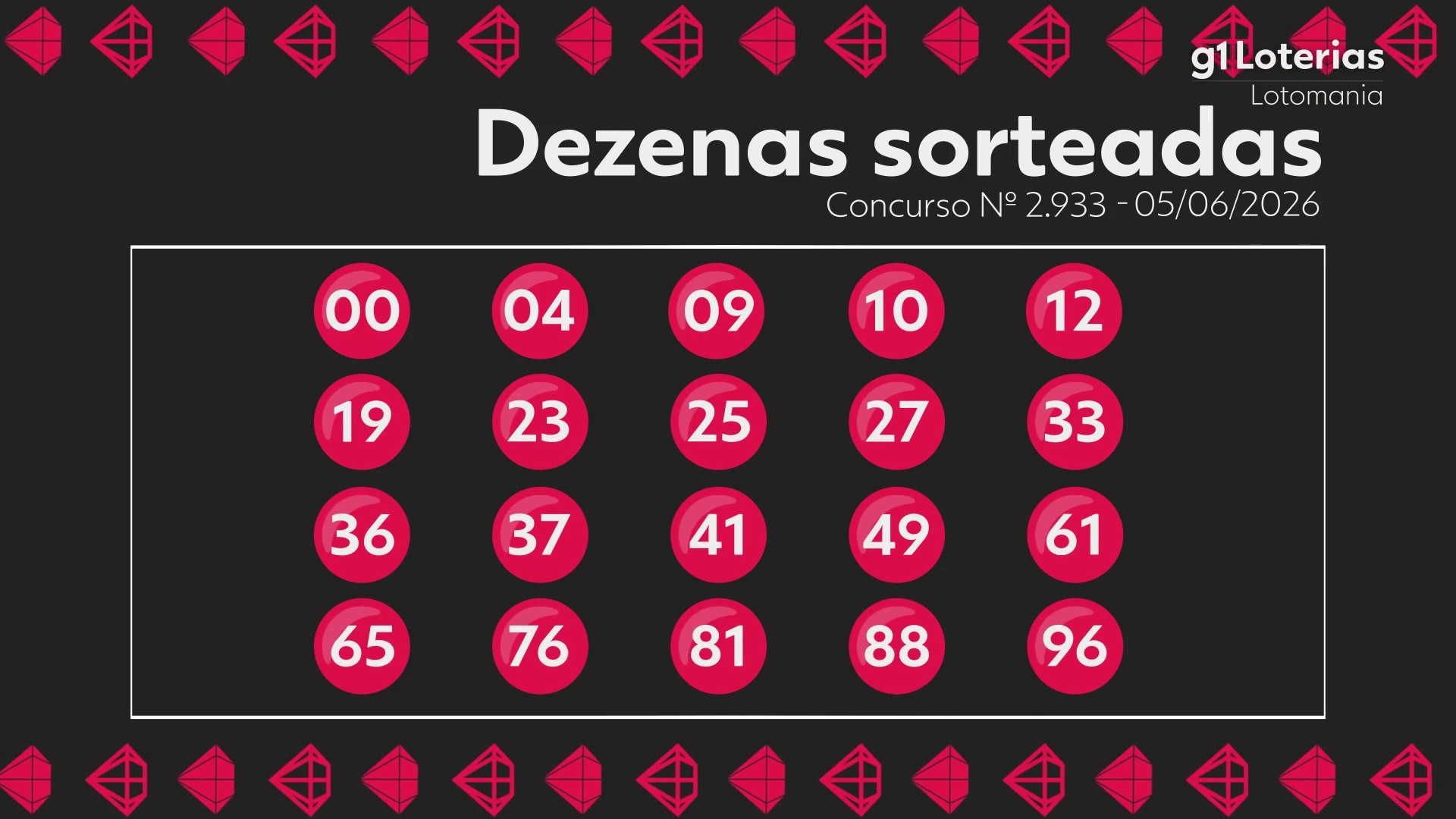
Lotomania today: results of contest 2933 and numbers drawn
Lotomania Resultg1See below the draw numbers for Lotomania contest 2933 held this Friday (5):0 - 4 - 9 - 10 - 12 - 19 - 23 - 25 - 27 - 33 - 36 - 37 - 41 - 49 -...
Participe da conversa
Seu comentario ajuda a manter a discussao viva e ainda convida outros leitores a continuar navegando pelo portal.
Seja o primeiro a comentar esta noticia.