



Leia a noticia completa
Zelle was created by banks in the USA
Getty Images
Amid criticism from Donald Trump's government against Pix, former federal deputy Eduardo Bolsonaro (PL-SP) suggested on Wednesday (3) that Brazil could "go to the negotiating table" when mentioning the use of Zelle, which he called "the American Pix".
On the TMC News channel, the son of former president Jair Bolsonaro said that the "USA has mechanisms very similar to Pix, such as Zelle."
"So you can go to a negotiation table with the Americans with good arguments", followed the impeached former deputy who has lived in the USA for over a year, making political articulations that seek to favor the Bolsonarist camp. 25% on Brazilian products.
"Brazil has unfairly harmed American companies that operate in competing electronic payment services, including through policies that favor its national champion, Pix", states the document of the commercial investigation launched against Brazil in July last year.
The American government accused the Brazilian Central Bank of playing a dual role in Pix - "as regulator and owner/operator" of Pix - creating a "conflict of interests, in the absence of adequate procedural safeguards".
American criticism they continue to cite the requirement for the use of Pix by financial institutions with more than 500,000 accounts and for the payment system to be displayed on the main screen of the banks' application in Brazil.
In the pre-campaign for re-election, President Luiz Inácio Lula da Silva (PT) has been using the argument that the United States and the Bolsonaro family would be against Pix.
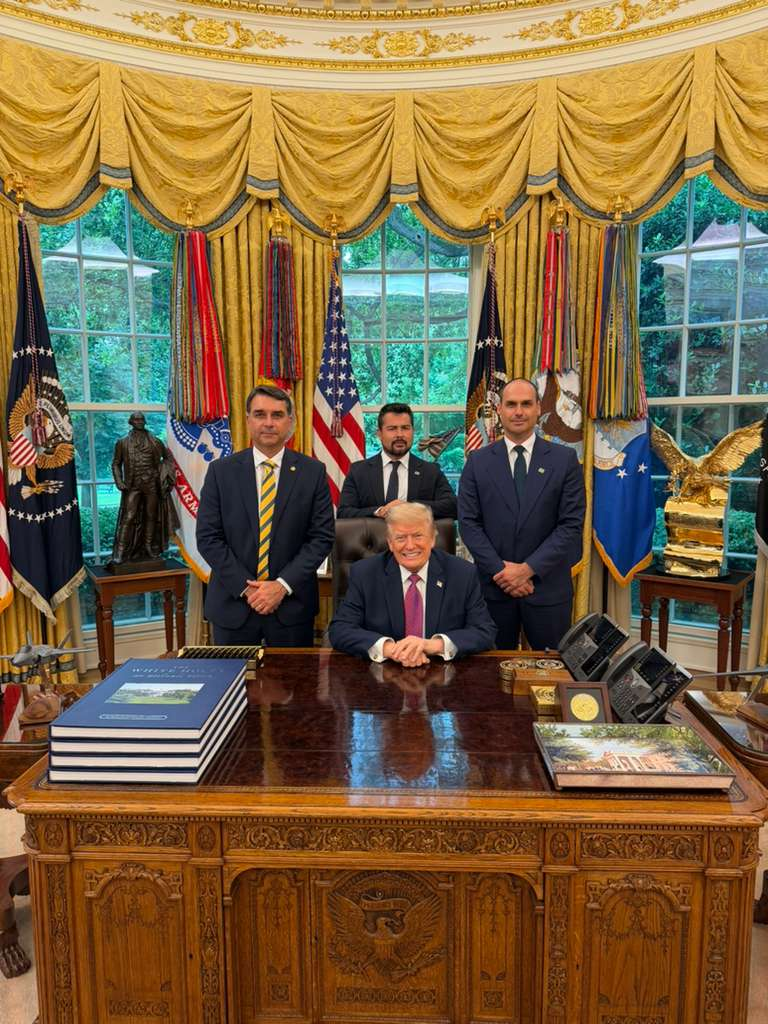
Flávio Bolsonaro, Eduardo Bolsonaro and Paulo Figueredo with Donald Trump
Disclosure
Senator and presidential candidate Flávio Bolsonaro (PL-RJ), in turn, has mentioned that Pix was launched in 2020, during the government of Jair Bolsonaro (PL) - despite the project having started during the Michel Temer (MDB) government, in 2018.
Eduardo Bolsonaro's statements have already had repercussions in the government camp, with PT deputies accusing the former president's children of acting against Brazil.
Deputy Lindbergh Farias (PT-RJ) called them "surrenders": "Eduardo Bolsonaro confesses that he wants to hand over our public and free Pix, operated by our Central Bank, to the Americans. We will not allow it."
The former minister already Gleisi Hoffmann (PT-PR), said that Eduardo "wants to exchange our Pix for the American system called Zelle, as a negotiating point to remove American taxation, which they helped articulate".
Pix was launched in 2020 and became the target of an investigation by the American government
Getty Images via BBC
What is Zelle and how does it compare to Pix
Unlike Pix - a public payment system, created and operated by the Brazilian Central Bank -, the Zelle is a private payment and transfer system, operated by American banks.
The service has been operated since 2017 by Early Warning Services, a company that is co-owned by seven of the largest American banks: Bank of America, Capital One, JPMorgan Chase, PNC Bank, Truist, U.S. Bank and Wells Fargo.
According to the company, Zelle is available in more than 2,400 banking applications in the country. In other words, the decision to use it or not depends on each bank.
In Brazil, participation in Pix is mandatory for all financial institutions authorized by the Central Bank with more than 500 thousand active accounts.
The American service announced that it reached 151 million registered users in 2024, including consumers and small businesses, making more than US$1 trillion (around R$5 trillion) in transfers that year.
Pix, in turn, is used by more than 170 million individuals in Brazil, or 80% of the country's population, handling R$35.4 trillion in transfers in 2025 alone.
CBS News, the BBC's U.S. partner, calls Zelle a "banking industry's response to the growing success of peer-to-peer payment services like PayPal," a global online payments platform separate from banks.
One limitation of services like PayPal, Venmo and Cash App is that users must use the same service to transfer money. With Zelle, anyone with a bank account at a participating financial institution can send money.
Like Pix, the American service allows a bank customer to quickly send funds to another person using just their email address or phone number. In Brazil, customers can also use their CPF or a "random key" for transfers.
According to Early Warning Services, the money is deposited directly into the bank account "within minutes". Pix is an instant service, which makes payments in seconds, being available 24 hours a day, 7 days a week, including on weekends and holidays.
Bank of America also highlights on its website that, "in some situations, the recipient's financial institution may cause a delay in processing the transfer" via Zelle.
Also according to Early Warning Services, "there are normally no fees for consumers to send or receive money through Zelle", but this is not a rule. It is possible that banks charge fees for transactions, so you need to check with financial institutions.
In Brazil, Pix is free for individuals, individual microentrepreneurs (MEIs) and individual entrepreneurs, and charges low fees for legal entities, which vary from 0.89% to 1.45% per transaction, depending on the bank, the volume of receipts and the channel used.
The limits for sending and receiving money through Zelle are defined by each participating bank or credit union.
On Pix, limits for individuals are defined by financial institutions, based on the user's risk profile and behavior.
In an article published in 2025 in which he praised Pix, Nobel Prize-winning American economist Paul Krugman said that "Pix is a kind of public version of Zelle."
"But Pix is much easier to use. And although Zelle is big, Pix has become simply huge, being used by 93% of Brazilian adults. It appears to be rapidly replacing cash and cards," wrote Krugman.
Following the mention of Pix in the report produced by the Office of the United States Trade Representative (USTR) this week, the Brazilian Federation of Banks (Febraban) defended the payment method and said that the conclusion of the US investigation stems from "incomplete information" about the objectives and functioning of the financial system.
"Pix is a payment infrastructure, and
It is an open and non-discriminatory model, with the participation of banks, fintechs, national and foreign financial institutions", stated the entity.
Febraban also pointed out that "there is no restriction on the entry of new participants, of any size or segment of the financial industry, as long as they operate in the national market".
Federal government post from July 2025: Lula's administration has sought to use episodes to try to improve its image
Federal Government
Why does PIX bother the Trump administration so much?
The mention of Pix in the report published by the USTR this week was not the first US attack on the payments system.
Pix was mentioned in another USTR report on March 31 in which the US lists what it considers to be trade barriers from more than 60 countries against American companies. At the time, the Brazilian government reacted and President Lula stated that "Pix is from Brazil".
In the report from March last year, however, the payments system was not mentioned directly, unlike what happened in this year.
A source heard by BBC News Brasil who is close to the negotiations between Brazil and the USA comments that one of the hypotheses for the toughening of tone now was the outcome of a recent meeting of the World Trade Organization (WTO) in which Brazil blocked a proposal from the USA and other countries to extend the moratorium on customs tariffs on electronic transmissions, which includes digital services such as streaming, software and games.
There is also the major defeat that Trump's tariffs suffered in the American judiciary in February this year, when the Supreme Court considered that the instrument that had been used to support the measures (the International Emergency Economic Powers Act, or IEEPA, for its acronym in English), did not actually authorize the American government to institute the tariffs.
In an article from March this year, two analysts from the American research center Brookings Institute pointed out that, in the face of From this setback, Section 301, used in the investigation against Brazil, could enter the American government's menu as an option to tax its commercial partners again.
On the financial sector side, jurist Camila Villard Duran draws attention to the expansion of Pix in Brazil, "which directly alters the competitive balance for American companies, such as Visa and Mastercard", but especially to the broader phenomenon in which it is inserted, of structural transformation and reorganization of the international monetary and financial order.
"Pix already It is not just an efficient payments system. It represents a model of public infrastructure, which reduces dependence on foreign private networks and concentrates, at the domestic level, jurisdictional control over data and financial flows", highlights Duran.
The professor points out that, in the USTR report, the US makes similar criticisms to those made against Brazil in countries such as India, Thailand and Pakistan, "where national public policies promote domestic payment systems, impose data localization requirements or create regulatory barriers to the activities of foreign companies".
"In all In these cases, the US argument is similar: such measures would be discriminatory and restrict the access of American companies to national markets", she adds.
From economics to politics
Given this panorama, Duran assesses that the pressure on Pix and payment systems in other countries is also linked to an even broader issue, of sovereignty.
What is at stake, she says, is no longer just competition between companies, "but control over infrastructures considered critical".
"In my research, so much about the creation of the digital euro as well as the projects of alternative platforms for cross-border financial transactions, I note that the idea of 'monetary sovereignty' is moving very quickly from the autonomy of monetary policy to jurisdictional control over payment infrastructures and the monetary data they generate", says Duran.
"Currency, in the digital economy, increasingly becomes information and, in this context, jurisdictional control over this data becomes a central element of monetary power state."
With information from Vitor Tavares, Thais Carrança, Daniel Gallas and Camilla Veras Motta, from BBC News Brasil in São Paulo and London.
Source: G1
Four decapitated bodies are left in front of Congress in the Mexican state of Guerrero
Police officers found four decapitated bodies inside an abandoned vehicle next to the Congress in the Mexican state of...
Colombian court bans presidential candidate from wearing national team shirt as 'symbol'
Abelardo de la Espriella, candidate for president of ColombiaAFPA judge banned the ultra-right candidate for president...
US expands sanctions against Cuban president and targets Castro family members
Miguel Díaz-Canel, president of Cuba, says he is ready to defend the country from the United States during the 65th an...

Toque agora.




Historias das musicas em destaque
 Historia da musica
My Immortal: Learn to Play One of Evanescence's Greatest Classics on Guitar
04/06/2026
Few songs have managed to cross generations with the same emotional intensity as "My Immortal", one of Evanescence's biggest hits. Rele...
 Historia da musica
Learn to Play This Song on Guitar and Develop New Musical Techniques
04/06/2026
Some songs have the ability to mark moments, awaken emotions and remain alive in listeners' memories for many years. When a song brings...
 Historia da musica
Lugar Secreto by Gabriela Rocha is a song that combines technique, emotion and spirituality
04/06/2026
Lugar Secreto is one of Gabriela Rocha's best-known songs and has become a reference in the Brazilian gospel scene. His message talks a...
 Historia da musica
The Nights by Avicii is a perfect song for those who like motivating and energetic music.
04/06/2026
The Nights is one of the most inspiring songs released by Avicii. With a message about enjoying life, creating memories and living each...
 Historia da musica
Ninguém Explica Deus é uma cifra emocionante para quem deseja tocar uma mensagem de fé e reflexão
04/06/2026
Ninguém Explica Deus se tornou uma das músicas religiosas mais populares dos últimos anos. Interpretada por Preto no Branco, a canção a...
 Historia da musica
More Than Words by Extreme continues to be one of the most sought after songs by guitar lovers
04/06/2026
More Than Words is a true international music classic. Recorded by the band Extreme, the song won over generations for its simplicity,...
 Historia da musica
Almighty God by Fhop Music is a worship track that strengthens technique and musical sensitivity
04/06/2026
Almighty God is a worship song that highlights divine greatness, sovereignty and power. Performed by Fhop Music, the song presents a mo...
 Historia da musica
Água Viva by Eliana Ribeiro is an inspiring song for musicians who want to play songs of faith and hope
04/06/2026
Água Viva is one of Eliana Ribeiro's best-known songs and carries a deep message of spirituality, confidence and renewal. With an excit...
 Historia da musica
Castle on the Hill by Ed Sheeran is an excellent song for developing rhythm and interpretation on the guitar
04/06/2026
Castle on the Hill is one of the most popular songs of Ed Sheeran's career and has won over millions of listeners around the world for...
 Historia da musica
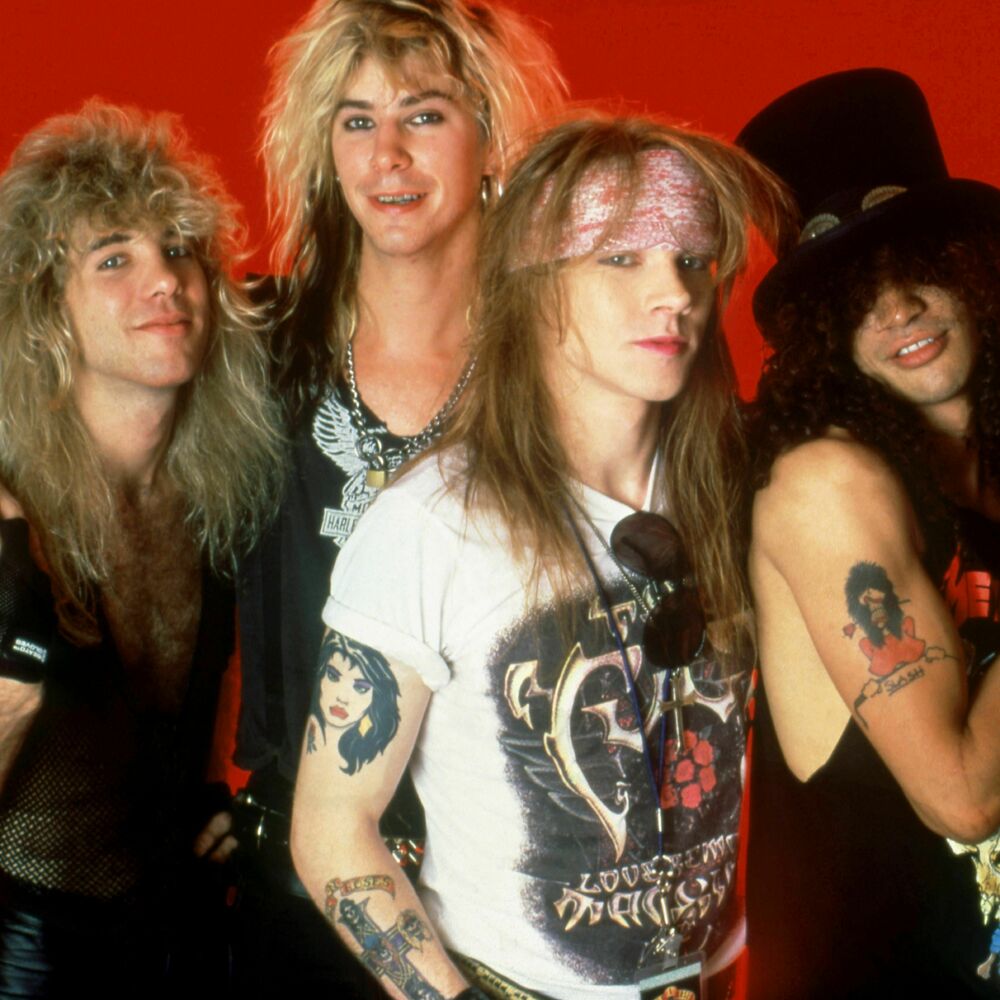
Pretty Tied Up by Guns N Roses is a rock song to train your attitude and grip on the guitar
04/06/2026
Pretty Tied Up, by Guns N Roses, is a song with the raw and striking energy of hard rock. The song carries the band's identity, with ri...
Mais noticias para voce
 Noticia
04/06/2026
Google Maps spots mysterious object near the location of an alleged UFO in PR
After the repercussions of the alleged UFO case involving influencer Mayk Leão, internet users began sharing on social media an image from Google Maps that woul...
 Noticia
04/06/2026
Government officials ask US deputies to investigate the Bolsonaro and Master clan
Deputies from the government base of President Luiz Inácio Lula da Silva (PT) sent a formal request to parliamentarians from the United States Democratic Party...
 Noticia
04/06/2026
Oil closes down 3% as tensions ease in the Middle East
Oil closed lower this Thursday (4), pressured by the prospect of reduced tensions in the Middle East after the apparent progress in negotiations between Israel...
 Noticia
04/06/2026
Young autistic man who disappeared is found in a fast food chain in Lapa
The 28-year-old autistic girl, identified as Laura Heringer Venicio - who disappeared on Tuesday night (2) - was found this Thursday (4), in a fast food chain i...
 Noticia
04/06/2026
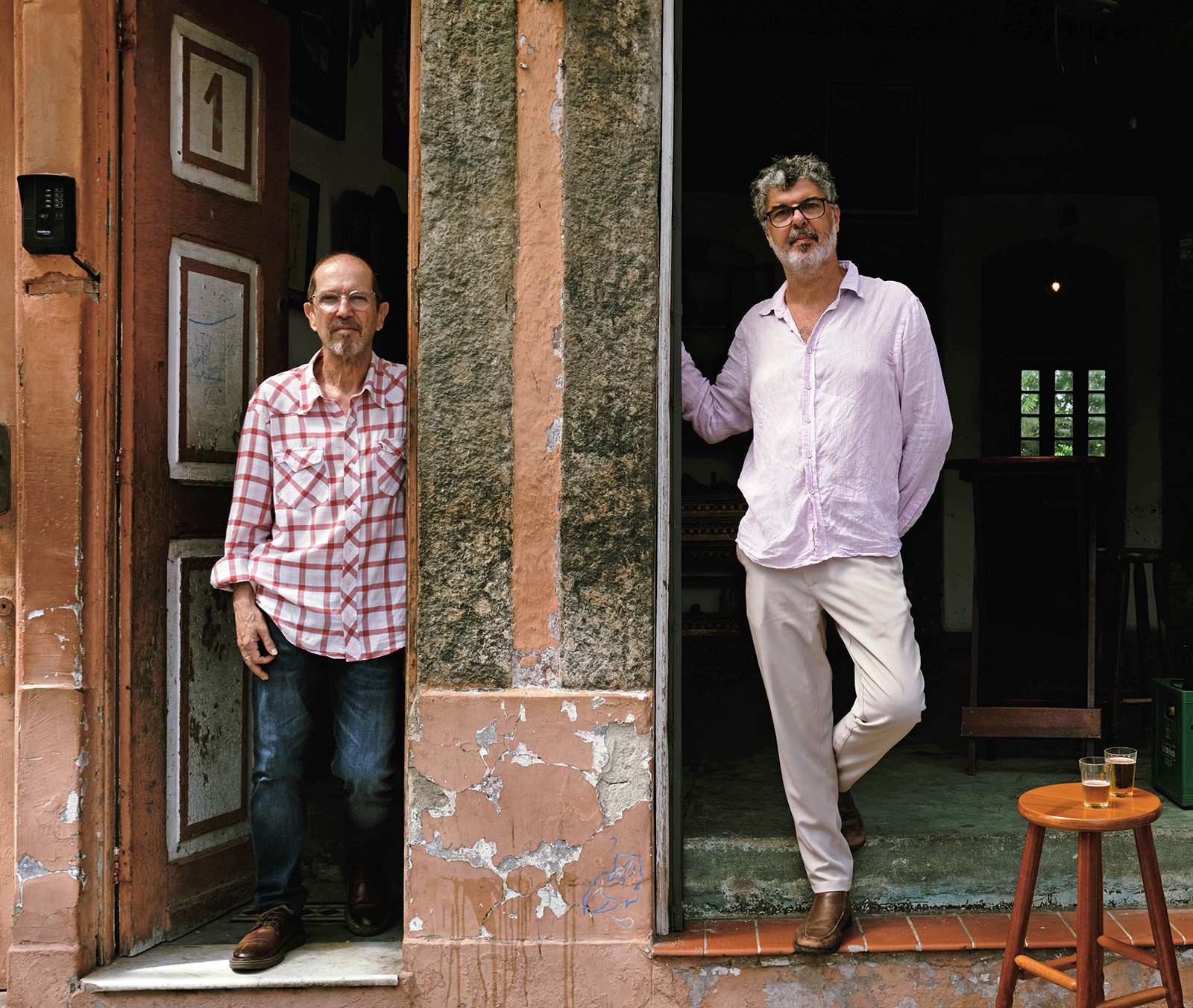
Rodrigo Lessa and Edu Neves move from choro to jazz on the Latin route of their original album 'Tempo de samba'
Rodrigo Lessa (on the left) and Eduardo Neves play nine original songs in a modern gafieira atmosphere on the album 'Tempo de samba'Disclosure♫ NEWS♬ "Tempo de...
 Noticia
04/06/2026
FIFA bans vuvuzelas and bottles at the 2026 World Cup; see rules
Fans who want to bring more noise and excitement to World Cup games will have to leave their vuvuzelas at home. FIFA has banned the use of traditional plastic h...
Participe da conversa
Seu comentario ajuda a manter a discussao viva e ainda convida outros leitores a continuar navegando pelo portal.
Seja o primeiro a comentar esta noticia.