



Leia a noticia completa
General strike against labor reform paralyzes public services in Portugal
A general strike in Portugal interrupted transport services, closed schools and affected hospitals this Wednesday (3), in protest against a broad labor reform proposed by the center-right government of Prime Minister Luís Montenegro.
The strike, called by the country's main union federation, the CGTP, is the second general strike in six months and occurs as the government tries to approve the "Work XXI" package, a reform that foresees more than 50 changes to the Portuguese Labor Code.
Download GloboPop to watch short vertical videos from Globo
According to the government, the changes seek to modernize labor legislation, increase productivity and improve the competitiveness of the Portuguese economy.
The unions claim that the proposal reduces workers' rights, increases the precariousness of employment and facilitates layoffs.
Check out what is at stake and the main changes foreseen in Portugal's labor law.
Longer temporary contracts
One of the main changes proposed is the extension of the maximum duration of temporary employment contracts.
Fixed-term contract: has an end date defined from the beginning. Currently, it can last a maximum of two years. Under the reform, the limit would increase to three years.
Indefinite-term contracts: these are employment contracts with an indefinite term, such as replacing an employee on leave or in projects with an indefinite duration. Today, this contract can last up to four years. The proposal extends the period to five years.
For unions, the measure increases the insecurity of workers, especially young people, by extending periods of employment without a permanent contract.
Flexibilization of outsourcing
The reform also eliminates current restrictions on the use of outsourcing after collective layoffs or the elimination of jobs.
Today, Portuguese companies that carry out layoffs of this type are prevented from hiring outsourced services for the same functions for a specified period. The proposal revokes this limitation.
According to the government, the change increases companies' flexibility. The trade union centrals claim that the measure facilitates the replacement of their own workers with cheaper outsourced labor.
Return of the individual time bank
Another point that generated a strong reaction from the unions is the reintroduction of the individual time bank, which was abolished in 2019.
Under the proposal, the worker will be able to work up to two overtime hours per day, increasing the weekly working hours to up to 50 hours. The annual limit will be 150 additional hours, with compensation through subsequent time off.
The reform also changes the rules of the collective time bank, a mechanism that allows companies to compensate overtime with future time off.
Currently, the adoption of this regime for a group of workers depends on approval in a referendum held among the affected employees.
With the new proposal, this consultation would no longer be necessary: if at least 75% of workers agree with the agreement, the company will be able to apply the time bank to the entire group, including those who voted against or did not participate in the decision.
Unions argue that the change reduces workers' individual decision-making power over their own working hours.
Rules for dismissals
The proposal also changes the rules for cases in which the Portuguese courts consider a dismissal to be illegal. Today, in Portugal, when a court concludes that a worker was dismissed irregularly, the general rule is that he has the right to return to his job.
Only micro-companies can replace this reinstatement with the payment of compensation.
With the reform, companies of any size will be able to choose to compensate the worker instead of readmitting him, even after a court decision in favor of the employee.
According to the government, the change gives companies more flexibility and reduces conflicts in work relationships.
As compensation, it increases the minimum value of compensation paid in these cases.
The package also simplifies disciplinary and dismissal procedures for small and medium-sized companies, reducing bureaucratic requirements and formal steps in employee dismissal processes. Critics of the reform claim that the changes weaken protection against unjustified dismissals, while the government argues that they make the job market more agile and competitive.
Remote work and new forms of work
The Portuguese government's project also makes the rules on remote work (or teleworking) more flexible, allowing greater adoption of hybrid models and reducing some administrative requirements.
Among the main proposals are:
The reform also makes the rules of teleworking more flexible, which is now officially called "remote work".
In cases of a hybrid regime, the contract must specify the proportion between remote and in-person working days.
The worker may also temporarily change the location from which he carries out his activities only by informing the employer. The change will come into effect automatically if the company does not present a written objection, replacing the current rule, which requires agreement between the two parties.
In addition, the proposal eliminates the requirement for specific medical examinations before adopting remote work. According to the government, the objective is to adapt the legislation to new forms of work that emerged after the digitalization of the economy and the expansion of home office.
The proposal also provides for reinforcement of the so-called "right to disconnection", a principle that seeks to protect workers from professional contacts outside working hours.
Artificial intelligence in the workplace
One of the novelties of the Portuguese labor reform is the inclusion of specific rules for the use of artificial intelligence (AI) in the workplace.
The government states that the measure seeks to adapt legislation to the challenges of the so-called Economy 4.0 and expand the adoption of new technologies by companies.
According to the Executive, Portugal still has a level of use of artificial intelligence lower than the European Union average, which would justify the modernization of labor rules.
The main change envisaged is the requirement for mandatory human supervision in decisions made with the help of algorithms or AI systems.
According to the proposal, companies will not be able to rely exclusively on automated tools to define issues related to personnel management.
The requirement applies especially to processes considered sensitive, such as recruitment and selection of candidates, performance evaluations and dismissals. In these cases, there must always be a human responsible person monitoring and validating the decisions.
The reform also introduces algorithmic regulation mechanisms, with the aim of increasing transparency regarding the use of automated systems in work management and preventing important decisions from being taken without supervision or clear criteria.
According to the Portuguese government, the changes seek to reconcile the adoption of new technologies with the protection of workers' rights in an increasingly digitalized labor market.
Parental leave and benefits
Among the measures are the payment of 100% of shared parental leave in the first six months, the expansion of mandatory parental leave from 14 to 30 days and the creation of specific leaves in cases of termination of pregnancy.
Broader parental leave: the reform provides that parents who share leave to care for the baby will receive 100% of their salary during the first six months of leave.
Furthermore, the mandatory leave for parents after the birth of their child will increase from 14 to 30 days.
Leave in case of termination of pregnancy: the proposal creates a specific period of absence from work for women who suffer termination of pregnancy, guaranteeing labor protection during that time.
Installed payment of benefits: in Portugal, workers normally receive a holiday bonus and a Christmas bonus, equivalent to extra payments throughout the year. Under the reform, the employee will be able to choose to receive these amounts in monthly installments, along with their salary, instead of receiving larger amounts on specific dates.
Two extra days linked to vacation: workers will be able to request up to two additional days of rest per year, associated with the vacation period. These days can be used to extend or bring forward vacations.
What remains for the reform to come into effect
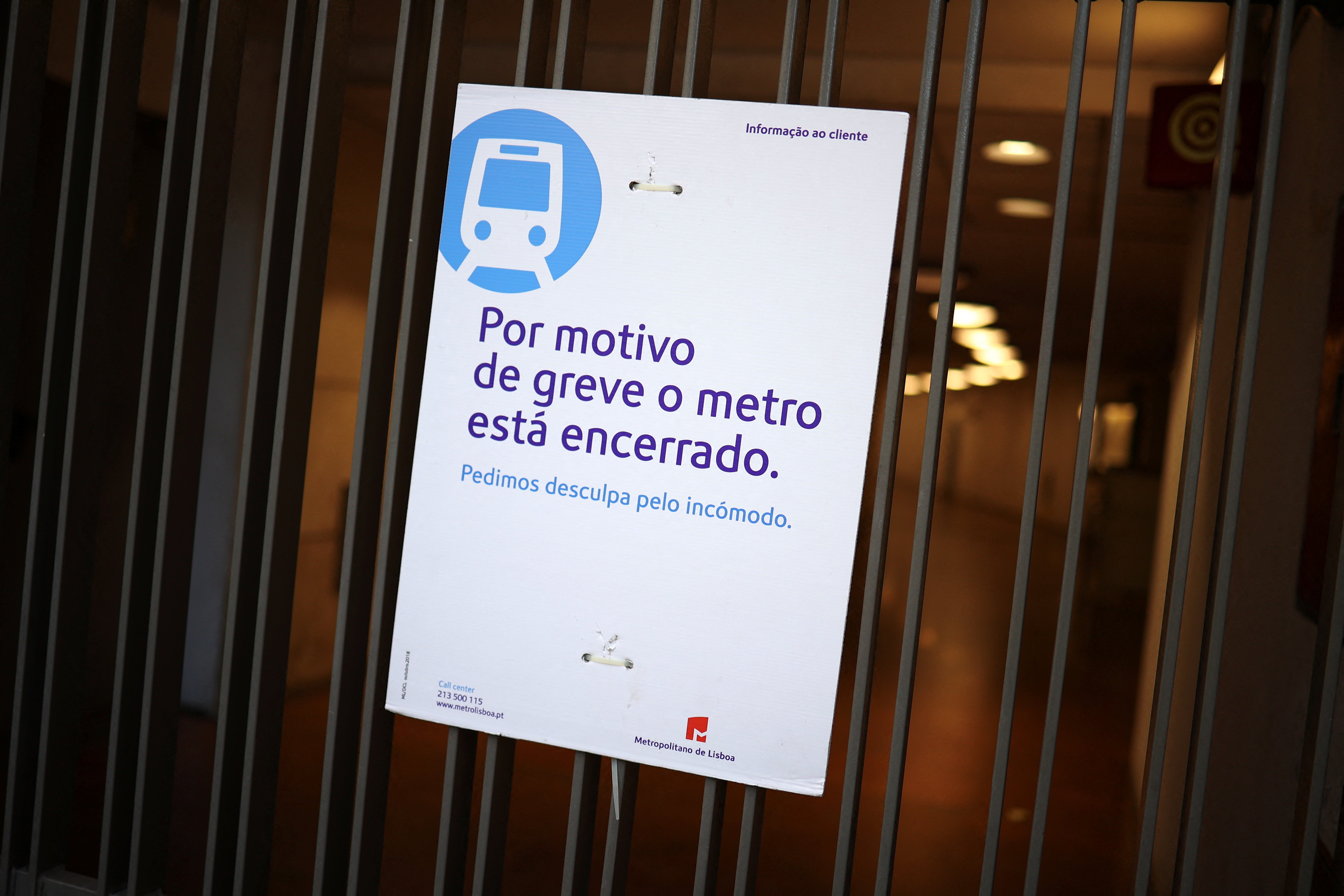
Metro entrance closed in Lisbon, Portugal
REUTERS/Pedro Nunes
After nine months of negotiations without consensus with unions and employers, the government approved the reform package in May and sent it to the Assembly of the Republic. The project still needs to be analyzed and voted on by deputies to come into force.
Montenegro hopes to obtain approval from Parliament in the coming weeks, counting on the support of the right-wing Chega party.
The general strike in Portugal is the second national mobilization against labor reform in less than six months. The first took place in December 2025 and marked the first general strike in Portugal since the protests against austerity measures recorded in 2013.
However, Prime Minister Luís Montenegro defends the reform and states that the changes are necessary to increase the productivity and competitiveness of the Portuguese economy.
According to him, the country has one of the strictest labor laws among members of the Organization for Economic Co-operation and Development (OECD), which limits the ability of companies to adapt to market changes.
The general strike, which began this Wednesday (3), had impacts on several sectors in Portugal.
There were flight cancellations and delays, interruptions in rail transport and urban public transport, school closures and reduced service in hospitals and public offices.
Airlines operating routes between Brazil and Portugal, such as TAP, Azul and Latam, also registered changes in their operations due to the strike. (see more about the impacts)
*With information from RFI and international agencies
Source: G1

Drone explodes in port in Romania; VIDEO shows detonation
See the moment when a drone explodes in a port in RomaniaThe self-detonation of a maritime drone caused a large explos...
Israeli army orders evacuation of Lebanon residents amid attacks
The Arab spokesman for the Israel Defense Forces issued warnings this Friday (5) to residents of parts of southern Leb...
Almost 500 kg of drugs valued at R$10 million are seized in SP
Almost 500 kg of drugs hidden in a refrigerated truck were seized, on Thursday afternoon (4), on the Washington Luís h...

Toque agora.



Historias das musicas em destaque
 Historia da musica
Psalm 107: learn to play Samara Lourenço in a song of gratitude
05/06/2026
Psalm 107, by Samara Lourenço, is a song of praise inspired by gratitude, God's faithfulness and the recognition of his wonders. The so...
 Historia da musica
Só Por Amor A Ti: learn to play Ana Paula Valadão in a song of dedication and faith
05/06/2026
Só Por Amor A Ti, by Ana Paula Valadão, is a profound song of praise, marked by delivery, obedience and devotion. The song talks about...
 Historia da musica
De Bem Com a Vida: learn to play Os Serranos in a happy and passionate song
05/06/2026
De Bem Com a Vida, by Os Serranos, is a light, lively and romantic song. With positive lyrics and a melody that conveys joy, the song i...
 Historia da musica
January 6, 2003: learn to play Fernando and Sorocaba on the guitar
05/06/2026
6 January 2003, by Fernando and Sorocaba, is a country song full of longing, memory and emotion. The lyrics talk about a date that was...
 Historia da musica
Savior: learn to play Billy Bob Thornton in a strong, reflective song
05/06/2026
Savior, by Billy Bob Thornton, is a song with a deep atmosphere, reflective lyrics and a sound that combines emotion, narrative and int...
 Historia da musica
Garden In The City: learn to play Melanie with a light and expressive chord
05/06/2026
Garden In The City, by Melanie, brings a delicate, artistic atmosphere full of personality. It is an ideal song for those who like song...
 Historia da musica
Aceto Mi Derrota: learn to play the emotional song by Marco Antonio Solis
05/06/2026
Aceto Mi Derrota, by Marco Antonio Solis, is an intense, romantic song full of feeling. With an interpretation marked by the pain of pa...
 Historia da musica
It's Luxury Only: learn to play Ary Barroso's classic samba on the guitar
05/06/2026
É Luxo Só, by Ary Barroso, is one of those songs that carries the soul of Brazilian samba in every chord. With an elegant rhythm, strik...
 Historia da musica
My Immortal: Learn to Play One of Evanescence's Greatest Classics on Guitar
04/06/2026
Few songs have managed to cross generations with the same emotional intensity as "My Immortal", one of Evanescence's biggest hits. Rele...
 Historia da musica
Learn to Play This Song on Guitar and Develop New Musical Techniques
04/06/2026
Some songs have the ability to mark moments, awaken emotions and remain alive in listeners' memories for many years. When a song brings...
Mais noticias para voce
 Noticia
05/06/2026
Leonardo mocks an employee's request for time off during the World Cup: "Are you going to play?"
Leonardo has been making waves on social media after being asked by one of his employees about taking time off when the Brazilian team is on the field at the Wo...
 Noticia
05/06/2026
Corinthians visits Mirassol to start the Paulista U20 campaign
By Marcelo Nascimento on 05 de June de 2026 at 09:31 This Friday, Corinthians plays its first game for the 2026 Paulista Sub-20 Championship. The black and whit...
 Noticia
05/06/2026
Pitty Appears in a Bikini Inspired by Abaporu, Delights Fans and Goes Viral with Rare Clicks on the Beach
Pitty once again made waves on social media by sharing rare footage of a moment of rest on a deserted beach. Always discreet when it comes to her personal life,...
/https://i.s3.glbimg.com/v1/AUTH_59edd422c0c84a879bd37670ae4f538a/internal_photos/bs/2026/T/v/kIvyRKStasvz7onALFag/shakira-em-copacabana-foto-panlo-porciuncula-afp.jpg) Noticia
Noticia
05/06/2026
Shakira will be the attraction of one of the three opening ceremonies of the World Cup; Anitta will also give a presentation
Singer Shakira will perform in Mexico City at the first of the three World Cup opening ceremonies.The Colombian singer will perform "Dai Dai", the tournament's...
 Noticia
05/06/2026
Amid uncertainty over ceasefire, 4 people die in attack in Lebanon
Israeli attacks killed four people in southern Lebanon this Friday (5), according to the Lebanese state news agency NNA. The attacks, which took place in the ci...
 Noticia
05/06/2026
Exclusive: Santos has an agreement with a company to build a new CT at the base
Marcelo Teixeira, president of Santos, told CNN Brasil that the club has an agreement with a company to build a new Training Center for the youth category. On t...
Participe da conversa
Seu comentario ajuda a manter a discussao viva e ainda convida outros leitores a continuar navegando pelo portal.
Seja o primeiro a comentar esta noticia.