


Leia a noticia completa
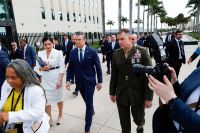
There is a scene that sums up the state of Iran's war better than any official statement. On Thursday (28), American and Iranian negotiators signed an MoU (memorandum of understanding) to extend the ceasefire for 60 days and reopen talks on the nuclear program.
On the same day, the United States bombed drones and an Iranian launch site near the Strait of Hormuz, Iran fired at an American base in Kuwait, and Kuwait intercepted a missile. The agreement was born by being violated.
And, a detail that is not small, Donald Trump has not yet signed it. He asked for "a few days to think." Tehran, in turn, warned that any Western narrative about a "finalized" agreement is worthless until it officially informs the Pakistani mediator.
João Fonseca analyzes victory over Ruud: "I wasn't that crazy"
João Fonseca celebrated qualifying for the Roland Garros quarter-finals after his victory over Casper Ruud this Sunday...
João Fonseca reveals feeling of victory in Slam under the presence of Guga
João Fonseca continues to write his name in the history of world tennis. The 19-year-old defeated Norwegian Casper Ruu...
Rock In Rio announces new ticket option with area in front of the stage
Rock In Rio announced a change in ticket options for the next edition, which will take place between the first weekend...
This is the faithful portrait of May 2026: there is neither full war nor peace, there is a tense interregnum that the oil market has already priced as optimism (Brent fell below US$91 on Friday, accumulating a fall of around 15% in the month) and that the commanders on the ground treat as a mere pause to recharge.
The war that began on February 28 is not the "Twelve Day War" of June 2025. It is something else, of another magnitude.
The US and Israel launched Operation Epic Fury (Roaring Lion, in the Israeli code name) during nuclear negotiations still ongoing, in the month of Ramadan, and the opening salvo killed the supreme leader himself, Ali Khamenei. Iran responded with Operation True Promise IV, which its state media dubbed the "Ramadan War."
Toque agora.


Mojtaba Khamenei was designated successor on March 8. There was a Pakistan-brokered ceasefire on April 8, which collapsed at the Islamabad Talks. Since April 13, a "double blockade" has been in effect: the American Navy blocks Iran, and Iran blocks the Persian Gulf. It is this impasse that the 60-day MoU attempts to unlock.
The point that the news here simplifies as "Iran closed the strait" is, in fact, a sovereignty dispute with implications for the law of the sea.
Tehran doesn't just want to reopen Hormuz. It wants to institutionalize control that it did not have before the war, proposing joint management with Oman, since the navigable channel passes through the territorial waters of both countries.
Under the Maritime Convention, tolls cannot be charged for passage through an international strait, but it is possible to charge for "services" provided to vessels - and it is exactly this loophole that Iran is working on.
The idea is older than it seems. From the middle of the 15th century until 1857, Denmark charged the so-called Sound Dues to every ship that crossed the Øresund Strait, at the entrance to the Baltic, a tax that King Eric of Pomerania invented and which was only abolished by the Copenhagen Convention, when the maritime powers paid the Danish crown a lump sum indemnity to get rid of it once and for all.
Tehran is reinventing the Danish toll with 21st century vocabulary. It's called an "environmental tax", not a toll, and the difference is purely semantic. The US rejects any form of Iranian control.
The revealing detail, little commented on outside the region: Treasury Secretary Scott Bessent threatened to sanction Oman, a close ally of Washington, if the sultanate facilitates the collection. When you need to threaten your own ally to sustain your position, the problem is no longer military. It became regional architecture.
The MoU provides for "unrestricted" passage and the removal of Iranian mines within 30 days, but the text itself contradicts itself: CNN points out differences over whether it includes the withdrawal of American forces and the end of the blockade of Iranian ports. Tehran says yes. Washington denies it.
Meanwhile, tens of thousands of seafarers remain stranded along the canal, war insurance premiums remain prohibitive, and GPS jamming persists.
It is worth remembering the scale of the shock.
At its peak in March, the blockade took about 20% out of global oil trade and forced Gulf producers to cut close to 10 million barrels/day, with Brent hitting $119.50 on March 9, the highest since 2022.
The US went so far as to temporarily lift restrictions on the purchase of Russian oil to ease prices, an irony that speaks volumes about the urgency.
The story that hardly circulates in Brazil is that of the Gulf monarchies, which had been normalizing relations with Tehran and were targeted anyway. Bahrain, Kuwait, Qatar, Saudi Arabia, the UAE and Jordan have received Iranian missiles and drones. Qatar became the first Arab country to shoot down Iranian aircraft (two Su-24 bombers), and yet Doha publicly denied having "joined the campaign against Iran", in a diplomacy of balance that is difficult to sustain.
There was friendly fire of embarrassing proportions: a Kuwaiti Air Force F/A-18 shot down three American F-15E fighters. And, in a fact that defines the Arab position, UN Security Council Resolution 2817 condemned the Iranian reprisals against the Gulf countries, and not the American-Israeli attacks that started it all.
When Yemen's Houthis entered the war on March 28 and threatened to close Bab al-Mandeb as well, it became clear what was at stake: not an Iran-Israel conflict, but the shattering of the entire Gulf security architecture.
Understand what the Abraham Accords are that Trump requires countries to sign
For the Brazilian reader, the war is "USA, Israel and Iran". The European reading is different. The E3 (UK, France and Germany) committed to "proportional defensive measures". A naval coalition was formed around Cyprus: Italy, the Netherlands and Spain sent ships; Greece, frigates and F-16; Ireland offered.
The British base of Akrotiri, in Cyprus, was hit by a drone. Iranian missiles were intercepted by the NATO (North Atlantic Treaty Organization) integrated defense over Turkish territory on at least three occasions (Dörtyol, in Hatay; Gaziantep; and near Incirlik, in Adana), with Secretary-General Mark Rutte reaffirming the commitment to defend Turkey.
American B-1 and B-52 bombers positioned themselves in Fairford, United Kingdom, and Ramstein, Germany. A French soldier died in a drone attack on a base in Iraqi Kurdistan, a death confirmed by Emmanuel Macron.
The most telling episode, however, was one of refusal: on March 16, both European NATO allies and China rejected Donald Trump's appeal to help reopen Hormuz, leading the president to call the decision a "very foolish mistake." It was the first time in a long time that Brussels and Beijing converged against Washington in an active theater of war.
Inside, Iran lives under restriction.
The opening cyberattacks took down the country's internet for more than 60 hours, with connectivity falling to 1% of normal, and access remains rationed to government-approved users.
The war was preceded by the return of sanctions via the "snapback" mechanism in September 2025 and the collapse of the rial, which Bessent celebrated in December as the "grand culmination" of maximum pressure, in addition to the massacres of protesters in January 2026.
On the nuclear front, it is worth separating what the IAEA (International Atomic Energy Agency) actually says from what is attributed to it: the agency classifies the Iranian program as "ambitious", complains about the blocking of inspections of bombed sites, but claims that there is no evidence of ongoing armamentization.
The British and American reading describes Tehran's strategy as nuclear hedging: maintaining the technical infrastructure to assemble a weapon in the short term without actually producing it.
The most incisive assessments go further: the stockpile of enriched uranium would be bargaining leverage, and Iran would be willing to dilute or export it in exchange for sanctions relief and security guarantees.
Not by chance, sources linked to the negotiation claim that Tehran would have managed to include in the MoU the release of around US$12 billion, half of its frozen assets abroad.
There is also a civilizational cost that is rarely mentioned: UNESCO (United Nations Educational, Scientific and Cultural Organization) and Blue Shield International have classified damage to protected sites, from Golestan Palace to the Chehel Sotoun pavilion and monuments in Isfahan, as a war crime.
A methodological warning that every honest analyst needs to make. The numbers are fog. The US, Israel and Iran have imposed heavy censorship, and specific victims and events are difficult to independently verify. Iran reports around 3,468 deaths, while human rights organizations say 3,636. The US and Israel estimate more than 6,000 Iranian military personnel have been killed. The Iranian government itself estimates the economic loss at between US$300 billion and US$1 trillion.
For Brazil, the immediate effect is ambiguous, and the 2026 election raises the stakes. Brent jumped 22.9% in the first 30 days of war and, although it fell to close to US$90 with optimism about the truce, volatility benefited Petrobras and PRIO and helped drive the Ibovespa to a record high of around 194 thousand points in April.
As the State is a large shareholder of the state-owned company, the high Brent improves dividends and the fiscal picture. The problem is the transfer.
Brazil imports gasoline, diesel and fertilizers (much of it from the Middle East), and the privatization of refineries such as RLAM (Landulpho Alves Refinery) reduced Petrobras' ability to cushion prices, as noted by Adriano Pires, from CBIE (Brazilian Infrastructure Center).
In an election year, the historic temptation to artificially hold fuel resurfaces, deteriorating the state-owned company's accounts, while the energy shock overlaps with American tariff protectionism and creates grounds for stagflation (Coface is already talking about pressure on the basic food basket heading into the 2026/27 harvest).
The optimistic counterpoint, recalled by Ineep (Institute for Strategic Studies of Petroleum, Natural Gas and Biofuels): with 80% of Hormuz's oil going to Asia, the drop in supply from the Middle East opens up space for Petrobras to expand exports to China, which may be able to "hold off" the Iranian absence for around two months.
The important question is not whether Trump signs the MoU. It's whether the incentive structure allows it to last. Iran wants to transform Hormuz into a permanent sovereign asset.
The US wants the strait open, uranium enriched outside the country and the nuclear program closed, three conditions that Tehran treats as negotiable in phases, not as a block.
In the middle, there are the Arabs targeted by the neighbor they courted, a Europe that discovered itself exposed without having chosen, and a China that prefers the stability of the oil flow to any alignment.
As long as each isolated incident, a drone here, a missile in Kuwait there, reactivates the risk premium in Brent, the truce will continue to be what it is today: real enough to move markets, fragile enough not to remove anyone from their combat post.
Analysis: Iran's nuclear program remains uncertain in negotiations | WW
* Thiago de Aragão is CEO of Arko Internacional
Source: CNN

Historias das musicas em destaque
 Historia da musica
Learn to play Polly by Nirvana: the dark number that marked generations on the guitar
31/05/2026
Polly, by Nirvana, is one of those songs that seems simple at first listen, but carries enormous weight in each chord. With a raw, dire...
 Historia da musica
Learn to play "Vida Louca Vida" by Cazuza on the guitar: the song that transformed poetry into freedom
31/05/2026
Few songs in Cazuza's career manage to convey as much emotional intensity as "Vida Louca Vida". With deep verses and a striking interpr...
 Historia da musica
Learn to play Anna Júlia on the guitar: the song that made millions learn music and marked an entire generation
31/05/2026
Few Brazilian songs have managed to cross as many generations as "Anna Júlia", a big hit by the band Los Hermanos. Released in 1999, th...
 Historia da musica
Learn to play Coming Around Again, by Carly Simon: the perfect song to get emotional on the guitar
30/05/2026
Coming Around Again, by Carly Simon, is one of those songs that seems simple at first listen, but carries enormous emotional strength....
 Historia da musica
Learn to play "All The Things You Are" on the guitar and discover why this classic crosses generations
30/05/2026
Few songs manage to convey as much elegance, romanticism and sophistication as "All The Things You Are". Recorded by several artists ov...
 Historia da musica
Learn how to play "Say Goodnight" by Beat Crusaders and discover why this melody wins over anime and rock fans to this day
30/05/2026
"Say Goodnight" is one of those songs that manages to convey emotion without needing exaggeration. With a melancholic atmosphere, but a...
 Historia da musica
Learn to play "Bad Obsession" by Guns N' Roses and discover the riff that marked a generation of rock
29/05/2026
Few songs manage to convey as much intensity and personality as "Bad Obsession". Released on the album Use Your Illusion I in 1991, the...
 Historia da musica
Learn to play Pelo Poder do Teu Amor, by Aline Barros, on the guitar
29/05/2026
For the Power of Your Love is one of those songs that crosses generations within gospel music because it speaks directly to the heart o...
 Historia da musica
Learn to play Ressuscita-me: the song by Aline Barros that moves you on the guitar
29/05/2026
Ressuscita me, by Aline Barros, is one of those songs that seem to be born from a deep request for a fresh start. The song talks about...
 Historia da musica
Learn to play Black by Pearl Jam: the exciting number that every guitarist needs to feel
28/05/2026
Black, by Pearl Jam, is one of those songs that seems to come straight from a painful memory. The song talks about loss, love that is i...
Mais noticias para voce
 Noticia
31/05/2026
Dua Lipa's wedding dress was inspired by Mick Jagger's bride
Singer Dua Lipa and actor Callum Turner tied the knot this Sunday (31) at the Old Maylebone Town Hall, in London. The voice of "Houdini" surprised by choosing a...
 Noticia
31/05/2026
Abel Ferreira is direct about controversial moves in Palmeiras x Chapecoense
Palmeiras suffered, but beat Chapecoense 1-0 in a duel full of tension and controversy this Sunday (31), in the 18th round of Series A of the Brazilian Champion...
 Noticia
31/05/2026
Rayan scores a great goal and adds for Brazil against Panama; look
The Brazilian Football Team extended the score to 3-1 against the Panamanian Football Team this Sunday (31), in a friendly preparatory match for the 2026 FIFA W...
Noticia
31/05/2026
João Fonseca surpasses Guga and is the youngest Brazilian in the quarterfinals of a Slam
Brazilian tennis won a historic chapter this Sunday (31). At 19 years, 9 months and 10 days, João Fonseca became the youngest Brazilian in the Open Era to reach...
 Noticia
31/05/2026
Lucas Paquetá scores Brazil's fourth goal against Panama; look
Brazil thrashes Panama this Sunday (31), in a friendly preparatory match for the 2026 World Cup. The fourth goal for Carlo Ancelotti's team was scored by Lucas...
 Noticia
31/05/2026
Fiscal deficit is a challenge for Colombia's next government, says economist
Colombia holds the first round of new presidential elections this Sunday (31). The three favorite candidates are: Iván Cepeda, representing the Colombian left;...
Participe da conversa
Seu comentario ajuda a manter a discussao viva e ainda convida outros leitores a continuar navegando pelo portal.
Seja o primeiro a comentar esta noticia.