



Leia a noticia completa
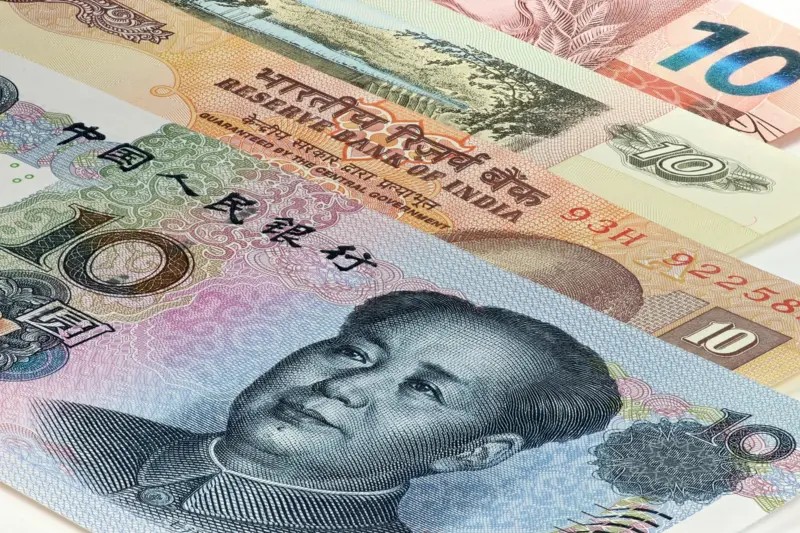
Some currencies fell, others held steady, and some proved more resilient - like the Chinese yuan - during the Iran war.
Getty Images
When the US and Israel war with Iran erupted in late February, it wasn't just the Middle East that felt the consequences.
As the conflict disrupted commercial shipping and the flow of goods around the world, oil prices rose, driving up inflation and shaking global markets.
How often happens in times of uncertainty, some investors have moved away from potentially riskier investments in emerging markets, placing their money in the US dollar, which is traditionally seen as a safe haven.
This has had an impact on many currencies - some have plummeted in value, while others have proved more volatile and some have even appreciated.
While the price of oil "affects everyone... currency fluctuations can amplify or dampen this effect", says economist André Perfeito, from the consultancy APCE.
So, when combined with other factors that also affect the economy, what do these exchange rate fluctuations mean for different countries and their citizens?
With rising oil prices, financial markets are projecting inflation above 5% this year
The hardest hit
The value of the currency can affect the price of everyday items, such as food
Bloomberg via Getty Images
Countries that import a large part of their energy, especially oil, are among those whose currencies have come under pressure.
They include India, Indonesia, the Philippines, Thailand and Egypt, which have faced new pressures from rising fuel costs and persistent foreign exchange shortages.
As investors moved money into US dollars, demand for these currencies fell and their value weakened, which in turn raised the cost of repaying debt issued in dollars.
Oil and other products - which were affected by the transport blockage in the Strait of Hormuz - are also generally priced in dollars.
As a currency loses value, imports become relatively more expensive, affecting everything from energy to plastics and fertilizers.
This impacts the price of food and everyday items in stores.
In India, the rupee has fallen about 5% against the US dollar since the start of the war and has reached repeated record lows as oil prices have risen.
The Indian currency was already weakening before the conflict, and the impact of the war intensified this trend.
Some central banks responded by raising interest rates and selling some of their US dollar reserves to support the value of their currencies.
The Bank of Indonesia has taken both of these steps, repeatedly selling dollars and buying its own currency, the Indonesian rupiah, to increase demand for it.
When interest rates rise, it means people get a higher return on their savings, but it also means higher payments on debts such as loans and mortgage payments.
Volatile and trending higher
The Russian ruble has been one of the best-performing currencies against the U.S. dollar since the start of the war with Iran, in large part because the Russia is a major oil producer
Bloomberg via Getty Images
Another group of currencies has been more volatile, with sharp swings in both directions.
Countries such as South Africa, Colombia, Chile and Mexico fall into this category.
These currencies often react sharply to global market mood: They weaken when investors seek safe havens like the dollar, but can recover quickly when commodity prices rise or appetite for risk rises. returns.
Some energy exporters, including Brazil and Malaysia, partially benefited from higher oil prices, which boosted export revenues and sustained investor interest.
Banks including Goldman Sachs and Bank of America highlighted strong demand for Brazilian government bonds and company shares in reports to clients in April. Goldman Sachs names Brazil as its top emerging market pick.
However, Martín Castellano, head of Latin America research at the Institute of International Finance, says higher energy prices could increase inflation in Brazil, delaying interest rate cuts and affecting capital flows.
Brazil also imports refined products such as gasoline and diesel, raising fuel costs in the country.
The Brazilian real has strengthened in part due to higher prices in the oil
Getty Images
Additionally, political uncertainty ahead of October's presidential election "will increase the risk premium on the exchange rate," XP economist Luiza Pinese wrote in a recent report.
A distinct group of currencies has remained more resilient for different reasons.
The Chinese currency has remained relatively stable, supported in part by capital controls and policy interventions that limit sharp fluctuations. These include restrictions on the flow of money into and out of the country and direct central bank interventions to closely manage the yuan's exchange rate.
The Russian ruble, one of the best-performing currencies against the dollar since the start of the Iran war, has also been supported by high energy revenues and tight capital controls, including measures that require exporters to convert foreign profits into rubles and limit the flow of money out of the country.
What about developed economies?
The Australian dollar has been less volatile, largely because Australia is a major exporter of commodities, particularly iron ore
Bloomberg via Getty Images
Currencies traditionally considered safe havens strengthened at the start of the crisis as investors sought safety. The US dollar and Swiss franc reached peaks before retreating to levels similar to those seen before the war.
Oil-linked currencies such as the Norwegian krone have received a significant boost from rising crude oil prices.
The Japanese yen, however, has not behaved like a typical safe-haven currency and has weakened, in part because Japan relies heavily on imported energy.
The Canadian and Australian dollars have also benefited from stronger prices for the commodities their countries export, such as crude oil, gas, metals, iron ore and coal, although concerns about global growth and trade tensions have limited those gains.
The euro and sterling have also had their own bouts of volatility, driven by concerns about higher energy costs, persistent inflation and slowing growth across Europe.
What happens now?
Economists say that while the initial airstrikes on Iran drove investors to safer assets and strengthened the dollar, the greenback has since weakened, which could help emerging markets.
"A weaker dollar normally "It means easier monetary conditions, more room for interest rate cuts in developing countries and lower risk aversion - all favorable to emerging markets," say economists at British global investment firm AllianceBernstein in a recent report. Continued disruptions from the Iran war are pushing the global economy into its "adverse" scenario, marked by a combination of weak growth and higher inflation.
In this scenario - where oil prices remain high, inflation becomes less stable and financial conditions become more restrictive - global growth could fall to 2.5% with inflation rising to 5.4%, compared to the fund's current forecast of 3.1% with 4.4% inflation.
The IMF has also outlined a more severe scenario, in which global growth falls to 2% and inflation exceeds 6%. The IMF is expected to update its forecasts again in July.
We used artificial intelligence to translate this report, originally written in English. The text was reviewed by a BBC journalist before publication. Find out more here about how the BBC is using artificial intelligence (link to English text).
Source: G1
/i.s3.glbimg.com/v1/AUTH_59edd422c0c84a879bd37670ae4f538a/internal_photos/bs/2021/p/U/NQo77ZQaOKcQ5j2QFVeQ/img-facebook.jpg)
Income Tax 2026: deadline ends this week and live program answered questions
Income Tax 2026: deadline ends this week and live program answered questions By next Friday, the Federal Revenue expec...
River Plate x Blooming: time and where to watch the South American game
River Plate and Blooming face each other this Wednesday (27), at 9:30 pm (Brasília time), in a game valid for the sixt...
Group urges US diplomats to leave countries amid Ebola outbreak
AFSA (American Foreign Service Association), which represents US diplomats, asked this Wednesday (27) that American fo...
Toque agora.




Historias das musicas em destaque
 Historia da musica
Learn to play Chega, the country music that turns pain into a new beginning
27/05/2026
Chega, by Zezé Di Camargo & Luciano, is one of those songs that speak directly to those who are tired of suffering for love. The lyrics...
 Historia da musica
Learn how to play Total Eclipse Of The Heart, Bonnie Tyler's classic that chills the guitar
26/05/2026
Total Eclipse Of The Heart is one of those songs that seems to be born ready to move people. In Bonnie Tyler's striking voice, the song...
 Historia da musica
Learn to play Memonça Boa on the guitar and feel the strength of this passionate fashion
26/05/2026
Membrança Boa, by Traia Véia, is one of those songs that seem simple, but reach straight to the heart. The song talks about the end of...
 Historia da musica
Learn to play Bete Balanço: the Frejat classic that has energy, attitude and an unforgettable chorus
25/05/2026
Bete Balanço is one of those songs that carries movement from the first chord. With lyrics full of image, dreams, risk and youth, the s...
 Historia da musica
Learn to play Star, by Simply Red, the chord that transforms feelings into guitar
24/05/2026
Star, by Simply Red, is one of those songs that mix romanticism, regret and a striking melody, perfect for those who like to play somet...
 Historia da musica
Learn to play Die With a Smile: the emotional ballad by Lady Gaga and Bruno Mars that conquered the world on guitar
24/05/2026
"Die With a Smile" is one of those songs that already looks like a classic. In the meeting of two giant voices of pop music, Lady Gaga...
 Historia da musica
Learn to play Rasgando a Madrugada, Eduardo Costa's perfect song for guitar
24/05/2026
Rasgando a Madrugada, by Eduardo Costa, is one of those songs that seem to be born in the silence of the night. The song carries the we...
 Historia da musica
Learn to play Autor Da Vida, the Oficina G3 classic that speaks straight to the heart
23/05/2026
Learn to play Autor Da Vida, the Oficina G3 classic that speaks straight to the heart Autor Da Vida, by Oficina G3, is one of those son...
 Historia da musica
Learn to play Te Esperando: the exciting country music by Luan Santana that made Brazil sing on the guitar
23/05/2026
Te Esperando, by Luan Santana, is one of those country songs that sticks in your memory because it mixes romanticism, longing and the p...
 Historia da musica
Learn to play Hey Joe: the Jimi Hendrix classic that every guitarist dreams of mastering
23/05/2026
Few songs carry as much attitude and history as Hey Joe, immortalized in the voice and guitar of Jimi Hendrix. With an unmistakable int...
Mais noticias para voce
 Noticia
27/05/2026
Government celebrates approval of 6×1 in the commission and aims for 450 votes in the plenary
The government celebrated the approval of the report by deputy Leo Prates (Republicanos-BA) on the end of the 6×1 scale. In a press conference after the vote in...
 Noticia
27/05/2026
Revenue seizes 120,000 fake football shirts in the Port of Santos
The Federal Revenue Service seized around 120,000 fake football shirts in the Port of Santos, on the coast of São Paulo. The shirts found inside a container bel...
 Noticia
27/05/2026
Wagner Moura appears with new look for film with Kristen Stewart
Actor Wagner Moura, 49, appeared this Wednesday (27) with a new look during the recording of "Flesh Of The Gods", a thriller starring the Brazilian and Kristen...
 Noticia
27/05/2026
Agricultural machinery sales drop more than 22% in revenue
The agricultural machinery and equipment industry continues to shrink, according to Abimaq (Brazilian Association of Machinery and Equipment Industry), with the...
Noticia
27/05/2026
Learn to play Chega, the country music that turns pain into a new beginning
Chega, by Zezé Di Camargo & Luciano, is one of those songs that speak directly to those who are tired of suffering for love. The lyrics bring a strong feeling o...
Noticia
26/05/2026
Learn how to play Total Eclipse Of The Heart, Bonnie Tyler's classic that chills the guitar
Total Eclipse Of The Heart is one of those songs that seems to be born ready to move people. In Bonnie Tyler's striking voice, the song mixes drama, intensity a...
Participe da conversa
Seu comentario ajuda a manter a discussao viva e ainda convida outros leitores a continuar navegando pelo portal.
Seja o primeiro a comentar esta noticia.