


Leia a noticia completa
Reform was challenged in court and remains under debate in ongoing processes, but the approved changes are in effect
Getty Images
While Brazil discusses the possibility of ending the 6x1 scale - in line with the pressure that has made several countries around the world adopt shorter working hours in search of a greater balance between work and personal life -, Argentina is moving in the opposite direction.
Amidst high rates of informality and growth in unemployment, the country approved a reform in February that promises to "modernize" labor relations, generate investment and help recover the economy, as advocated by Javier Milei's government.
End of the 6x1 scale: 40 hours a week, two days off, transition of up to 14 months; see details of the rapporteur's opinion
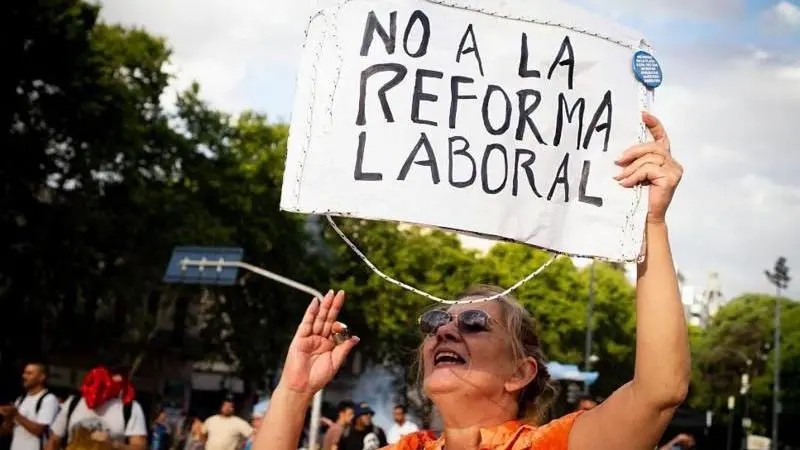
On the other side, workers and unions protest in the streets against the changes, which they consider a setback and a threat to the rights and well-being of Argentines, while experts point out that, although an update to the rules governing the labor market is welcome, the positive effects are more limited than what the Casa Rosada projects.
The Labor Modernization Law has also been challenged in court, without success. After a collective action filed by the General Confederation of Labor (CGT), a federal court ratified the reform in early May. But there are other processes in progress. Until they are judged, the new law is in force.
Among the main changes are the redefinition of the calculation of compensation for dismissal without just cause, excluding items such as the 13th salary and bonus from the calculation basis of the amount to be paid to workers, the possibility of splitting the 30-day vacation period and the classification of app drivers and delivery people as "independent workers" or self-employed.
One of the main criticisms of Argentine unions is against the expansion of list of "essential services", which have strong restrictions on the right to strike, including the education and customs sectors.
The new law also allows working hours of up to 12 hours a day, but with respect to the maximum limit of 48 hours a week.
That is, according to the new text, the working day in Argentina remains the same (8 hours a day and 48 hours a week). What changes is that employer and employee are authorized to make specific agreements in certain situations.
Even so, the minimum rest intervals must be respected: at least 12 hours between each shift and 35 hours of rest per week. The text also authorizes the use of the time bank so that extra hours worked on one day can be compensated with a shorter working day on another.
For Miguel Ángel Maza, professor of Labor Law at the University of Palermo, this is not an increase in working hours, since the maximum limit per week remains the same, but rather a flexibility in the division of working hours over the allowed 48 hours.
"I don't believe that this change will be widely used by companies, because It is not convenient. The exception may be large factories or assembly plants, which, by working a few extra hours a day, can shorten the week and save a day of energy", says Maza to BBC News Brasil. Senate
Reuters
The reform in Argentina draws special attention in Brazil, where the Chamber of Deputies is currently moving towards approving the end of the 6x1 work schedule with a short transition period.
On Monday (25/5), the president of the Chamber, Hugo Motta, and President Luiz Inácio Lula da Silva (PT) reached an agreement on the text that will be voted on.
The proposed amendment to the Constitution (PEC) establishes the obligation to have at least two days off per week.
If the constitutional amendment is enacted, the new rule must come into force within 60 days.
The proposal under discussion also foresees a reduction in working hours from 44 hours a week to 40 hours, which would come into force in two stages. First, there would be a reduction to 42 hours, also after 60 days. The 40-hour limit would be reached after one year. The change provides that the benefited workers will not suffer a salary reduction.
The expectation is that the text will advance this week in the plenary of the Chamber and then go to the Senate.
Argentina in the opposite direction
If the PEC is enacted, Brazil will join the list of countries that have instituted reductions in working hours in the last decade, including several in Latin America.
Chile approved in April 2023 a law that determined the gradual reduction of the 45-hour working day. hours to 40 hours per week, without salary reduction. In 2024, the journey went to 44 hours. In April 2026, it dropped to 42, expected to reach 40 in 2028.
In Colombia, the reduction in working hours from 48 to 42 hours per week was enacted in July 2021 by then president Iván Duque. The first reduction was in 2023, when it dropped to 47. In July 2026, it should reach 42 hours.
In March, Mexico also changed its legislation to shorten the working day from 48 to 40 hours. The change begins to be applied, without salary reduction, in January 2027, gradually, until reaching 40 hours a week in 2030.
Javier Milei's government defends the change in Argentina as a modernization of labor relations
AFP via Getty Images
In Europe, countries such as the Netherlands and Belgium are often cited as part of a vanguard in which shorter working hours and even weeks with just four working days are becoming a reality.
In Belgium, the first country in Europe to legislate on the subject, workers gained in February 2022 the right to complete a full working week in four days instead of five, without loss of salary.
However, Belgians do not have the option of working fewer hours per week. The law only allows them to condense their weekly working hours, which is a maximum of 38 hours, into fewer days.
Dutch law has several particularities, but, in general, workers cannot work more than 48 hours a week in a period of 16 weeks.
Still, the country has the lowest average number of hours actually worked per week in Europe: 32.1 hours, according to data from Eurostat, the official statistics agency of the European Union (EU).
In France, the standard working day is legally set at 35 hours per week, one of the lowest in the world.
Even in Brazil, the reduction of the working day from 48 to 44 hours was carried out 38 years ago, during the Constituent Assembly of 1988.
In this sense, Argentina seems to be going against the grain of the world, points out economist Carla Beni, professor at Fundação Getúlio Vargas.
According to the expert, especially in Latin America, the movement has been driven by governments with different ideological profiles.
"It is Argentina that is going in the opposite direction from the rest of the world, while Brazil has opened a debate to follow in the same footsteps as Chile, Colombia and Mexico and adapt to the welfare guidelines of the International Organization of work [ILO]", says Beni.
The ILO recommends reducing working hours to 40 hours a week and a maximum working time of up to 48 hours a week, as long as overtime is paid.
Miguel Maza agrees that Argentina is out of step with the global trend. "The limit of 48 hours a week [established by Argentina] is still too high for the modern world", he says.
The expert states, however, that the changes approved in the country in February this year are more symbolic than practical in nature.
"These are small setbacks in the job market, but it is not a serious change", he assesses.
But the message that the Milei government sends with the approval of the reform is more important, says Maza.
While the Casa Rosada signals a desire for change and commitment to improving the economy for the business community, workers "see a retrograde law that takes away their rights", he summarizes.
Economic crisis, informality and rigidity
The macroeconomic scenario and of the Argentine labor market helped Javier Milei's government to obtain approval of the reform in Congress, according to experts interviewed by BBC News Brasil.
The unemployment rate in the country rose to 7.5% at the end of last year, the highest level for a fourth quarter since the covid-19 pandemic.
But the record levels of informality are identified as the biggest problem in the Argentine market, with almost half of workers without guaranteed rights.
According to the most recent data from the Institute National Statistics and Census Bureau (Indec), informal employment reached 43% of total employment in the second quarter of 2025.
This number represents almost 6 million people who do not have health insurance, sick leave, dismissal compensation or social security contributions.
Among those under 29 years of age, the rate reaches almost 6 in 10, and this number is even higher among young women, according to Indec.
The data is not isolated, with job insecurity increasing over the last 13 years, with more workers in informal jobs, according to data from the Argentine Integrated Pension System and the Permanent Household Survey.
Informal employment reached 43% of total employment in Argentina
Reproduction/TV Globo
Added to this is a lasting economic crisis and a long government battle against high inflation (32.4% in the 12 months up to April), which reduces the power of purchase.
According to Miguel Maza, the Argentine Executive managed to reach an agreement in the Legislature by convincing allies that this reform will bring investments.
"For the government, it is a political success to present the project to the business community, the International Monetary Fund [IMF] and the United States government", he says.
The main argument of Milei and his supporters is that the reform has the capacity to generate more formal jobs due to lower costs for companies.
"This law represents a turning point in Argentine labor history", stated the Presidency of the Republic in a press release after the project was approved by the Senate.
"After years of labor disputes that benefited only a few, excessive bureaucracy and obsolete regulations in the face of profound economic and technological changes, we are now facing a profound transformation that restores predictability, dynamism and freedom to the labor market." 1970 that only suffered some very marginal changes", points out Marina Dal Poggetto, director of the Economics area at the Austral University, in Buenos Aires, and professor at the IAE Business School.
According to the economist, this rigidity in the labor market contributed to the increase in informality and the use of the so-called "monotributo", a simplified tax regime for small taxpayers, created to facilitate the formalization of self-employed people - something similar to the MEI and Simples Nacional in Brazil, but which, in the face of inflation high exchange rate and fiscal controls, has become a centerpiece for independent workers.
The monotax has generated much of the employment growth in Argentina in recent years, says Dal Poggetto, but is considered "a long-term fiscal problem", because it provides for a lower social security contribution.
"Something like around 26 monotax payers are needed to pay a minimum pension", says the economist.
'Without an improvement in economic activity, there are no jobs'
But, amid accusations crusades and divergent opinions on the subject, critics do not see any advantages in the reform and the most skeptical believe that it should simply maintain the status quo.
For Miguel Ángel Maza, from the University of Palermo, the reform, in addition to representing a small setback for workers, should not produce enough changes for businesspeople to feel motivated to invest in the country, expand their businesses or hire more workers.
He argues that, to promote investment, it is necessary to change market conditions and the Argentine tax system, which he considers "very onerous".
The reform includes tax benefits to encourage companies to increase the number of employees. Companies that hire the unemployed, self-employed or former civil servants will receive discounts on employer social security contributions during the first four years.
Maza recognizes these changes, but says he believes the impact will be limited.
In terms of reducing informal work, Marina Dal Poggetto states that the impact still needs to be studied.
But he claims to believe that the situation in the Argentine labor market is closely linked to the stagnation in growth and the health of the general economy, something that the reform does not solve.
Inflation harms workers' real wages and their purchasing power
Bloomberg via Getty Images
Although labor laws can help "a little more or a little less at the margin", if economic activity does not grow, it is very difficult to increase employment, says the expert.
In previous governments, says Dal Poggetto, the Conducting an "too closed" economy, with capital controls and great inequality, boosted informality, but without increasing unemployment rates.
"With Milei, we are seeing unemployment rates rise, albeit at relatively low levels", she says.
"We are seeing, so to speak, a process of trying to increase the economy's productivity, while unemployment increases. But we still need to see to what extent the flexibility of the workforce mitigates this process", she assesses.
For Dal Poggetto, the rise in unemployment tends to lead more Argentines to informality, especially given the ease provided by companies like Uber and PedidosYa, a food delivery app widely used in the country.
'This bill takes us back 100 years'
Another problem that the reform seeks to resolve, according to the government, are the high costs that Argentine companies have with labor lawsuits, employer and personal contributions and compensation in cases of dismissal.
With this focus, the reform transferred part of the responsibilities of the National Labor Court to the common or federal courts.
The project also redefined the formula for calculating compensation for dismissal, restricting what constitutes employee remuneration. This way, vacations, bonuses and other items not included in the monthly salary were excluded from the calculation.
The main change is that the company will not pay directly to fire an employee. Large companies will have to pay a monthly amount equivalent to 1% of salaries to the new Labor Assistance Fund (FAL), while small and medium-sized companies will pay 2.5% of salaries. The fund will be responsible for paying compensation.
Marina Dal Poggetto recognizes that the country is experiencing a problem in this sector. "In Argentina, with its high inflation, the indexation mechanisms for labor actions, especially the fines imposed in the 1990s to try to formalize the labor market, ended up being very expensive", says the economist.
"Many companies, especially small ones, had difficulties paying compensation or resolving legal proceedings resulting from layoffs."
Dal Poggetto states, however, that it is still too early to assess whether the measures will have a practical effect. "And, obviously, any effect will be closely associated with the dynamics of economic activity", he points out.
Miguel Ángel Maza sees the creation of the FAL as one of the points of the reform with the greatest potential to benefit the business community. But he says that, even so, the impact will be minimal. "I have the impression that with this 1%, not much will be financed and that it will not be successful", he says.
For Carla Beni, from FGV, the reform is based on the idea that, with more flexible labor rules, entrepreneurs will be able to hire more.
"But this is not proven in reality, because demand is what does the hiring.
With strong economic activity, there are more hires, regardless of the cost, including labor", says Beni.
Critics of the reform and Argentine unions also argue that the FAL makes dismissal costless for the company, at the same time that it starts to use resources that would go to Social Security, harming the country's pension system.
There is also concern that the new law will encourage the dismissal of workers, because employers will not hesitate to use the fund created specifically for this purpose. end.
In addition, the opposition points to an emptying of labor justice and a weakening of unions, especially with the limitations imposed on strikes.
"Far from being a law that modernizes, it is a law that sets us back and does not add any new rights to workers. On the contrary, what it does is generate a regressive process in terms of rights, unprecedented in Argentina", said the leader of the Peronist opposition bloc, Union for the Fatherland, Germán Martínez, about the law.
"This bill takes us back 100 years. One hundred years in individual rights, in collective rights. It is a search that focuses, essentially, on the transfer of economic resources from workers to the employing sector", said the co-secretary of the Argentine CGT, Jorge Sola.
Source: G1

Chinese company says it has a device capable of "translating" pet sounds
Chinese technology company Hangzhou Meng Xiaoyi Technology claims to have developed a device capable of "translating"...
Anahí and Poncho: project reveals reason for reunion between the two
Singer Anahí, 43, and actor Alfonso Herrera, 42, caught the attention of fans when they reunited in January after year...
With Bernard decisive, Atlético-MG qualifies in the Copa Sudamericana
Atlético-MG is in the round of 16 of the Copa Sudamericana. This Wednesday (27), at Arena MRV, Bernard scored the goal...
Toque agora.




Historias das musicas em destaque
 Historia da musica
Learn how to play "I Love You" and discover why Billie Eilish moves millions with just a few chords
27/05/2026
There are songs that seem simple at first, but carry an emotional intensity that is difficult to explain. "I Love You", by Billie Eilis...
 Historia da musica
How to play the classic "Careless Whisper" on the guitar and move anyone in the first chords
27/05/2026
Few songs can create such an intense and nostalgic atmosphere as George Michael's "Careless Whisper." From the first few seconds, the f...
 Historia da musica
Learn to play Chega, the country music that turns pain into a new beginning
27/05/2026
Chega, by Zezé Di Camargo & Luciano, is one of those songs that speak directly to those who are tired of suffering for love. The lyrics...
 Historia da musica
Learn how to play Total Eclipse Of The Heart, Bonnie Tyler's classic that chills the guitar
26/05/2026
Total Eclipse Of The Heart is one of those songs that seems to be born ready to move people. In Bonnie Tyler's striking voice, the song...
 Historia da musica
Learn to play Memonça Boa on the guitar and feel the strength of this passionate fashion
26/05/2026
Membrança Boa, by Traia Véia, is one of those songs that seem simple, but reach straight to the heart. The song talks about the end of...
 Historia da musica
Learn to play Bete Balanço: the Frejat classic that has energy, attitude and an unforgettable chorus
25/05/2026
Bete Balanço is one of those songs that carries movement from the first chord. With lyrics full of image, dreams, risk and youth, the s...
 Historia da musica
Learn to play Star, by Simply Red, the chord that transforms feelings into guitar
24/05/2026
Star, by Simply Red, is one of those songs that mix romanticism, regret and a striking melody, perfect for those who like to play somet...
 Historia da musica
Learn to play Die With a Smile: the emotional ballad by Lady Gaga and Bruno Mars that conquered the world on guitar
24/05/2026
"Die With a Smile" is one of those songs that already looks like a classic. In the meeting of two giant voices of pop music, Lady Gaga...
 Historia da musica
Learn to play Rasgando a Madrugada, Eduardo Costa's perfect song for guitar
24/05/2026
Rasgando a Madrugada, by Eduardo Costa, is one of those songs that seem to be born in the silence of the night. The song carries the we...
 Historia da musica
Learn to play Autor Da Vida, the Oficina G3 classic that speaks straight to the heart
23/05/2026
Learn to play Autor Da Vida, the Oficina G3 classic that speaks straight to the heart Autor Da Vida, by Oficina G3, is one of those son...
Mais noticias para voce
 Noticia
27/05/2026
Federal Lottery today: results of competition 6069 and numbers drawn
Federal Lottery FlyersG1See below the tickets drawn from contest 6069 of the Federal Lottery held this Wednesday (27):1st - Ticket 074090: R$500,0002nd - Ticket...
 Noticia
27/05/2026
Botafogo suffers another transfer ban and remains banned from signing players
Botafogo increased its number of problems with the fourth transfer ban applied by FIFA. With the sanction this Wednesday (27), Glorioso is prohibited from signi...
 Noticia
27/05/2026
ChatGPT creator launches plan against electoral misinformation in Brazil
OpenAI, creator of the artificial intelligence platform ChatGPT, launched this Wednesday (27) a plan against electoral disinformation in Brazil and the United S...
 Noticia
27/05/2026
Alcolumbre defends dialogue and rural debt PL should be until June
The president of the Senate, Davi Alcolumbre (União-AP), defended dialogue before voting on the bill on the renegotiation of rural debts (PL 5122/23) with resou...
Noticia
27/05/2026
Learn how to play "I Love You" and discover why Billie Eilish moves millions with just a few chords
There are songs that seem simple at first, but carry an emotional intensity that is difficult to explain. "I Love You", by Billie Eilish, is exactly like that....
Noticia
27/05/2026
How to play the classic "Careless Whisper" on the guitar and move anyone in the first chords
Few songs can create such an intense and nostalgic atmosphere as George Michael's "Careless Whisper." From the first few seconds, the famous solo transports any...
Participe da conversa
Seu comentario ajuda a manter a discussao viva e ainda convida outros leitores a continuar navegando pelo portal.
Seja o primeiro a comentar esta noticia.