



Leia a noticia completa
Huawei Technologies announced on Monday (25) that within five years it will manufacture chips using a new industry-leading technology, highlighting Beijing's efforts to counteract US sanctions that have hampered China's production of sophisticated chips.
Huawei, at a semiconductor symposium in Shanghai, said its cutting-edge chips will have transistor density equivalent to 1.4-nanometer processes by 2031, but did not provide independent performance data.
The target is significant as China's most advanced proven chipmaking capability is widely seen at around 7 nanometers, while 1.4 nanometers is expected to be close to the global frontier for advanced chipmaking by the end of the decade.

Breastfeeding spaces: Abrasce will guide shopping malls only after STF ruling
Abrasce (Brazilian Association of Shopping Centers) stated this Wednesday (27) that it is following the decision of th...
Caracas 1 x 3 Botafogo: see the best moments in the South American Championship
Botafogo visited Caracas on Wednesday night (27), winning 3-1 at the UCV Olympic Stadium, in Caracas, Venezuela, in th...
Atlético-MG 1 x 0 Puerto Cabello: the best moments in the South American Championship
Atlético-MG hosted Puerto Cabello, on Wednesday night (27), won 1-0, at Arena MRV, in Belo Horizonte (MG), and guarant...
In general, experts consider it unlikely that China will reach this level through conventional manufacturing alone, as Washington has restricted its access to advanced lithography tools and other key semiconductor technologies.
Taiwanese TSMC, the world's largest producer of the most advanced chips, currently uses a 2-nanometer manufacturing technology and plans to introduce a 1.4-nanometer process for mass production in 2028.
"Tau Scaling Law"
Huawei on Monday unveiled a new principle for improving chips, noting that the industry can no longer rely on shrinking transistors to achieve advances in computing, a pattern known as Moore's Law, as they have become so small that their dimensions are measured in just a few atoms.
Toque agora.




The Tau Scaling Law, as the principle is called, instead focuses on reducing the time it takes for signals and data to travel through chips and computing systems, Huawei said.
While the global chip industry is increasingly investing in post-Moore's Law solutions, from advanced packaging to chiplets, the search has become especially urgent for China.
U.S. export controls have restricted Chinese companies' access to the most advanced chipmaking tools, especially the equipment needed to produce microprocessors at cutting-edge process nodes.
This has made alternative routes to higher performance essential to Beijing's goal of creating a world-leading, self-reliant semiconductor sector.
"What Huawei is proposing is a shift from traditional node-driven scaling to system-level efficiency scaling," said He Hui, director of semiconductor research at Omdia.
"Rather than relying solely on smaller transistors, the company is focusing on shortening the interconnect, reducing latency, and improving data movement within the chip, which is a reliable way to extract more performance when high-end lithography is constrained."
More AI, more risks
The risks of Huawei's chip advances are doubly high as cutting-edge technologies have become an increasingly important pillar of China's future economic development and geopolitical leverage.
Huawei's Ascend series of chips are central to Chinese AI models, including DeepSeek's latest V4 flagship model, launched last month.
Huawei said its Kirin smartphone chips, scheduled to launch later this year, will be the first to use a Tau Scaling Law architecture called LogicFolding, which the company says shrinks the size of interconnects within chips and significantly improves performance.
LogicFolding will also be applied to Ascend chips by 2030, as well as to large AI clusters made up of hundreds or thousands of chips in data centers, the company said.
Huawei added that its microprocessor division has designed and mass-produced 381 chips over the past six years based on the Tau Scaling Law for use in industries such as smartphones and AI computing.
Alternative to Nvidia
Huawei was included in a US trade blacklist in 2019, which prevented it from
use many U.S.-origin technologies, including chips and software, which has restricted its ability to rely on globally contracted chipmakers.
Huawei went into what it described as an "extreme survival mode" after the restrictions were imposed. A secret chip project led by He Tingbo, president of Huawei's semiconductor business and director of the Committee of Scientists, has become central to its survival strategy.
The company made a surprise comeback in 2023 with the launch of the 5G-capable Mate 60 series smartphones, powered by a system-on-chip produced by China's largest contract chipmaker, Semiconductor Manufacturing International Corp (SMIC), using 7-nanometer technology.
SMIC shares rose 7.6% this Monday following Huawei's announcement of its LogicFolding architecture. SMIC has also recently invested in post-Moore's Law pathways, establishing an advanced encapsulation research institute in Shanghai in January.
Demand for Ascend chips has surged in China this year as domestic technology companies seek alternatives to US firm Nvidia, whose most advanced AI processors are blocked from being sold in China.
Nvidia Chief Executive Jensen Huang said earlier this month that the company had "largely ceded" China's AI chip market to Huawei.
While acknowledging progress, analysts say China continues to lag behind global leaders in the most advanced process technology.
"Cost, power, temperature and systems integration continue to be key challenges, especially for cloud AI servers," said Brady Wang, associate director at Counterpoint Research.
"In the short term, China may close the gap with global leaders, but the technological gap with the most advanced nodes will still remain," he added.
Huawei chip chief He acknowledged that its latest approach still faces major hurdles, including the need for new chip design tools suited to Tau Scaling and the challenge of avoiding overheating, from mobile chips to large AI data centers.
"Considering all the various constraints, we found some very good solutions... I can say with confidence that in the next 10 years, our solutions for mobile computing and AI computing will be competitive," said He.
Why is social media under fire for being "addictive"?
Source: CNN
Historias das musicas em destaque
 Historia da musica
Learn how to play "I Love You" and discover why Billie Eilish moves millions with just a few chords
27/05/2026
There are songs that seem simple at first, but carry an emotional intensity that is difficult to explain. "I Love You", by Billie Eilis...
 Historia da musica
How to play the classic "Careless Whisper" on the guitar and move anyone in the first chords
27/05/2026
Few songs can create such an intense and nostalgic atmosphere as George Michael's "Careless Whisper." From the first few seconds, the f...
 Historia da musica
Learn to play Chega, the country music that turns pain into a new beginning
27/05/2026
Chega, by Zezé Di Camargo & Luciano, is one of those songs that speak directly to those who are tired of suffering for love. The lyrics...
 Historia da musica
Learn how to play Total Eclipse Of The Heart, Bonnie Tyler's classic that chills the guitar
26/05/2026
Total Eclipse Of The Heart is one of those songs that seems to be born ready to move people. In Bonnie Tyler's striking voice, the song...
 Historia da musica
Learn to play Memonça Boa on the guitar and feel the strength of this passionate fashion
26/05/2026
Membrança Boa, by Traia Véia, is one of those songs that seem simple, but reach straight to the heart. The song talks about the end of...
 Historia da musica
Learn to play Bete Balanço: the Frejat classic that has energy, attitude and an unforgettable chorus
25/05/2026
Bete Balanço is one of those songs that carries movement from the first chord. With lyrics full of image, dreams, risk and youth, the s...
 Historia da musica
Learn to play Star, by Simply Red, the chord that transforms feelings into guitar
24/05/2026
Star, by Simply Red, is one of those songs that mix romanticism, regret and a striking melody, perfect for those who like to play somet...
 Historia da musica
Learn to play Die With a Smile: the emotional ballad by Lady Gaga and Bruno Mars that conquered the world on guitar
24/05/2026
"Die With a Smile" is one of those songs that already looks like a classic. In the meeting of two giant voices of pop music, Lady Gaga...
 Historia da musica
Learn to play Rasgando a Madrugada, Eduardo Costa's perfect song for guitar
24/05/2026
Rasgando a Madrugada, by Eduardo Costa, is one of those songs that seem to be born in the silence of the night. The song carries the we...
 Historia da musica
Learn to play Autor Da Vida, the Oficina G3 classic that speaks straight to the heart
23/05/2026
Learn to play Autor Da Vida, the Oficina G3 classic that speaks straight to the heart Autor Da Vida, by Oficina G3, is one of those son...
Mais noticias para voce
 Noticia
28/05/2026
"Off Campus" stars will team up for new erotic miniseries
Mika Abdalla and Stephen Kalyn, who play the couple Allie and Dean in the hit "Off Campus: Amores Improbáveis" returned to star in the new erotic audio series "...
 Noticia
28/05/2026
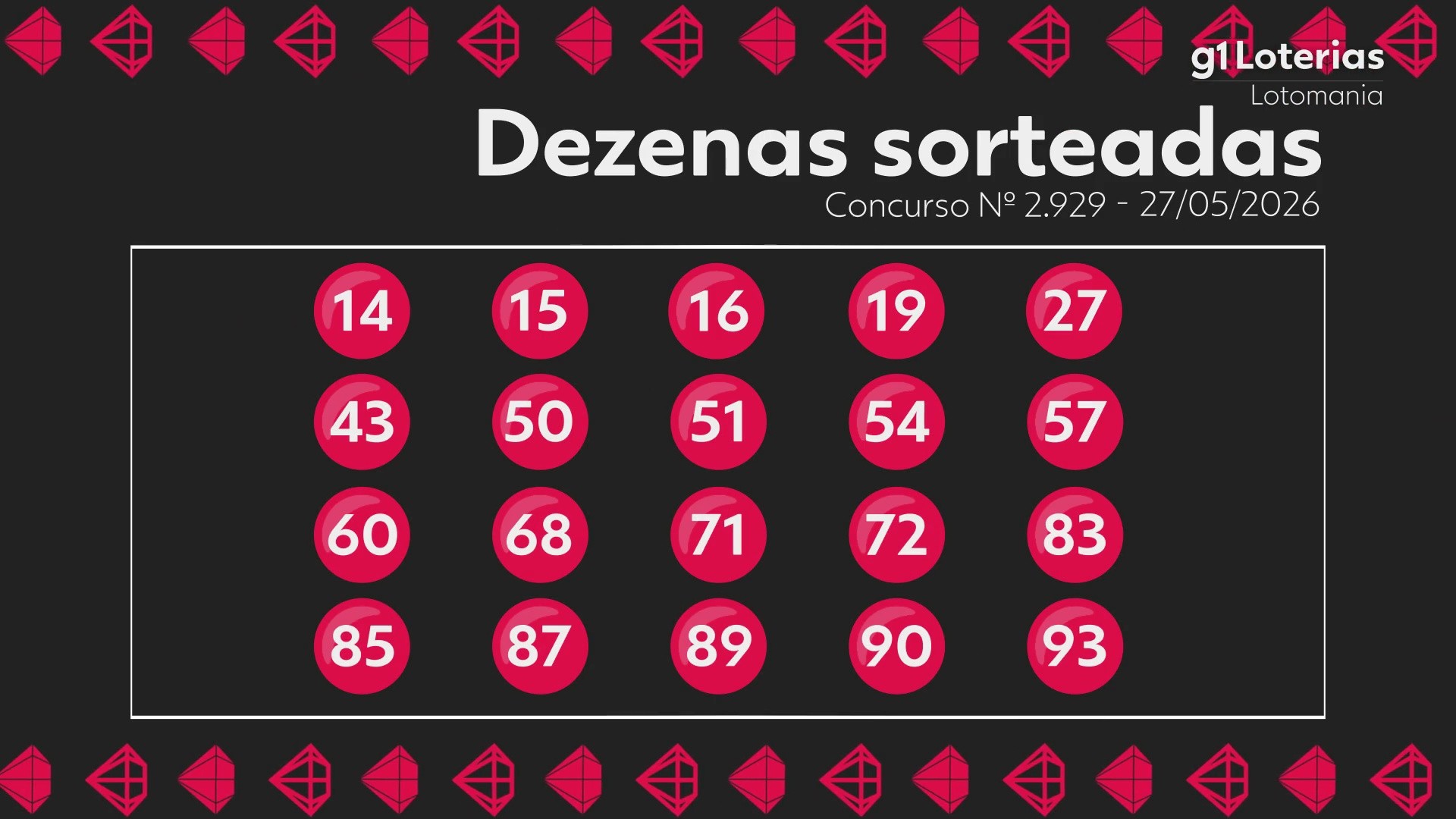
Lotomania today: results of contest 2929 and numbers drawn
Lotomania Resultg1See below the draw numbers for Lotomania contest 2929 held this Wednesday (27):14 - 15 - 16 - 19 - 27 - 43 - 50 - 51 - 54 - 57 - 60 - 68 - 71...
 Noticia
28/05/2026
Dupla Sena today: results of contest 2962 and numbers drawn
Dupla Sena resultg1See below the draw numbers for Dupla Sena contest 2962 held this Wednesday (27):1st draw: 17 - 24 - 38 - 43 - 45 - 482nd draw: 5 - 16 - 34 -...
 Noticia
28/05/2026
Super Sete today: results of contest 852 and numbers drawn
Super Sete steering wheelsG1See below the numbers drawn from the columns in contest 852 of Super Sete held this Wednesday (27):Numbers drawn per columnSee how m...
Noticia
27/05/2026
Learn how to play "I Love You" and discover why Billie Eilish moves millions with just a few chords
There are songs that seem simple at first, but carry an emotional intensity that is difficult to explain. "I Love You", by Billie Eilish, is exactly like that....
Noticia
27/05/2026
How to play the classic "Careless Whisper" on the guitar and move anyone in the first chords
Few songs can create such an intense and nostalgic atmosphere as George Michael's "Careless Whisper." From the first few seconds, the famous solo transports any...
Participe da conversa
Seu comentario ajuda a manter a discussao viva e ainda convida outros leitores a continuar navegando pelo portal.
Seja o primeiro a comentar esta noticia.