




Leia a noticia completa
The most recent data from the Violence Atlas 2026 indicates continued growth in records of violence against LGBTQIAPN+ people in Brazil.
Released this Tuesday (26) by Ipea (Institute of Applied Economic Research) in partnership with the FBSP (Brazilian Public Security Forum), the survey shows an increase in notifications among different groups and points out that the indicators follow an upward trend throughout the historical series analyzed.
Among homosexual and bisexual people, 10,250 cases of violence were recorded in 2024, a number 5.5% higher than that observed in the previous year. Compared to the beginning of the series, accumulated growth reached 212.7%, indicating a significant expansion in notifications over the last decade.

Without Salah, Egypt beats Russia before friendly against Brazilian team
Egypt began its preparations for the World Cup with a 1-0 victory over Russia, this Thursday (28), in a friendly playe...
Iranian TV says US aircraft destroyed; White House does not confirm
Iran's state broadcaster said this Friday (29), local time, that a United States aircraft was destroyed in Jam provinc...
Senate police investigate alleged plan to attack Flávio Bolsonaro
The Senate Police opened an investigation to investigate the statements made by funk singer Misael Rangel da Silva e S...
The data shows that registrations against homosexual people increased from 7,043 to 7,378 between 2023 and 2024, an increase of 4.8%. Among bisexual people, cases increased from 2,675 to 2,872 notifications, an increase of 7.4% in the period.
The Atlas also identified an increase among transgender people and transvestites. In 2024, 5,575 records of violence against this group were recorded, an increase of 2.6% in the annual comparison.
Although growth has been observed across different groups, the Atlas highlights that victimization patterns are not homogeneous within the LGBTQIAPN+ population. The behavior of the indicators varies according to sexual orientation, gender identity, age group and access to reporting and assistance mechanisms, which requires careful reading of the aggregated numbers.
Toque agora.




Another point highlighted by the Atlas is that the records only represent the episodes that reached the health system. Therefore, the authors warn that the numbers do not necessarily correspond to all the situations of violence experienced by the LGBTQIAPN+ population, a group that historically faces barriers to reporting and institutional access.
In 5 years, Brazil has seen a 240% increase in adoptions by gay couples, points out CNJ | CNN PRIME TIME
Growth in records requires caution in interpretation, says Atlas
The researchers highlight that the increase in notifications does not necessarily mean that violence has increased at the same rate. According to the report, factors such as expanding the coverage of information systems, strengthening the service network and increasing the number of people who began to identify as members of the LGBTQIAPN+ population may influence the results observed.
Still, the Atlas states that the size of the growth recorded in recent years suggests that the phenomenon cannot be explained solely by statistical improvements and requires attention to possible real changes in the pattern of violence directed at this population.
Violence is concentrated among younger people
The report also points to a concentration of cases in younger age groups. Among gender nonconforming people, the highest percentages of victimization appear between 15 and 29 years of age, remaining high until early adulthood. Among transgender men, the incidence is even more concentrated between the ages of 15 and 24.
According to the report, the concentration of violence among younger people may indicate a period of greater exposure to family, school and social conflicts related to sexual orientation and gender identity. The authors observe that discrimination processes tend to gain intensity precisely in stages of identity affirmation and social insertion.
The authors also highlight that the available data has limitations and may not fully capture the violence suffered by the LGBTQIAPN+ population, especially among children under 10 years of age, a group that does not appear specifically in the records analyzed.
Nevertheless, in the researchers' assessment, monitoring these indicators over time allows us to identify changes in patterns of violence and guide more targeted public policies.
The report argues that expanding recording capacity and qualifying the data produced is a central part of combating violence against historically vulnerable groups.
Atlas of Violence
The Atlas of Violence 2026 marks a decade of the partnership between Ipea (Institute of Applied Economic Research) and the FBSP (Brazilian Public Security Forum) in monitoring lethality in Brazil.
The study was prepared based on data from the Mortality Information System (SIM) and the Notifiable Diseases Information System (Sinan), from the Ministry of Health (MS).
Although official indices point to a historic drop in lethal violence, research shows that there has been a critical increase in the underreporting of homicides.
Source: CNN

Historias das musicas em destaque
 Historia da musica
Learn to play Black Hole Sun: Soundgarden's dark classic that chills the guitar
28/05/2026
Black Hole Sun, by Soundgarden, is one of those songs that seems to be born from a strange dream: beautiful, heavy, melancholic and hyp...
 Historia da musica
Learn how to play "I Love You" and discover why Billie Eilish moves millions with just a few chords
27/05/2026
There are songs that seem simple at first, but carry an emotional intensity that is difficult to explain. "I Love You", by Billie Eilis...
 Historia da musica
How to play the classic "Careless Whisper" on the guitar and move anyone in the first chords
27/05/2026
Few songs can create such an intense and nostalgic atmosphere as George Michael's "Careless Whisper." From the first few seconds, the f...
 Historia da musica
Learn to play Chega, the country music that turns pain into a new beginning
27/05/2026
Chega, by Zezé Di Camargo & Luciano, is one of those songs that speak directly to those who are tired of suffering for love. The lyrics...
 Historia da musica
Learn how to play Total Eclipse Of The Heart, Bonnie Tyler's classic that chills the guitar
26/05/2026
Total Eclipse Of The Heart is one of those songs that seems to be born ready to move people. In Bonnie Tyler's striking voice, the song...
 Historia da musica
Learn to play Memonça Boa on the guitar and feel the strength of this passionate fashion
26/05/2026
Membrança Boa, by Traia Véia, is one of those songs that seem simple, but reach straight to the heart. The song talks about the end of...
 Historia da musica
Learn to play Bete Balanço: the Frejat classic that has energy, attitude and an unforgettable chorus
25/05/2026
Bete Balanço is one of those songs that carries movement from the first chord. With lyrics full of image, dreams, risk and youth, the s...
 Historia da musica
Learn to play Star, by Simply Red, the chord that transforms feelings into guitar
24/05/2026
Star, by Simply Red, is one of those songs that mix romanticism, regret and a striking melody, perfect for those who like to play somet...
 Historia da musica
Learn to play Die With a Smile: the emotional ballad by Lady Gaga and Bruno Mars that conquered the world on guitar
24/05/2026
"Die With a Smile" is one of those songs that already looks like a classic. In the meeting of two giant voices of pop music, Lady Gaga...
 Historia da musica
Learn to play Rasgando a Madrugada, Eduardo Costa's perfect song for guitar
24/05/2026
Rasgando a Madrugada, by Eduardo Costa, is one of those songs that seem to be born in the silence of the night. The song carries the we...
Mais noticias para voce
 Noticia
28/05/2026
Austrian man who planned attack on Taylor Swift concert sentenced to 15 years in prison
One of the young people who planned an attack on a Taylor Swift concert in Austria is taken by agents to courtLisa Leutner/ReutersAn Austrian court sentenced to...
 Noticia
28/05/2026
In tribute at Granja Comary, Felipão asks the team to donate for Brazil
Luiz Felipe Scolari was honored at Granja Comary this Thursday (28). The World Cup champion coach was presented with a plaque that highlights the main achieveme...
 Noticia
28/05/2026
Irish friendly is halted after pro-Palestine protest; look
Ireland and Qatar are facing each other this Thursday (28), in a friendly that takes place at the Aviva Stadium, in Dublin. Right at the beginning of the match,...
 Noticia
28/05/2026
"The Nobility of Love": Will Tonho be king of Batanga? Find out what his end will be like
With an ending scheduled for the beginning of September, the outcome of one of the characters in the soap opera "A Nobreza do Amor" may already be close to bein...
 Noticia
28/05/2026
Anthropic releases Opus 4.8 while working on Mythos release
Anthropic announced this Thursday (28) the launch of the updated Claude Opus 4.8 model, while working to release the Mythos model to all customers in the coming...
 Noticia
28/05/2026
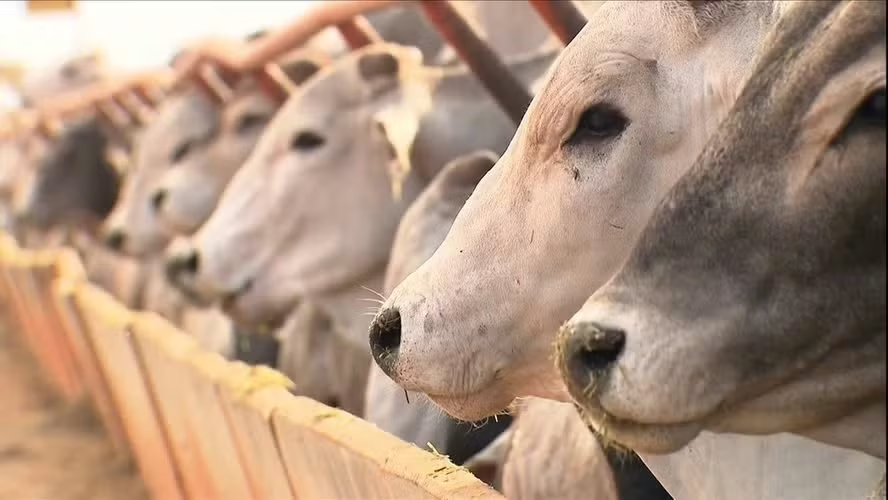
Live cattle maintain firm prices in the face of restricted animal supply
The availability of cattle for slaughter and the pace of purchases by the meatpacking industries are contributing to the stability of cattle prices in the main...
Participe da conversa
Seu comentario ajuda a manter a discussao viva e ainda convida outros leitores a continuar navegando pelo portal.
Seja o primeiro a comentar esta noticia.