




Leia a noticia completa
The resumption of the trial of Dr. Jairinho and Monique Medeiros, accused of the death of Henry Borel, puts back into operation one of the most specific mechanisms of the Brazilian criminal system: the Jury Court. Provided for in the Federal Constitution and regulated by the Criminal Procedure Code (CPP), this model transfers the decision on conviction or acquittal in intentional crimes against life to ordinary citizens.
The session takes place this Monday (25), at the II Rio de Janeiro Jury Court. In this case, the defendants are responsible for triple homicide and other related crimes related to the facts investigated.
Why the case will be judged by the Jury Court
The jurisdiction of the Jury Court is provided for in article 5, item XXXVIII, of the Federal Constitution, which guarantees the popular trial for intentional crimes against life. In practice, this means that completed or attempted homicides are not decided exclusively by qualified judges. The trial is now shared between the magistrate and citizens summoned to temporarily serve as jurors.

One of the most violent thieves in the city of São Paulo is arrested; see video
A 23-year-old man, considered by the police to be one of the most violent thieves in the city of São Paulo, was arrest...
Djokovic advances at Roland Garros after scare against Frenchman
Serbian Novak Djokovic advanced this Wednesday to the third round of the French Open by beating Frenchman Valentin Roy...
Federal Government signs service order for "middle section" on BR-319
The federal government signed today the first of four service orders for asphalting and recovery of the so-called "mid...
In addition to constitutional competence, the procedure is governed by articles 406 and 497 of the Code of Criminal Procedure.
In the Henry Borel case, the criminal action reached the plenary after the investigation phase and after the so-called pronouncement decision, a judicial act that does not condemn the accused, but recognizes that there is sufficient evidence of authorship and materiality for them to be submitted to popular trial.
Thus, it is important to emphasize that submission to the jury does not represent advance recognition of guilt, but only the understanding that the final decision must be made by the jurors of the Sentencing Council.
Toque agora.



How the Sentencing Council is formed
One of the initial moments of the session is the formation of the Sentencing Council.
The Code of Criminal Procedure determines that seven jurors be drawn from among citizens previously summoned by the Judiciary to serve at that Jury Court meeting. These jurors assume a legal commitment to judge impartially and begin to exercise a public function during the trial.
There is also the possibility of refusals by the parties. Both the Public Prosecutor's Office and the defense can reject certain jurors without needing to justify the reason within the legal limit provided for in the CPP. The objective is to preserve impartiality and reduce the risk of influencing the outcome.
Once the council is formed, the jurors remain incommunicado about the merits of the process until the vote.
What happens in the plenary instruction phase
After the jury is installed, the plenary instruction phase begins. This stage works as an oral reconstruction of the process before the jurors.
First, witnesses for the prosecution are heard. Then, defense witnesses. Experts responsible for technical examinations can also provide clarifications and, at the end, the accused themselves are interrogated, if they choose to speak. The interrogation of defendants is a procedural right and not an obligation. According to the constitutional principle of non-self-incrimination, the accused can remain silent without this being interpreted as an element of guilt.
During this phase, the Public Prosecutor's Office and defense can ask questions directly to witnesses and explore contradictions, documents and reports.
In the Henry Borel case, the body of evidence includes expert evidence produced during the investigation, including exams that supported the official conclusion about the cause of death.
How debates between the prosecution and defense work
Once the production of evidence in plenary has concluded, the trial enters an essential phase of the Jury Court: oral debates. At this time, no new evidence is produced. What happens is the legal and narrative interpretation of the elements already existing in the process.
The Public Prosecutor's Office supports the complaint and tries to demonstrate that the facts and evidence justify the conviction.
The defense can adopt different lines of argument provided for by the legal system: denying authorship, contesting qualifications, questioning the validity of the evidence, sustaining insufficiency of evidence or defending acquittal.
The CPP also provides for a reply and rejoinder, which are seen as additional opportunities for the parties to express their opinions after the initial arguments.
It is precisely at this stage that legal concepts such as authorship, intent, qualifications and causal link tend to gain greater prominence before jurors.
What exactly do jurors decide
Contrary to what is often imagined, jurors do not directly define the length of the sentence. Once the debates are over, they only respond to the so-called requisites, questions formulated by the judge according to the structure provided for in the Code of Criminal Procedure.
Typically, the sequence involves questions about:
- existence of the criminal act (materiality);
- participation or authorship;
- acquittal;
- incidence of qualifiers or specific causes.
Voting takes place in a private room and using secret ballots. The decision is taken by a majority of votes and constitutes the so-called sovereign verdict, a constitutional principle that limits the review of the merits of the jurors' decision.
What happens if there is a conviction
If the jurors recognize the criminal responsibility of the accused, the trial enters the sentencing phase.
At this point, the presiding judge resumes procedural leadership to carry out the dosimetry of the sentence, following the method provided for in article 68 of the Penal Code. First, the base penalty is established based on an analysis of the judicial circumstances. Then, aggravating and mitigating factors are considered. And, finally, the judge applies causes of increase or decrease that may be recognized.
In the Henry Borel case, possible recognition of the qualifiers and other crimes attributed to the defendants also comes into analysis, which directly influences the final calculation of the sentence and the initial compliance regime.
What happens if there is an acquittal
If the jurors respond to the questions in a favorable manner to the accused and decide to acquit, the presiding judge must render an acquittal sentence, respecting the constitutional principle of the sovereignty of verdicts, provided for in article 5, item XXXVIII, of the Constitution.
In practice, this means that defendants no longer receive punishment for the facts judged in that case.
If they remain in pre-trial detention exclusively for this case, the legal tendency is for the arrest to be revoked and a release permit issued, unless there is another independent legal basis that justifies maintaining custody or another arrest order in force.
Juror's decision does not automatically end the process
Although sovereign, the jury's decision, whether acquittal or condemnatory, does not necessarily immediately end the process.
The Public Prosecutor's Office, the prosecution assistance and also the defense may file an appeal in the cases provided for in article 593 of the Code of Criminal Procedure. Among the possible grounds is the allegation that the jurors' decision was manifestly contrary to the evidence in the case, in addition to nullities that occurred during the session or questions about the setting of the sentence.
In these cases, the court does not directly replace the jurors' decision with a new conclusion about guilt or innocence.
As a rule, in compliance with the constitutional principle of the sovereignty of verdicts, the court may order a new trial to be held by the Jury Court, so that another Sentencing Council can re-analyze the case.
Thus, the defense can question both aspects of the trial and the dosimetry of the sentence defined by the presiding judge, and, in the same way, the prosecution can appeal if it understands that there was an error in the application of the sentence or disagreement in relation to some point of the sentence, even with the conviction.
Only after the closure of the applicable appeals and the final judgment will the decision become definitive in the process.
What is being discussed in the Henry Borel case
Dr. Jairinho and Monique Medeiros are charged with triple homicide, torture, coercion during the process and procedural fraud. Against Monique, the accusation also alleges relevant omission and ideological falsehood.
According to the investigation, Henry died in the early hours of March 8, 2021, inside the apartment where he lived with his mother and then stepfather, in Barra da Tijuca. Initially, the accused stated that the boy had suffered a domestic accident after falling out of bed. The hypothesis was ruled out by the autopsy report from the Instituto Médico-Legal.
-
Change imageChange image
1 of 5
Henry Borel celebrating his 4th birthday, in May 2020 - Photo: Personal Archive
-
Change imageChange image
2 out of 5
Henry Borel, aged 4, died on March 8 - Reproduction
-
Swap imageSwap imageSwap image
3 out of 5
Leniel Borel in the documentary "Henry Borel Case, The Mark of Evil" - Disclosure
-
Change imageChange image
-
Swap imageSwap imageSwap image
4 out of 5
image of Henry Borel in action in honor of Children's Day - Disclosure/Leniel Borel
-
Change imageChange image
5 out of 5
On the left Dr. Jairinho, on the right Monique Medeiros with her son Henry Borel - Arte/CNN
-
-
-
-
-
default view
full view
grid view
According to the exams, Henry had 23 injuries spread across his body and died as a result of internal bleeding and liver laceration caused by blunt force. Investigations also showed that the child had been subjected to previous attacks.
In addition to the criminal outcome for the defendants, the trial takes place in a context in which the case also prompted legislative changes, including the creation of the Henry Borel Law, aimed at strengthening the protection of children and adolescents who are victims of domestic violence.
Source: CNN

Historias das musicas em destaque
 Historia da musica
Learn to play Chega, the country music that turns pain into a new beginning
27/05/2026
Chega, by Zezé Di Camargo & Luciano, is one of those songs that speak directly to those who are tired of suffering for love. The lyrics...
 Historia da musica
Learn how to play Total Eclipse Of The Heart, Bonnie Tyler's classic that chills the guitar
26/05/2026
Total Eclipse Of The Heart is one of those songs that seems to be born ready to move people. In Bonnie Tyler's striking voice, the song...
 Historia da musica
Learn to play Memonça Boa on the guitar and feel the strength of this passionate fashion
26/05/2026
Membrança Boa, by Traia Véia, is one of those songs that seem simple, but reach straight to the heart. The song talks about the end of...
 Historia da musica
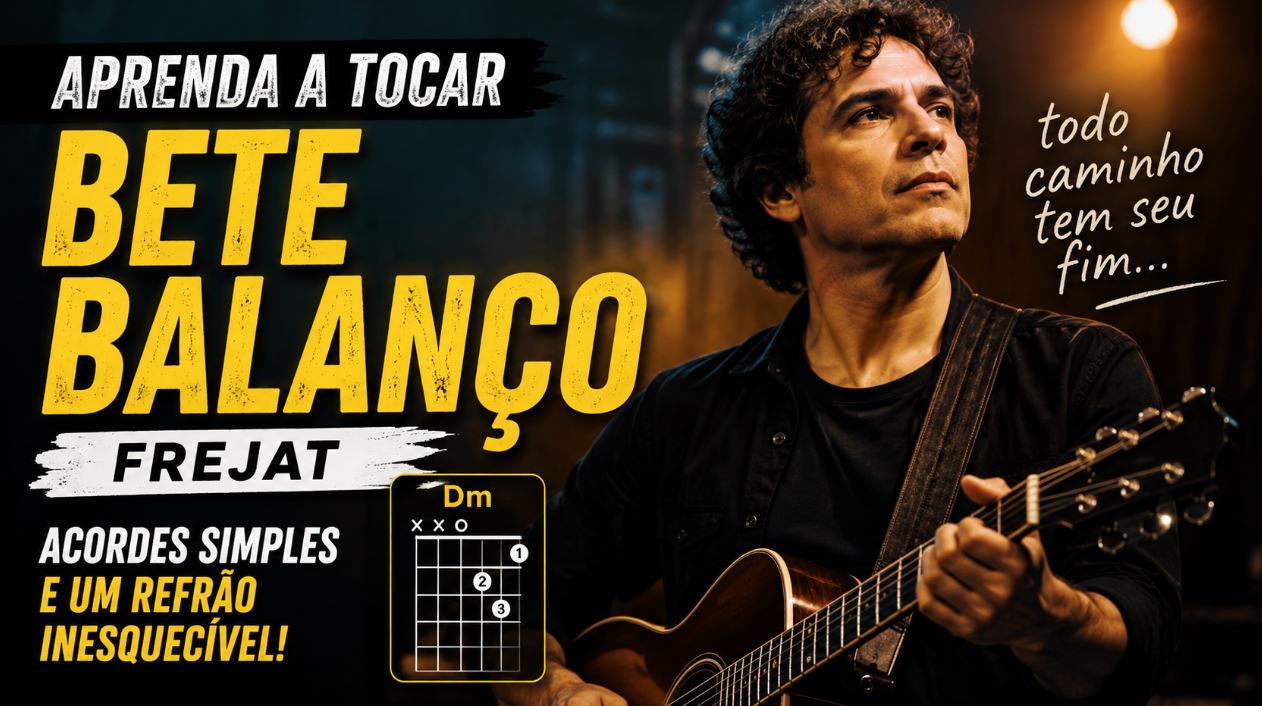
Learn to play Bete Balanço: the Frejat classic that has energy, attitude and an unforgettable chorus
25/05/2026
Bete Balanço is one of those songs that carries movement from the first chord. With lyrics full of image, dreams, risk and youth, the s...
 Historia da musica
Learn to play Star, by Simply Red, the chord that transforms feelings into guitar
24/05/2026
Star, by Simply Red, is one of those songs that mix romanticism, regret and a striking melody, perfect for those who like to play somet...
 Historia da musica
Learn to play Die With a Smile: the emotional ballad by Lady Gaga and Bruno Mars that conquered the world on guitar
24/05/2026
"Die With a Smile" is one of those songs that already looks like a classic. In the meeting of two giant voices of pop music, Lady Gaga...
 Historia da musica
Learn to play Rasgando a Madrugada, Eduardo Costa's perfect song for guitar
24/05/2026
Rasgando a Madrugada, by Eduardo Costa, is one of those songs that seem to be born in the silence of the night. The song carries the we...
 Historia da musica
Learn to play Autor Da Vida, the Oficina G3 classic that speaks straight to the heart
23/05/2026
Learn to play Autor Da Vida, the Oficina G3 classic that speaks straight to the heart Autor Da Vida, by Oficina G3, is one of those son...
 Historia da musica
Learn to play Te Esperando: the exciting country music by Luan Santana that made Brazil sing on the guitar
23/05/2026
Te Esperando, by Luan Santana, is one of those country songs that sticks in your memory because it mixes romanticism, longing and the p...
 Historia da musica
Learn to play Hey Joe: the Jimi Hendrix classic that every guitarist dreams of mastering
23/05/2026
Few songs carry as much attitude and history as Hey Joe, immortalized in the voice and guitar of Jimi Hendrix. With an unmistakable int...
Mais noticias para voce
 Noticia
27/05/2026
Analysis: Why ending war with Iran might be very difficult for Trump?
US President Donald Trump's war with Iran hasn't exactly been a resounding success so far. And a large part of the American public hopes that the end of the con...
 Noticia
27/05/2026
Google opens AI engineering center in SP; g1 met space
Google's new engineering center in São Paulo.Darlan HelderGoogle opened this Wednesday (27) its second AI engineering center in Brazil. The space is located at...
 Noticia
27/05/2026
Bricklayers killed by police officers in Rio were reportedly mistaken for drug traffickers
The two bricklayers who died after being shot by military police officers this Wednesday morning (27) in São Gonçalo, in the Metropolitan region of Rio de Janei...
 Noticia
27/05/2026
Leaving Fluminense, Ganso is offered to Serie A rivals; see details
After leaving Fluminense, Paulo Henrique Ganso was offered to a rival in Series A of the Brazilian Championship. This is Athletico-PR, coached by Odair Hellmann...
Noticia
27/05/2026
Learn to play Chega, the country music that turns pain into a new beginning
Chega, by Zezé Di Camargo & Luciano, is one of those songs that speak directly to those who are tired of suffering for love. The lyrics bring a strong feeling o...
Noticia
26/05/2026
Learn how to play Total Eclipse Of The Heart, Bonnie Tyler's classic that chills the guitar
Total Eclipse Of The Heart is one of those songs that seems to be born ready to move people. In Bonnie Tyler's striking voice, the song mixes drama, intensity a...
Participe da conversa
Seu comentario ajuda a manter a discussao viva e ainda convida outros leitores a continuar navegando pelo portal.
Seja o primeiro a comentar esta noticia.