



Leia a noticia completa
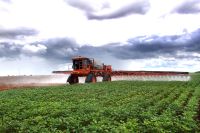
The combination of higher costs, tighter credit and depressed prices of agricultural commodities should put pressure on Brazilian agribusiness and the pesticide industry throughout this year, according to sector representatives.
Vice-president of Sindiveg (National Union of the Plant Defense Products Industry) and executive at Ihara, Julio Borges Garcia stated that the environment is not favorable for the sector. "I'm afraid this year will be worse than last year," he said.
According to him, the increase in production costs, with increases in fertilizers, fuels and freight, added to more expensive and scarce credit, occurs at a time when commodity prices have not followed the same upward trajectory.
/i.s3.glbimg.com/v1/AUTH_59edd422c0c84a879bd37670ae4f538a/internal_photos/bs/2021/p/U/NQo77ZQaOKcQ5j2QFVeQ/img-facebook.jpg)
Income Tax 2026: deadline ends this week and live program answered questions
Income Tax 2026: deadline ends this week and live program answered questions By next Friday, the Federal Revenue expec...
River Plate x Blooming: time and where to watch the South American game
River Plate and Blooming face each other this Wednesday (27), at 9:30 pm (Brasília time), in a game valid for the sixt...
Group urges US diplomats to leave countries amid Ebola outbreak
AFSA (American Foreign Service Association), which represents US diplomats, asked this Wednesday (27) that American fo...
Garcia stated that pesticide prices reached high levels during the pandemic, but then dropped significantly. "Prices are at the lowest levels we've ever seen in history," he said. According to him, however, the recent escalation of tensions in the Middle East has once again put pressure on raw material costs. "We've already had at least 30 assets that have risen by more than 20%, 30%, 40%," he said, highlighting, above all, glyphosate.
Garcia said that the cost increases have not yet been fully passed on to rural producers, but should gradually reach the market. According to him, part of the purchases made previously still used old stocks. "About 15% of what was purchased managed to take advantage of the old prices", he explained.
Despite this, the executive stated that there are currently no global problems with product supply. The assessment is shared by André Pozza, marketing director at Syngenta in Brazil.
Toque agora.


"There is today, globally speaking, no problem of lack of production or any problem of not being able to produce a product like we had during the Covid period", said Pozza. According to him, the main current impacts are related to the rise in energy, oil and freight.
Pozza stated that the adjustments vary depending on the origin of the products. According to him, pesticides from China registered an increase of around 40% in the cost of origin, also influenced by freight, while other products increased between 3% and 5%.
According to Garcia, the transfer of costs should not result in an increase in margins for the industry. "It's just a pass on of this cost increase to the industries, it won't be an increase in margin", he stated. He added that manufacturers, resellers and cooperatives have been recording lower results than those observed in previous years, due to the combination of lower product prices and higher fixed costs.
Pozza also described an environment of pressured margins throughout the agribusiness chain. "From the farmer, through the industry, through the distribution network, the entire chain is working under pressure on margins due to increased costs", he stated.
Purchasing pace
In relation to purchases for the 2026/27 harvest, Pozza said that the pace is above that recorded in the same period last year, although still below the historical average. According to him, the market was around 25% commercialized at this time in 2025, while it currently varies between 30% and 35%, depending on the region. Historically, however, the average percentage in this period would be close to 40%.
Pozza attributed the anticipation of purchases to the fear of new price increases after the start of international conflicts. "Producers who already had their planning aligned anticipated this increase agenda and went to the market to take their cost position", he stated.
He highlighted, however, that there is not much room for producers to postpone purchases. For Pozza, the calendar for the next harvest, whose planting begins in September in some regions of the country, reduces the space for postponing negotiations.
Credit and default
Rural credit was also highlighted as one of the sector's main concerns.
Garcia stated that the industry has lost resources in recent years and that there must be a greater fight for guarantees to grant financing.
"The bank will not want to give directly to the producer as it was doing. It will be more through the industries", he stated. According to him, companies tend to act as intermediaries in the selection of producers with better credit conditions.
Garcia also said that the cost of financing has become an additional obstacle for farmers. "The producer can't pay," he said. According to him, the profitability of grains in recent years has fallen to levels that make it difficult to even pay leases.
The executive also reported an increase in defaults in the sector. According to him, the index doubled between 2024 and 2025 and, in the first quarter of 2026, it doubled again compared to the same period last year.
In addition to cost pressure, the sector is following the fall in agricultural commodities and the behavior of the exchange rate. "I was expecting a little bit of a reaction from commodity prices, but far from what it should be to offset these cost increases," said Garcia. He also stated that the appreciation of the real against the dollar also worries the segment.
President of Sindiveg and executive of Bequisa, Maurício Marques stated that the scenario "changes the producer's spirit". According to him, in years with favorable weather conditions, farmers tend to invest more in technology and products with higher added value.
Marques described the current moment as difficult for Brazilian agriculture, especially due to the drop in commodity prices. According to him, soybeans, which were sold at around R$180 per bag three years ago, currently cost around R$110. Corn, which was sold between R$75 and R$80, would be close to R$50. "Input costs, in general, have gone up. Oil has gone up, freight has gone up. And the commodity has not," he said.
Source: CNN

Historias das musicas em destaque
 Historia da musica
Learn to play Chega, the country music that turns pain into a new beginning
27/05/2026
Chega, by Zezé Di Camargo & Luciano, is one of those songs that speak directly to those who are tired of suffering for love. The lyrics...
 Historia da musica
Learn how to play Total Eclipse Of The Heart, Bonnie Tyler's classic that chills the guitar
26/05/2026
Total Eclipse Of The Heart is one of those songs that seems to be born ready to move people. In Bonnie Tyler's striking voice, the song...
 Historia da musica
Learn to play Memonça Boa on the guitar and feel the strength of this passionate fashion
26/05/2026
Membrança Boa, by Traia Véia, is one of those songs that seem simple, but reach straight to the heart. The song talks about the end of...
 Historia da musica
Learn to play Bete Balanço: the Frejat classic that has energy, attitude and an unforgettable chorus
25/05/2026
Bete Balanço is one of those songs that carries movement from the first chord. With lyrics full of image, dreams, risk and youth, the s...
 Historia da musica
Learn to play Star, by Simply Red, the chord that transforms feelings into guitar
24/05/2026
Star, by Simply Red, is one of those songs that mix romanticism, regret and a striking melody, perfect for those who like to play somet...
 Historia da musica
Learn to play Die With a Smile: the emotional ballad by Lady Gaga and Bruno Mars that conquered the world on guitar
24/05/2026
"Die With a Smile" is one of those songs that already looks like a classic. In the meeting of two giant voices of pop music, Lady Gaga...
 Historia da musica
Learn to play Rasgando a Madrugada, Eduardo Costa's perfect song for guitar
24/05/2026
Rasgando a Madrugada, by Eduardo Costa, is one of those songs that seem to be born in the silence of the night. The song carries the we...
 Historia da musica
Learn to play Autor Da Vida, the Oficina G3 classic that speaks straight to the heart
23/05/2026
Learn to play Autor Da Vida, the Oficina G3 classic that speaks straight to the heart Autor Da Vida, by Oficina G3, is one of those son...
 Historia da musica
Learn to play Te Esperando: the exciting country music by Luan Santana that made Brazil sing on the guitar
23/05/2026
Te Esperando, by Luan Santana, is one of those country songs that sticks in your memory because it mixes romanticism, longing and the p...
 Historia da musica
Learn to play Hey Joe: the Jimi Hendrix classic that every guitarist dreams of mastering
23/05/2026
Few songs carry as much attitude and history as Hey Joe, immortalized in the voice and guitar of Jimi Hendrix. With an unmistakable int...
Mais noticias para voce
 Noticia
27/05/2026
Government celebrates approval of 6×1 in the commission and aims for 450 votes in the plenary
The government celebrated the approval of the report by deputy Leo Prates (Republicanos-BA) on the end of the 6×1 scale. In a press conference after the vote in...
 Noticia
27/05/2026
Revenue seizes 120,000 fake football shirts in the Port of Santos
The Federal Revenue Service seized around 120,000 fake football shirts in the Port of Santos, on the coast of São Paulo. The shirts found inside a container bel...
 Noticia
27/05/2026
Wagner Moura appears with new look for film with Kristen Stewart
Actor Wagner Moura, 49, appeared this Wednesday (27) with a new look during the recording of "Flesh Of The Gods", a thriller starring the Brazilian and Kristen...
 Noticia
27/05/2026
Agricultural machinery sales drop more than 22% in revenue
The agricultural machinery and equipment industry continues to shrink, according to Abimaq (Brazilian Association of Machinery and Equipment Industry), with the...
Noticia
27/05/2026
Learn to play Chega, the country music that turns pain into a new beginning
Chega, by Zezé Di Camargo & Luciano, is one of those songs that speak directly to those who are tired of suffering for love. The lyrics bring a strong feeling o...
Noticia
26/05/2026
Learn how to play Total Eclipse Of The Heart, Bonnie Tyler's classic that chills the guitar
Total Eclipse Of The Heart is one of those songs that seems to be born ready to move people. In Bonnie Tyler's striking voice, the song mixes drama, intensity a...
Participe da conversa
Seu comentario ajuda a manter a discussao viva e ainda convida outros leitores a continuar navegando pelo portal.
Seja o primeiro a comentar esta noticia.