


Leia a noticia completa
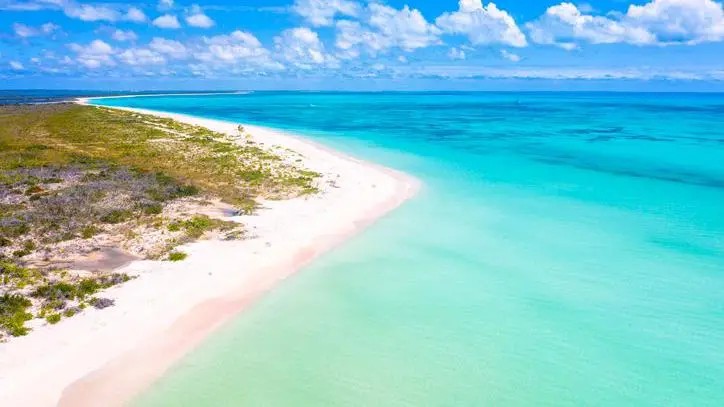
Barbuda is one of the Caribbean islands where locals complain about restricted access to beaches
GETTY IMAGES
On the small Caribbean island of Barbuda, the Pink Sands Beach bar had been frequented by locals and some tourists for more than 20 years.
"It was a very welcoming place", says Miranda Beazer, former owner of the establishment. She remembers that people would gather there to play dominoes or relax after Sunday mass.
Named after the pink sand of the beach where it operated, the bar was one of the community's meeting points until the arrival of Hurricane Irma in 2017, when the approximately 2,000 inhabitants of Barbuda were evacuated to the neighboring island of Antigua.
Beazer's bar was destroyed, as was his home. "No one was left unscathed... it was devastating. I cried for two weeks," she says.
Before the bar could be rebuilt, her husband died. After that, foreign developers began offering large sums for the land, but Beazer refused all of their offers.
"It's not money I'm looking for," she says. "What I want is to continue with my land."
Then the excavators arrived. According to Beazer, what was left of the bar after the hurricane was demolished by foreign developers.
Since then, she has been fighting in court for the right to regain access to the area she claims to be her land.
The issue, however, comes up against the land laws of Antigua and Barbuda.
In Barbuda, the land belongs collectively to the community. In practice, residents can request lease contracts to occupy certain lands, but they are not private owners of these areas. All land is communal, and citizens have the right to be consulted and to decide on major development projects.
This tenure system emerged after the end of slavery in Barbuda, in 1834, and was officially recognized by the government of Antigua and Barbuda in 2007, with the approval of the Barbuda Land Law.
Beazer claims to have leased 30 acres (about 121 thousand m²) of coastline, but currently has access to just eight.
The Global Legal Action Network (GLAN), a network of lawyers that supports Beazer, claims that the remainder of the area is being illegally occupied by foreign developers Murbee Resorts and Peace Love and Happiness (PLH).
Miranda Beazer is in a legal dispute to regain access to what it considers its land
MIRANDA BEAZER
In a statement, Murbee claims to be the legal holder of a lease in Barbuda and says that it "did not carry out construction activities in no land on which it does not have legal authority to act, nor has it carried out any construction."
PLH maintains that it "does not and has never occupied" the area and that it has "strictly followed" all agreements since signing a land lease agreement in Barbuda in February 2017.
But Beazer maintains, like many other Barbuda activists, that it remains determined to fight for access to the site.
"If you were to come here someday and experience this for yourself, you would truly understand why we are so attached to this little piece of land we have."
Beazer Land is the last stretch of Barbuda's southern coast that remains accessible to locals.
But, as with many beaches on Caribbean islands where residents are not protected by property laws, the area is now under threat from millionaire developers who want to turn it into an exclusive getaway catering only to tourists.
Robert De Niro is one of the investors behind the developments on the coast of Barbuda
MONDADORI PORTFOLIO VIA GETTY IMAGES
One of the investors in the real estate sector a few kilometers from Beazer's land is Oscar-winning actor Robert De Niro.
Alongside Australian billionaire James Packer, he is part of the Paradise Found group, responsible for The Beach Club Barbuda development.
The resort, which occupies an area of 400 acres (about of 1,618,742 m²) and should be completed later this year, it will include the Nobu Beach Inn, a luxury hotel made up of 17 houses.
There will also be 25 beachfront homes.
Residents say they can no longer visit or see the beach where the resort was built, following the recent construction of a bypass road to isolate the complex. According to reports, prices for land at the Beach Club start at US$7 million (about R$39.6 million).
On the official website, the resort is described as "a rare island community on one of the last untouched coasts of the Caribbean."
The Miranda Beazer land is the last strip of southern coastline that has not yet been acquired by developers
Reproduction
But John Mussington, president of the Barbuda Council, the island's local authority, argues that this "community" was only possible through the circumvention of the 2007 Land Law.
To allow the construction of the Beach Club, the government passed new legislation, the Paradise Found Law, in 2015. The text states that the 2007 law does not apply to the Beach Club complex.
Activists filed a legal challenge that went all the way to Antigua and Barbuda's highest court, the Judicial Committee of the Privy Council (JCPC), in the United Kingdom. Antigua and Barbuda maintained this legal structure after gaining independence from the United Kingdom in 1981.
In 2022, the JCPC ruled in favor of the government of Antigua and Barbuda, concluding that "the rights granted to citizens of Barbuda solely by reason of their status as Barbudans (...) do not constitute an interest or right in property."
In a statement, Paradise Found stated that the Beach Club was "developed in accordance with the laws and approval processes of Antigua and Barbuda" and that public access to Princess Diana Beach, now part of the complex, "remains unchanged".
Barbuda is not the only Caribbean island where laws inherited from the colonial period are at the center of land disputes.
1,600 km west of there, another long-running campaign advocates greater access to beaches for residents in Jamaica.
Devon Taylor, president of the Jamaica Beach Birthright Environmental Movement (Jabbem), says that the current legislation The country's land authority discriminates against Jamaicans because "it makes it clear that we have no rights to the coastal strip or surrounding areas."
Devon Taylor says the number of beaches accessible to locals in Jamaica is dwindling
DEVON TAYLOR
The Jamaican government recently proposed a new law to expand locals' access to beaches, but Taylor argues that rather than strengthening Jamaicans' land rights, the measure imposes further restrictions on where they can travel by encouraging hotels selling beach access passes to residents.
"You are selling access back to people," he says. According to him, the proposal represents a return to a kind of "colonial logic".
The Jamaican government did not respond to the BBC's request for an interview.
According to Jabbem, less than 1% of Jamaica's coastline remains freely accessible to the local population. Alongside other community groups, the organization is currently fighting five separate legal disputes against the Jamaican government and private developers over beach access for residents.
More than 1,000 kilometers west of Barbuda, Jamaica is also facing disputes over beach access
Reproduction
As tourists seek out lesser-known destinations, smaller Caribbean islands such as Grenada are also facing legal disputes.
Kriss Davies, president of the activist group Grenada Land Actors, fears that, with the increase in demand, the arrival of more large resorts will make Granada lose the charm that makes it unique for both residents and tourists.
According to the United Nations Development Program (UNDP), the Caribbean "is the most tourism-dependent region in the world".
Among all tourists visiting the region, about half are Americans.
Local activists in Barbuda say they are losing access to the island's beaches
BLRRC
For governments across the region, the sector's continued growth represents an attractive avenue for economic development.
But, as Taylor asserts, "travel is never neutral: it carries economic and moral weight."
"These developments often displace residents from ancient coastlines, restrict public access to beaches, and they divert wealth precisely from the people whose culture sustains the tourist experience."
While the demand for a piece of paradise continues to grow, land defenders in the Caribbean remain concerned that tourism, instead of bringing opportunities, will irreversibly transform the place they call home.
Source: G1

'The Murder of Roger Ackroyd', 100 years old: why was Agatha Christie's novel voted the best whodunit of all time?
The crime writer Agatha ChristieAlamyIn 2013, the British Crime Writers Association (CWA) met to choose, as part of it...
Divers try to bring food to survivors trapped in cave in Laos: 'Getting them out won't be easy'
Watch the moment rescue team finds 5 of the missing in cave in LaosDivers taking part in the rescue of five survivors...
'I thought he was having a stroke', says Joe Biden's wife, about her husband's performance in the debate with Trump in 2024
Former US President, Joe Biden, in a photo with his wife, Jill Biden, and the couple's cat, in an image released on Ma...
Toque agora.




Historias das musicas em destaque
 Historia da musica
How to play the classic "Careless Whisper" on the guitar and move anyone in the first chords
27/05/2026
Few songs can create such an intense and nostalgic atmosphere as George Michael's "Careless Whisper." From the first few seconds, the f...
 Historia da musica
Learn to play Chega, the country music that turns pain into a new beginning
27/05/2026
Chega, by Zezé Di Camargo & Luciano, is one of those songs that speak directly to those who are tired of suffering for love. The lyrics...
 Historia da musica
Learn how to play Total Eclipse Of The Heart, Bonnie Tyler's classic that chills the guitar
26/05/2026
Total Eclipse Of The Heart is one of those songs that seems to be born ready to move people. In Bonnie Tyler's striking voice, the song...
 Historia da musica
Learn to play Memonça Boa on the guitar and feel the strength of this passionate fashion
26/05/2026
Membrança Boa, by Traia Véia, is one of those songs that seem simple, but reach straight to the heart. The song talks about the end of...
 Historia da musica
Learn to play Bete Balanço: the Frejat classic that has energy, attitude and an unforgettable chorus
25/05/2026
Bete Balanço is one of those songs that carries movement from the first chord. With lyrics full of image, dreams, risk and youth, the s...
 Historia da musica
Learn to play Star, by Simply Red, the chord that transforms feelings into guitar
24/05/2026
Star, by Simply Red, is one of those songs that mix romanticism, regret and a striking melody, perfect for those who like to play somet...
 Historia da musica
Learn to play Die With a Smile: the emotional ballad by Lady Gaga and Bruno Mars that conquered the world on guitar
24/05/2026
"Die With a Smile" is one of those songs that already looks like a classic. In the meeting of two giant voices of pop music, Lady Gaga...
 Historia da musica
Learn to play Rasgando a Madrugada, Eduardo Costa's perfect song for guitar
24/05/2026
Rasgando a Madrugada, by Eduardo Costa, is one of those songs that seem to be born in the silence of the night. The song carries the we...
 Historia da musica
Learn to play Autor Da Vida, the Oficina G3 classic that speaks straight to the heart
23/05/2026
Learn to play Autor Da Vida, the Oficina G3 classic that speaks straight to the heart Autor Da Vida, by Oficina G3, is one of those son...
 Historia da musica
Learn to play Te Esperando: the exciting country music by Luan Santana that made Brazil sing on the guitar
23/05/2026
Te Esperando, by Luan Santana, is one of those country songs that sticks in your memory because it mixes romanticism, longing and the p...
Mais noticias para voce
 Noticia
27/05/2026
Smuggling and piracy generated record losses of R$514 billion in 2025
Brazil faced losses exceeding R$514 billion due to counterfeiting, smuggling and piracy in 2025, according to the ABCF (Brazilian Association to Combat Counterf...
 Noticia
27/05/2026
Cynthia Erivo hits back at critics who doubt her friendship with Ariana Grande
Actress Cynthia Erivo, 39, spoke in an interview with Variety magazine about her friendship with artist Ariana Grande, during the recording of the box office hi...
 Noticia
27/05/2026
Pará approves law that forces aggressors to pay for electronic ankle bracelets
The Legislative Assembly of Pará (Alepa) approved, this Tuesday (26), a Bill that obliges aggressors of women to pay for the electronic ankle bracelets used as...
 Noticia
27/05/2026
Brazilian dinosaur 'cried' to survive; understand why
A new study suggests that some semi-aquatic dinosaurs, such as Spinosaurus, could "cry salty tears" to eliminate excess salt from their bodies. The research, pu...
Noticia
27/05/2026
How to play the classic "Careless Whisper" on the guitar and move anyone in the first chords
Few songs can create such an intense and nostalgic atmosphere as George Michael's "Careless Whisper." From the first few seconds, the famous solo transports any...
Noticia
27/05/2026
Learn to play Chega, the country music that turns pain into a new beginning
Chega, by Zezé Di Camargo & Luciano, is one of those songs that speak directly to those who are tired of suffering for love. The lyrics bring a strong feeling o...
Participe da conversa
Seu comentario ajuda a manter a discussao viva e ainda convida outros leitores a continuar navegando pelo portal.
Seja o primeiro a comentar esta noticia.